
Democrats in Congress have long denounced Trump as an enemy of democracy, but they haven’t put any sort of brake on American militarism.
By Norman Solomon, The Nation
Donald Trump’s power has thrived on the economics, politics, and culture of war. The runaway militarism of the last quarter-century was a crucial factor in making President Trump possible, even if it goes virtually unmentioned in mainstream media and political discourse. That silence is particularly notable among Democratic leaders, who have routinely joined in bipartisan messaging to boost the warfare state that fueled the rise of Trumpism.
Trump first ran for president nearly a decade and a half after the “Global War on Terror” began in the wake of the 9/11 attacks. The crusade’s allure had worn off. The national mood was markedly different than in the era when President George W. Bush insisted that “our responsibility” was to “rid the world of evil.”
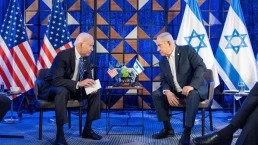
Working-class Americans had more modest goals for their government. Distress festered as income inequality widened and economic hardships worsened, while federal spending on war, the Pentagon budget, and the “national security” state continued to zoom upward. Even though the domestic effects of protracted warfare were proving to be enormous, multilayered, and deeply alienating, elites in Washington scarcely seemed to notice.
Donald Trump, however, did notice.
Pundits were shocked in 2015 when Trump mocked the war record of Republican Senator John McCain. The usual partisan paradigms were further upended during the 2016 presidential campaign when Trump denounced his opponent, Hillary Clinton, as “trigger happy.” He had a point. McCain, Clinton, and their cohort weren’t tired of US warfare—in fact, they kept glorifying it—but many in non-affluent communities had grown sick of its stateside consequences.
Repeated deployments of Americans to war zones had taken their toll. The physical and emotional wounds of returning troops were widespread. And while politicians were fond of waxing eloquent about “the fallen,” the continual massive spending for war and preparations for more of it depleted badly needed resources at home.
Recent Posts
AI Doesn’t Need ‘Superintelligence’ or Evil Intent to Start a Nuclear War
Take Action Now Neither extraordinary machine intelligence nor malicious intent is required for catastrophe to result.By Paul Slovic and Herbert…
30 Months After Uproar Over Jonathan Glazer’s Oscar Speech, What Do His Pro-Israel Denouncers Say Now?
Take Action Now Given all that has happened, I recently contacted some signers of the open letter to ask whether they still fully believe in its…

Midterms Have Revived Universal Healthcare Debate. These States Are Ahead of Everyone.
Take Action Now States have often served as laboratories to test health policies later implemented nationally.By Markian Hawryluk, KFF Health……

Nobel Peace Prize Turns Toward Peace in 2026
Take Action Now To have finally acknowledged someone whose work in any way addressed the horrors of Zionism is an encouraging sign from the Nobel…