
Rather than calling for impeachment, Schumer criticized Trump for what he said was worsening Iran’s “nuclear ambition.”
By Sharon Zhang, Truthout
A wave of momentum behind impeaching President Donald Trump for his genocidal threats toward Iran on Tuesday came to a screeching halt by the end of the week as Democratic leaders like Senate and House minority leaders Chuck Schumer (New York) and Hakeem Jeffries (New York) hand-wrung over such a process being a “distraction,” reporting says.
After Trump threatened that “a whole civilization will die tonight” on Tuesday morning, over 70 lawmakers, including a handful of senators, called for Trump to be impeached or be removed via the 25th Amendment over the threat. His threat was so beyond the pale that even far right figures like Candace Owens and Tucker Carlson criticized him, and called for an end to the war.
This was the biggest wave of calls for impeachment during Trump’s second term yet, coming as speculation flew over what horrors Trump would unleash upon the country of 93 million people — amid a war in which the U.S. and Israel have killed over 1,700 civilians thus far, including at least 254 children, according to human rights group Human Rights Activists News Agency.
But the calls likely won’t lead to consequences for Trump any time soon. Time reported on Friday that “[b]oth paths — impeachment or the 25th Amendment — are, to the mind of party Leadership, a distraction from their planned midterm campaign focused on high costs and unchecked corruption.”
Neither Jeffries nor Schumer has called for impeachment or removal in response to the threat. Their refusal to act is sure to ignite further fury as the Democratic Party still manages to garner worse approval ratings than Republicans due to widespread views that the party is weak and ineffective.
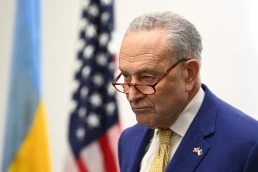
On Wednesday, Schumer, a longtime supporter of Israel, held a press conference criticizing Trump for the war and the ceasefire — making critiques not necessarily of the concept of war with Iran itself, but of the way that Trump is going about it.
“The Iranian regime is still standing. Not just standing, but now emboldened,” he said. “Iran’s nuclear ambition, worse. The bottom line is that Iran still has its nuclear stockpile. Its nuclear ambitions are still unchecked, if not accelerated.” He said that the Senate would undertake a war powers resolution next week — far past Trump’s deadline for civilization-wide annihilation that ultimately did not come to pass on Tuesday.
Party leaders evidently believe an impeachment effort highlighting Trump’s horrific war would fail, and thus isn’t worth trying — even as Rep. Al Green (D-Texas) pointed out that introducing articles of impeachment is a way to demonstrate the gravity of the situation. Jeffries directly stated he wouldn’t be backing an impeachment effort, saying: “I don’t want to get out ahead of that discussion … we want to be able to do [impeachment] in an informed way.”
Time further reported: “A failed impeachment effort, a party leader suggested privately, risks being framed as tacit approval of the President’s conduct, while also diverting attention from the party’s core economic message on affordability and health care — issues party leaders believe resonate more directly with voters.”
This belief simply isn’t true, and ignores the support that Democrats could gain by taking a principled stance.
Trump’s approval has been driven to new lows amid his war on Iran, which has broken records for unpopularity. Polling for IMEU Policy Project and Demand Progress by Data for Progress recently found that 43 percent of voters say they are less likely to vote for Republicans due to the war, demonstrating a huge swath of voters that the Democrats could appeal to by staking out an anti-war stance.
Further, affordability issues are directly tied to the war, with the U.S. and Israel’s aggression prompting the retaliatory closure of the Strait of Hormuz, causing energy costs — and costs of goods downstream from that — to soar. Republicans are reportedly even considering enacting further cuts to health care subsidies in order to pay for the White House’s towering $200 billion supplemental funding request for the war.
Recent Posts

Austin Man Shot by ICE Facing Paralysis After Being Refused Medical Care
Take Action Now “This isn’t law enforcement,” said U.S. Senate candidate James Talarico. “It’s lawlessness.”By Julia Conley, Common Dreams…

Oregon Data Centers by the Numbers: 111 Facilities Consume Nearly One-Quarter of State’s Power, According to New Report
Take Action Now A first-of-its-kind report details the footprint of the controversial facilities.By Kyra Buckley, Oregon Public Broadcasting For…

Trump Says He Is in ‘Deciding Mode’ on Destroying Iran
Take Action Now The Pentagon’s own death count is undercounting US troops killed in the seven-month war, the Washington Post has reported.By…

In the Age of AI, Nuclear Weapons Abolition Is a Renewed Imperative
Take Action Now As long as we have nuclear weapons, the job of ending humanity will continue to be as easy as the push of a button—or an AI agent…