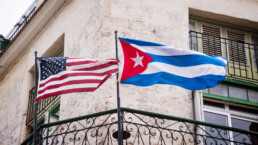
U.S. authorities and corporate media have given extensive coverage of protests which took place in eastern Cuba in response to deteriorating conditions which Cubans say are a product of US policies themselves
On March 17, people in Santiago, a city in Eastern Cuba, took to the streets to protest the increased blackouts and food shortages they have been experiencing. The protest occurred as shortages generated by the US blockade of Cuba have worsened across the island. Instead of lifting the blockade or taking Cuba off the state sponsors of terrorism list, the US government and corporate media have once again exploited the spontaneous protest to launch “a new counterrevolutionary media offensive”, claim US-based Cuba solidarity activists.
“If Biden really wants to stand by the Cuban people, if the US government were to actually care about the Cuban people, they would immediately end this blockade,” said People’s Forum Executive Director Manolo De Los Santos. “In fact, with the stroke of a pen, they could immediately take Cuba off the State Sponsors of Terrorism list, which prevents Cuba from accessing financial services around the world and be able to trade freely.”
Immediately upon learning of the Santiago protest, the US Embassy in Havana posted on X, “We urge the Cuban government to respect the human rights of the protestors and address the legitimate needs of the Cuban people.”
In fact, the Cuban government immediately responded to the protests. Beatriz Jhonson Urrutia, the highest level authority in Santiago, along with other provincial authorities went to the streets to engage in dialogue with those that had participated in the protest and listened to their concerns.
The response is a stark contrast to the “respect to human rights of…protesters” seen in the United States. For the past six months, hundreds of thousands have been mobilizing in cities and towns across the country to demand a ceasefire in Gaza, and national and local leaders have repressed, ignored, and ridiculed protesters and their demands.
US Assistant Secretary of State for Western Hemisphere Brian Nichols wrote on X, “The Cuban government will not be able to meet the needs of its people until it embraces democracy and the rule of law and respects the rights of Cuban citizens.”
Maria Elvira Salazar, a far-right member of Congress, who in March 2023 attempted to codify Cuba’s designation as a state sponsor of terror wrote about the Santiago protest, “It is 65 years of socialism; of repression, prison, death and exile; of blackouts, sicknesses and hunger. Cuba wants freedom!”
Media war
Meanwhile, international corporate media has also been quick to capitalize on the Santiago protest to push their own long standing narrative about Cuba. For example, in its report on the protests, Argentina-based right-wing regional media outlet Infobae referred to Miguel Díaz-Canel as a “dictator”, and called the government a “regime” and “a Castrist dictatorship”. It also heavily quotes a statement from the Madrid-based Cuban Observatory of Human Rights, which is a recipient of funding from the National Endowment for Democracy (NED), a US government funded foundation. While the piece is mostly focused on unsubstantiated allegations of repressive actions carried out by Cuban security forces, it reserves one line at the end of the article to mention the real reasons that Cubans are dealing with challenging material conditions: “The pandemic, the toughening of US sanctions, and endogenous errors in the economic and monetary policy have intensified the structural problems of the Cuban system in the last three years.”
This general narrative is repeated in other news outlets across the region like NBC-owned Telemundo which also referred to the Cuban revolution as when “the Castro brothers took power in 1959”. The Telemundo article stated: ‘The protests, which are a rarity in a Cuba where power usually quickly suffocates any public outcry, are the largest since July 11, 2021 when thousands of Cubans from the island took to the streets to cries of ‘We want freedom!’”
Cuba and Latin America reject US attempts at meddling
For many both on the island and outside, the response by US officials and corporate media to the protest on March 17 represents a clear attempt to weaponize the real material challenges facing Cubans due to the tightening of the blockade in order to push regime change. In fact, as many point out, this is precisely a goal of the blockade.
Recent Posts
Blanche says Trump isn’t trying to meddle with Alaska election results by suing over Senate race
Take Action Now A day after the lawsuit was filed on Thursday, Peltola called it “just flagrant, flagrant corruption in my opinion” and a diversion…
The Courage to Keep the Oath
Take Action Now Why We Must Stand with Major Jason WatsonBy Jeffrey Sterling For almost two months, an Air Force officer has been sitting alone in…
‘Act of Collective Punishment’: Netanyahu Condemned Over ‘Full Lockdown’ of Occupied West Bank
Take Action Now The reaction to a shooting incident in Hebron, said one Palestinian critic, “represents an alarming escalation in Israel’s policies…
‘Stop The War on Iran’: Brooklyn Peace Activists Urge Jeffries to Help End Conflict
Take Action Now Democrats have a golden opportunity to capitalize on this issue, win big in November, and take real action on AI data centers to…