
Every person who laments that there supposedly is no anti-nuclear movement, rather than taking 2 minutes to search the web and join it, is part of the chain reaction.
By David Swanson, Let’s Try Democracy
If you would like to read what I wrote about Oppenheimer prior to watching the film, click here. I made what I still consider the most important points there, including the point that the decision to drop the bombs had nothing whatsoever to do with ending the war or saving lives.
If you would like to read some additional comments now that I’ve watched the film, and don’t mind that I discuss exactly what happens in the film, keep reading below.
The film was better than the reviews had led me to expect. The worst shortcoming, as expected, was on the motivations, justifications, and excuses for dropping the bombs on the two cities in Japan. There is also a major shortcoming in not showing a single Japanese person in the film. Nagasaki gets one tiny mention in the movie.
When Japan first comes up in the film as a new justification for creating nuclear weapons — the earlier justification of Germany having collapsed upon Germany’s surrender — we are fed the familiar nonsense about needing to nuke Japan to end the war. We’re even given an antiwar fantasy justification, wherein supposedly only the use of the bomb will educate people about the bomb. Next we are shown Secretary of War Henry Stimson lying that nuking Japan will save lives.
And then we see Oppenheimer tell Edward Teller that perhaps Japan would surrender if it just knew the bombs were coming (even though, in reality, Japan was already trying to surrender and did not succeed in surrendering until after two bombs had been dropped and the war had continued with the Soviet invasion). And, again, Oppenheimer suggests that use of the bomb will bring an end to all war. (Echoes of a recent Russian columnist suggesting that only using a bomb — again — will educate people and lead to not using the bombs.) Teller replies to Oppenheimer: “Until somebody builds a bigger bomb.”
Truman looks, in this movie, like the war-mad fool that he was, intent on starting an arms race at all costs. But the movie-makers went out of their way to protect him from looking much worse, by editing out the words “military base” from of the audio they played of Truman announcing the bomb use on the radio. Truman, in reality, lied that Hiroshima was a military base. He’s shown in the movie merely lying to Oppenheimer that the nukes saved lives — which can hardly seem like a lie to a movie audience that has been taught it for decades.
However, late in the movie, Oppenheimer comments that Stimson has said that Japan was already “essentially defeated.” Do viewers retroactively understand Stimson to have been lying in the previous scene where he said nuking Japan would save lives? I don’t know. Do they understand that Japan wanted to surrender and keep its emperor, but was denied this until after the bombings? I doubt it.
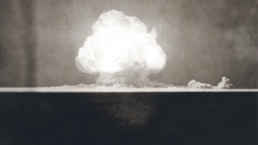
But something equally important is included in the film, and right smack dab in the spot where Hollywood movies require a happy ending. This movie ends with Oppenheimer telling Einstein that their earlier fear that using a nuclear bomb might create a chain reaction that would destroy the entire world — while unjustified in the sense that the Trinity test did not ignite the atmosphere — was actually true.
Oppenheimer seems to be referring here, in words placed in his mouth by the creators of this movie in 2023, to a chain reaction that involves human and governmental actions. He didn’t destroy the entire world by testing one bomb and catching the sky on fire. He destroyed the whole world by giving governments that cannot behave wisely the means of eradicating life on Earth if they merely continue behaving as they tend to behave. In other words, we are living in the chain reaction. We are the chain reaction.
Every person who laments that there supposedly is no anti-nuclear movement, rather than taking 2 minutes to search the web and join it, is part of the chain reaction. Every declaration that war must continue until Ukraine or Russia unconditionally surrenders, is part of the chain reaction. Every television network committed to never airing a voice for peace is part of the chain reaction.
Of course there’s no certainty in modern physics, much less in governmental actions. Knowing we’re living the chain reaction could lead to breaking the chain. In the meantime, though, the key question would seem to be: which link in the chain are you?
Recent Posts

“Propaganda Show”: IDF Raids Palestinian NGOs in the West Bank Ahead of Israeli Elections
Take Action Now “The raid onto the city center Ramallah is not a lonely activity. It happens every day that they raid different villages,…

ICE Planning $100 Million ‘Nightmare’ Domestic Spy Program
Take Action Now Under ERO ONE, Immigration and Customs Enforcement plans to hire 142 intelligence contractors with top secret clearances and deploy…

Postpone the AI Public Offerings Until Congress Acts
Take Action Now A company should not disclose a risk of catastrophe to humanity and then sell its shares to the public before any public authority…

Congress Has The Power to Fix the Trump-Saudi Nuclear Deal
Take Action Now Congress has at least 9 months and considerable leverage to make things right.By Alan J. Kuperman, Bulletin of the Atomic…