
In the wake of his death, the former Soviet leader has been given warm tributes in the US. But there’s precious little discussion of Gorbachev’s strong criticisms of US foreign policy or his warnings about the danger of US arrogance.
By Branko Marcetic, Current Affairs
When a major political figure dies, it’s always significant what’s singled out for forgetting. That’s the case with former president of the Soviet Union Mikhail Gorbachev, who’s been lionized in the Western press since his death last week, lauded for his efforts to democratize and bring new freedoms to the former USSR, and whose legacy has now been reduced to tatters by Russian president Vladimir Putin.
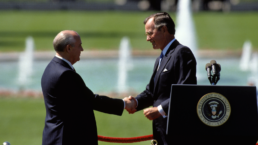
World leaders praised him. U.S. president Joe Biden feted Gorbachev as “a man of remarkable vision.” UK Labour Party leader Keir Starmer said he was “one of the great figures of the 20th century.” The president of the European commision said he was someone whose legacy is “one we will not forget.” Former U.S. Ambassador to Russia Michael McFaul called him “a figure who made the world better” and urged us to “learn from his legacy.” “Putin seems to view himself as the anti-Gorbachev,” writes David Remnick of the New Yorker, expressing his hope that “around the world,” Gorbachev’s belief in “democracy, the rule of law, and the peaceful and orderly transfer of power” would “prevail.” Putin’s pointed refusal to attend Gorbachev’s funeral became something of a mini-scandal in the West since his death.
This is largely in line with how the Western press has treated Gorbachev over the last ten years especially, when the former Soviet minister had offered mounting criticism of Putin’s authoritarianism at home. There’s no shortage of coverage of Gorbachev slamming the Russian president, warning of the return of Stalinism and totalitarianism, or his criticisms of dubious Russian elections, points the former Soviet president has made again and again over the years.
But there’s another, overlooked element of Gorbachev’s legacy, one that’s as absent from today’s eulogies as it was ignored by officials when he was alive. That’s Gorbachev’s harsh criticism of U.S. foreign policy after the end of the Cold War, particularly toward Russia, along with his frequent warnings that the decision-making in Washington was destabilizing the world, and his urgent demands that the United States and Russia engage in robust diplomacy. It’s not hard to see why this has been erased: many of Gorbachev’s points are today dismissed in the West purely as Putin apologism and pro-war excuse-making.
Recent Posts

Midterms Have Revived Universal Healthcare Debate. These States Are Ahead of Everyone.
Take Action Now States have often served as laboratories to test health policies later implemented nationally.By Markian Hawryluk, KFF Health……
Nobel Peace Prize Turns Toward Peace in 2026
Take Action Now To have finally acknowledged someone whose work in any way addressed the horrors of Zionism is an encouraging sign from the Nobel…
64 Groups to Congress: Start Preparing Tough and Effective Oversight Right Now
Take Action Now The question is not whether the public wants accountability, but whether Congress can conduct the meaningful oversight that exposes…
“Abolish ICE”: Protests Erupt in NYC After ICE Agents Shoot Father With 5-Year-Old Son in Car
Take Action Now “Candidates should seek support from the AI industry at their own peril.”By Amy Goodman, Darializa Avila Chevalier, and Carmen De…