
The 2006 mega-marches against legislation to criminalize the undocumented revealed the hidden power of immigrant workers.
By Alan Maass, The Call
When millions of immigrant workers and their families poured into the streets 20 years ago in a nationwide wave of immigrant rights mega-marches, the mainstream media declared that a “sleeping giant has woken up.” But it was the media that was waking up — to the deep anger of immigrant communities at intensifying attacks on their rights to live and work.
The marches began in Chicago on March 10, when a turnout in the hundreds of thousands stunned organizers who had hoped for a tenth as many. City after city followed, culminating in the “Great American Boycott” on May 1, under the slogan “no work, no school, no sales, no buying.” Well over 1 million people demonstrated in more than 150 cities across the U.S. and several in Mexico.
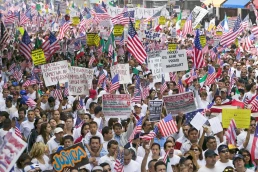
By the end of the month, the massive mobilizations — some of the largest in U.S. history to that point — had doomed federal legislation that would have made felons out of all 12 million undocumented immigrants in the U.S. The movement didn’t achieve further advances after that. But in the years to come, the mega-marches would leave their mark on left politics in the U.S., especially by delivering the message that immigrant rights are workers’ rights. As one favorite protest sign in 2006 read, “The sleeping giant wasn’t sleeping — we were working.”
Nothing Comes from Nowhere
While even the most optimistic activists were shocked by the size of the mega-marches, organizers remember earlier, more modest responses to the anti-immigrant climate that set the stage for 2006.
Jorge Mujica was a leader of Chicago’s March 10th Movement in 2006 and is now Strategic Campaigns Organizer of the Arise Chicago workers center. Mujica recalled immigrant rights activism in the 1990s bringing organizers together to protest California’s vicious anti-immigrant Proposition 187 in 1994. This was followed by federal immigration “reform” legislation heavily weighted to enforcement and signed into law by Democrat Bill Clinton.
In 2000, a new leadership in the AFL-CIO reversed the federation’s longstanding support for immigration restrictions and called for an amnesty for all undocumented workers, on the model of a previous amnesty in 1986, along with a path to legal status. The federation followed up by sponsoring the Immigrant Worker Freedom Rides, a national cross-country tour organized by immigrant workers themselves and modeled on the civil rights–era Freedom Rides to oppose racial segregation.
“The tour passed through more than a hundred cities,” said Justin Akers Chacón, co-author with Mike Davis of No One Is Illegal: Fighting Racism and State Violence on the U.S.-Mexico Border. “Local organizing committees were formed in each city, including at union locals led by workers who gained citizenship from the previous amnesty. That helped network together the nuclei of organizing centers that would play an important role in the mass strikes and marches of 2006.”
The Bush administration had intensified harsh enforcement measures put in place under Clinton, leading by the middle of the decade to a drastic increase in deaths at the border. At the same time, anti-immigrant vigilantes calling themselves the Minutemen began organizing patrols in Southwestern states. Their numbers were tiny compared to the mega-marches to come, but the Minutemen’s racist stunts grabbed media attention and won them support from high-profile right-wingers such as then-California Gov. Arnold Schwarzenegger.
At the end of 2005, a Wisconsin Republican named James Sensenbrenner introduced federal legislation that was everything the Minutemen could have dreamed of. Among other provisions, the Sensenbrenner bill, HR 4437, proposed classifying undocumented immigrants as “aggravated felons,” along with anyone who helped them enter or remain in the U.S. The support provision was so vague that it could have criminalized teachers who did not report undocumented parents. The Sensenbrenner bill passed the U.S. House in December and was expected to sail through the Senate.
HR 4437 became the lightning rod.
In Chicago, Mujica remembers discussions about Minutemen provocations and the Sensenbrenner bill spreading rapidly in the city’s Mexican hometown associations — clubs formed by people from the same states and towns in Mexico. ”The pattern of immigration was to concentrate in particular neighborhoods, where there were family relations and everybody could understand the language,” Mujica said. “So this was where people went to discuss political issues.”
The movement got a boost from an unexpected source. In 2005, two Spanish-language radio stations started a ratings battle, competing with each other “to show who was more pro-community than the other one,” Mujica said. “Their fight for ratings translated into a lot of coverage of what was going on. So when the call for the March 10 march happened, they were on the air, day and night, promoting it.”
‘Every Corner and Every Town’
As masses of people overflowed the West Side Chicago park where the March 10 mega-march was to begin, organizers tried to guess at the numbers: Was it 100,000 people? 300,000? Half a million? No one knew for sure, except that it was many times larger than any demonstration they had ever seen.
Immigrant workers had not only turned out with their families, friends, and neighbors but organized entire workplaces to take the day off. Immigrants from Mexico and Central America were the bulk of the crowd, but there were many who traced their ancestry to Poland, Korea, Ireland, and other countries.
When the opening rally spilled out of the park into several streets at once for the two-mile march to downtown, Chicago cops, usually aggressive with protests, were at a loss. “Nervous officers, watched closely by the department’s top brass, avoided confrontation,” wrote socialist journalist Lee Sustar. “[The cops wanted to know] who was in charge. ‘We all are,’ a young man said after successfully negotiating with police to keep his self-organized contingent on the street.”
That confidence could be felt in the days that followed. When workers at the Cobra Metal Works in the outer western suburbs, then a Republican stronghold, were fired for missing work March 10, the Chicago Workers Collaborative workers center rallied to their defense, and they quickly won reinstatement.
Two weeks later, it was Los Angeles’s turn. The LA mega-march on March 25 was probably the largest single mobilization, with estimates ranging from 500,000 to 1 million. Aerial photos show seas of people stretching as far as the eye can see in several directions from LA’s City Hall. The marchers had traveled from across Southern California and the Southwest.
The days before and after March 25 introduced a new feature of the immigrant uprising: student walkouts. An estimated 40,000 LA students left school the following Monday, March 27, marching through the streets and blocking freeways. When some schools tried to impose lockdowns, students defied threats of discipline. One 10th-grader named Sandra described students “climbing the fences to protest and have their voices heard.”
The student walkouts spread from LA to San Diego, then to Las Vegas, then across the Southwest, reaching Texas by the end of the week. The home of George W. Bush and a citadel of right-wing Republicans, Texas seldom saw large protests, much less militant ones. It did in 2006. “In Dallas, students who left schools across the city came together … for a protest at City Hall,” reads one report. “After rallying outside, the students flooded into the building to disrupt a city council meeting.”
The mega-marches culminated in the nationwide May 1 “Day Without an Immigrant” protests, which took place in at least 153 cities and 39 states. Nativo Lopez, president of the Mexican American Political Association and spokesperson for the Great American Boycott, explained how the mega-marches spread: “Capital is creating for us a movement that we didn’t have 20 years ago. Capital has sent immigrants to every corner and every town of the country, so that mass demonstrations are possible everywhere.”
By this point, the Wall Street Journal was expressing its concern about “absenteeism” on protest days. And with good reason — according to press reports, meatpackers across the Midwest were hit hard on May 1, with eight Perdue Farms and nine Tyson Foods plants shut down. Cargill Meat Solutions, the nation’s second-largest beef processor at the time, announced it would close voluntarily, giving its 15,000 workers May Day off.
Stopping Sensenbrenner
Support for the Sensenbrenner bill in Congress began to crumble under the pressure of the massive marches and especially the threat to U.S. businesses that relied on immigrant labor. Within weeks of the May 1 protests, enough senators had peeled away that the legislation was withdrawn before even coming to a vote.
This was a decisive victory for a movement defined by opposition to HR 4377. But the marchers of 2006 had hopes that went beyond stopping Sensenbrenner: for another amnesty for the undocumented or at least an immigration reform law not weighted overwhelmingly to enforcement. HR 4377 was the lightning rod, but the massive outpouring expressed the desire for more.
Those hopes went unrealized. For the rest of 2006, the Bush administration stepped up workplace raids and “no match” letter campaigns demanding that employers document each employee’s legal status or fire them. Yet mainstream immigrant rights organizations channeled energy away from marching and workplace confrontations, and into Democratic Party campaigns for the 2006 midterms. Despite winning back control of Congress, Democrats largely supported successor immigration legislation that dropped HR 4377’s criminalization provision but kept many of its harsh enforcement measures. When these bills failed, it was because they weren’t right-wing enough for Republicans.
The Democrats promised reform would come once a new president replaced George W. Bush. During his 2008 campaign, Barack Obama spoke movingly of “the 12 million people living in the shadows” and declared that “comprehensive immigration reform” would be a major priority of his administration. But like so many of his promises, the first 100 days of Obama’s presidency, and then the first year, came and went without any initiative on immigration.
“Once in power,” said Akers-Chacón, the Democrats “abandoned legalization and began their own process of criminalization, raids, and deportations. Obama’s eight years as president became even more devastating for immigrant workers, with a significant expansion of ICE and record number of deportations.”
A Lasting Imprint on the Left
Still, the defeat of the Sensenbrenner bill is a testament to the power of immigrant workers. And the organizing that went into the mega-marches put workers in a stronger position to fight for their rights on a local level.
In Chicago, workers at a nonunion factory that made soap and detergent went on strike in 2007 after management complied with the Bush administration’s Social Security “no match” letter demands. The strikers didn’t have the protection of a union and most were undocumented, but the spirit of the mega-marches emboldened them. Within two weeks, the company had to back down.
A year later, just after Obama’s election in November, workers at Republic Windows & Doors — in a throwback to the 1930s sit-down strikes — occupied their northwest side Chicago factory when they were told the company was closing without notice. Once again, the overwhelmingly Latino workforce included many who had marched in spring 2006. Republic’s owners were forced into a deal with a company that protected the workers’ jobs. The workers’ union, the United Electrical Workers (UE), organized a national victory tour that brought inspiration to thousands.
Beyond these direct effects, the mega-marches left a lasting imprint on the left. In 2006, social studies teacher Jesse Sharkey was working with other rank-and-file Chicago teachers to oppose the district’s plan for school closings, concentrated in Black and Latino neighborhoods.
“It was a difficult period,” Sharkey said. “We were doing organizing work, but we had very small forces, holding meetings in church basements with handfuls of people. I can remember going down to the March 10 protest with a group of other teachers, expecting a small crowd, and just being overwhelmed by the size of it. That really helped prop up our faith in the kind of organizing that we were doing.”
Sharkey and other teachers energized by the March 10 mega-march would soon form the Caucus of Rank-and-File Educators, which in 2010 won leadership of the Chicago Teachers Union, transforming it over the course of two strikes and many other struggles during the past 15 years. When Trump came to power again in 2024, the CTU connected with leaders of the 2006 mega-marches like Mujica to launch the #MayDayStrong initiative for a day of action on May 1, 2025. Another is planned for this year.
The turnouts last May Day fell well short of 2006. But Sharkey thinks that by asserting “workers have the potential power to stop tyranny,” the #MayDayStrong initiative is setting a different tone for anti-Trump opposition from the massive but fleeting one-day mobilizations like #NoKings.
“The view of the working class in this country doesn’t give our side enough credit for how powerful it’s been historically,” Sharkey said. “And we feel like this is a vocabulary we’re going to have to get familiar with. We’re going to have to start rebuilding those habits, that organizational capacity, the connections with each other that allow us to have these kinds of actions. We’re going to have to get in the practice of using our full organizational power. And the general strike is one of the most important expressions of that.”
Recent Posts
AI Doesn’t Need ‘Superintelligence’ or Evil Intent to Start a Nuclear War
Take Action Now Neither extraordinary machine intelligence nor malicious intent is required for catastrophe to result.By Paul Slovic and Herbert…

30 Months After Uproar Over Jonathan Glazer’s Oscar Speech, What Do His Pro-Israel Denouncers Say Now?
Take Action Now Given all that has happened, I recently contacted some signers of the open letter to ask whether they still fully believe in its…
Midterms Have Revived Universal Healthcare Debate. These States Are Ahead of Everyone.
Take Action Now States have often served as laboratories to test health policies later implemented nationally.By Markian Hawryluk, KFF Health……
Nobel Peace Prize Turns Toward Peace in 2026
Take Action Now To have finally acknowledged someone whose work in any way addressed the horrors of Zionism is an encouraging sign from the Nobel…