
As a movement builder, spokesperson, and candidate for the presidency, Jesse Jackson’s accomplishments were massive. He was one of the towering figures of American progressive politics in his era — or any era.
By Peter Dreier, Jacobin
One of the most famous photographs of Martin Luther King Jr shows him standing on the balcony at the Lorraine Motel in Memphis, Tennessee, with three of his top aides — Ralph Abernathy, Hosea Williams, and Jesse Jackson. The next night (April 4, 1968) on that same balcony, King was murdered. Jackson was one of several staffers with King at the hotel that fatal night.
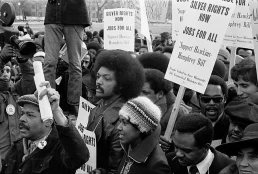
Jackson had been drawn into King’s inner circle at a young age. After King’s death, some activists considered Jackson to be the slain leader’s heir apparent, although others considered Jackson too young, inexperienced, and brash to assume King’s mantle. By the 1970s, however, Jackson had become the nation’s most visible civil rights leader. By the time he ran for president in 1984 and 1988, he had transcended the “civil rights” label to become the most visible progressive leader in the country, with a racially and economically diverse following that he called a “rainbow coalition.”
Twenty years later, in 2008, another photo symbolized the long journey that Jackson, and the nation, had taken. It showed Jackson standing in Chicago’s Grant Park, holding a small American flag, with tears in his eyes, as he listened to Barack Obama speak to a huge crowd on the night he was elected president of the United States. The photo did not require a caption. Jackson had clearly paved the way for Obama’s victory.
Eight years after that, then again four years later, Sen. Bernie Sanders — a longtime supporter of Jackson’s dating back to the Vermont socialist’s days as mayor of Burlington — would take up the mantle of Jackson’s mission in his own transformative presidential campaigns.
Recent Posts

Austin Man Shot by ICE Facing Paralysis After Being Refused Medical Care
Take Action Now “This isn’t law enforcement,” said U.S. Senate candidate James Talarico. “It’s lawlessness.”By Julia Conley, Common Dreams…

Oregon Data Centers by the Numbers: 111 Facilities Consume Nearly One-Quarter of State’s Power, According to New Report
Take Action Now A first-of-its-kind report details the footprint of the controversial facilities.By Kyra Buckley, Oregon Public Broadcasting For…

Trump Says He Is in ‘Deciding Mode’ on Destroying Iran
Take Action Now The Pentagon’s own death count is undercounting US troops killed in the seven-month war, the Washington Post has reported.By…

In the Age of AI, Nuclear Weapons Abolition Is a Renewed Imperative
Take Action Now As long as we have nuclear weapons, the job of ending humanity will continue to be as easy as the push of a button—or an AI agent…