
Georgia’s sweeping and political application of conspiracy law echoes a tactic that shattered the left roughly a hundred years ago, when the U.S. government targeted socialist parties and militant unions with laws against criminal syndicalism, espionage, and sedition.
By Tadhg Larabee and Eva Rosenfeld, Dissent
Just after sunrise on November 13, 2023, hundreds of protesters gathered in Gresham Park on Atlanta’s outskirts. As they zipped up painted jumpsuits, a police helicopter circled overhead. It was the start of the latest action in a sprawling, decentralized campaign to stop construction of the Atlanta Public Safety Training Center, better known as Cop City.
A two-year occupation of the Weelaunee Forest, the site of the proposed complex, ended in early 2023 after police killed a forest defender known as Tortuguita and, over several months, charged forty-two people with domestic terrorism. The majority of those charged were attending a protest music festival in March while property destruction occurred nearly a mile away. In April, three activists distributing fliers about the police murder of Tortuguita were arrested and jailed for almost three months. It was unclear whether any of the prosecutions would go forward until September, when Georgia’s attorney general, Chris Carr, brought a single case against sixty-one protesters, using the state’s exceptionally broad Racketeer Influenced and Corrupt Organizations (RICO) Act to paint the Stop Cop City movement as a criminal syndicate akin to the Mafia. The sprawling indictment accused them of a conspiracy to spread “virulent anarchist ideals.”
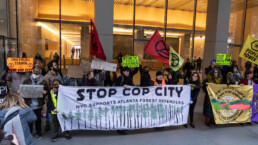
Amid this campaign of state repression, one segment of Stop Cop City put out a national call to action: Meet in Atlanta. March onto the construction site. Issue, through nonviolent direct action, what organizers called a “people’s stop-work order.” Render absurd, through widely publicized mass participation, the notion that this is a conspiracy and not a broad-based political movement.
“It’s vital to make sure everybody knows . . . that there are people in Atlanta that want this to stop,” said Lorraine Fontana, a seventy-six-year-old activist who was arrested days before the march for blocking the entrance to the construction site. “We’re holding saplings,” a young protester said. “To replant the forest that the police have destroyed in trying to build Cop City,” another added. Papier-mâché puppets and protest signs sat in the grass, collecting dew; one sign, shaped like a dragonfly, read, “This is what a domestic terrorist looks like.” Hours later, as the tear gas dissipated and the protesters retreated to Gresham Park, a riot policeman was photographed removing the same sign from nearby Constitution Road. In the hands of the officer, it seemed to turn this charge back on the state.
Recent Posts

The Courage to Keep the Oath
Take Action Now Why We Must Stand with Major Jason WatsonBy Jeffrey Sterling For almost two months, an Air Force officer has been sitting alone in…

‘Act of Collective Punishment’: Netanyahu Condemned Over ‘Full Lockdown’ of Occupied West Bank
Take Action Now The reaction to a shooting incident in Hebron, said one Palestinian critic, “represents an alarming escalation in Israel’s policies…
‘Stop The War on Iran’: Brooklyn Peace Activists Urge Jeffries to Help End Conflict
Take Action Now Democrats have a golden opportunity to capitalize on this issue, win big in November, and take real action on AI data centers to…

A Blue Wave Won’t Wash Away Our Oligarchy Problem
Take Action Now The massive election spending by Elon Musk and other billionaires is a huge problem, even if many of the superwealthy’s favorites…