
Making unlivable conditions even more dire, flooding in Gaza is just the first disaster of a long winter to come.
By , truthout
The recent deep low-pressure system that struck the Gaza Strip earlier this month resulted in a widespread humanitarian disaster. According to Gaza’s Government Media Office, flooding inundated 70,000 tents, leaving 350,000 people without shelter. The United Nations Office for the Coordination of Humanitarian Affairs (OCHA) also stated that more than 26,000 Palestinian families in the Gaza Strip had requested assistance after their shelters and belongings were damaged by rainfall. In addition, Gaza’s Civil Defense reported that a mother and three of her children died after a rain-soaked sand embankment collapsed onto their tent in Deir al-Balah.
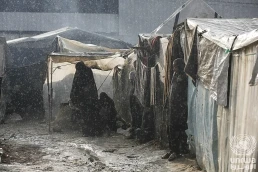
Around 1.4 million people in Gaza — roughly 65 percent of the population — are currently living in tents in overcrowded camps after the Israeli assault destroyed 82 percent of residential buildings. Most are living in worn-out tents that they have been using for years but cannot afford to replace or repair to make them more resistant to heavy rainfall. Shelter materials are extremely expensive in Gaza. For example, a single tent costs around $350, while a tarpaulin costs approximately $50.
For the fourth consecutive winter, Israel continues to restrict the entry of essential winter supplies, including blankets, warm clothing, proper tents, tarpaulins, basic materials needed to repair damaged homes, and heavy machinery required to drain floodwater and repair sewage networks. According to the Al Mezan Center for Human Rights, approximately 200,000 tents across the Gaza Strip have become completely worn out and can no longer provide even minimal protection against cold and rain. The International Organization for Migration has also confirmed that currently available shelter stocks cover only 17 percent of Gaza’s actual winter needs. The organization has stressed that Palestinians in Gaza need more durable and sustainable shelter solutions, including wooden structures, prefabricated housing units, and caravans.
In addition to this suffering, many families have few options but to pitch their tents in areas near the beach, as Israeli forces still control roughly 70 percent of the Gaza Strip within what is known as the “Yellow Line,” leaving more than 2 million Gazans confined to approximately 30 percent of the territory. These coastal areas are particularly vulnerable to flooding. Strong waves can reach far inland, flooding tents and washing them away. The lack of adequate rainwater drainage systems in these areas makes matters worse, as floodwater often mixes with sewage and accumulates around tents, turning their surroundings into pools of contaminated water.
According to OCHA, approximately 950,000 displaced people in Gaza are living in areas exposed to flooding, including more than 400,000 in locations considered at extremely high risk of flooding.
Aya Alshami, 25, a mother of two who is now living in a tent near the Gaza City port, told me that when the deep low-pressure system struck the Gaza Strip, her tent and all her belongings were flooded:
The rain was very heavy. I felt the top of the tent starting to sag and lean towards us. I tried to lift it, but the water had made it so heavy that I couldn’t manage on my own.
Then I heard my children shouting from inside, “Water is coming in!” We wondered where it was coming from. We thought we had secured everything, but then we found water seeping in from all sides.
My husband and I desperately tried to push the water out using a squeegee, but all our efforts were in vain. The mattresses were submerged, our belongings were soaked, and everything was flooded, turning the tent into a pool.
Alshami added that after her tent was flooded, she sat with her children in the street, drenched and shivering, with nothing to keep them warm:
These have been the worst days I have ever experienced. Before the war, winter was my favorite season. We lived in a warm home. I used to prepare sahlab and watch the rain falling while wrapped in a warm blanket. Now, I am literally homeless and helpless.
Although I received a new tent from a humanitarian organization after my previous one was flooded, I am certain it will not withstand the next rainfall. No matter how much you try to protect a tent from the rain, it’s all in vain. It’s still just a piece of fabric, the kind people use to enjoy a holiday at the beach in summer. And you’re expecting us to shelter ourselves in one through flooding and heavy rain?
Majdi Aswarki, 31, a father of three, was forced to relocate to a tent in Deir al-Balah after Israeli forces destroyed his home and took over his neighborhood, Al-Shaboura, in Rafah. Aswarki also told me that when he heard about the approaching low-pressure system, he tried to reinforce his tent to withstand the heavy rainfall.
“I sold my share of the cooking gas so I could buy four tarpaulins and wooden poles,” he said. “I also placed sandbags along the sides of my tent and used shovels to build barriers to prevent water from seeping in.”
However, all of Aswarki’s preparations proved futile in the face of the heavy rainfall:
The area where we live is very low-lying. This area is known to flood every winter, even before the war. From the first hour of rainfall, things were already out of control. The rain was so heavy that my tent collapsed and became completely submerged because there were no drainage channels.
All our clothes and blankets were soaked. We did not sleep at all that night. Instead, we spent the entire night trying to salvage whatever belongings we could. The water literally reached our knees, and we had nowhere to shelter from the rain. We were not the only ones affected; all my neighbors in the camp suffered the same fate.
For Aswarki and many others in Gaza, the suffering they experienced during the first rainfall of this winter is far from over. In fact, it is likely to be repeated with every storm, as the world continues to watch our suffering in silence without taking meaningful action to end it.
“It really breaks my heart that we have to keep pleading with the world to hear about our suffering. How much more do we have to tell you?” he said. “We spoke to you while we were being bombed, while we were starving, and while we were being displaced. And now we are speaking to you while we are drowning. Winter has only just begun.”
Recent Posts
Schumer, Who’s More Unpopular Than Trump, Gets a Challenger for Majority Leader
Take Action Now Trump has hit record low approval ratings during his second term, but even fewer Americans approve of Schumer.By Sharon Zhang,…

Populism Without A Party Or Why Senator Chuck Schumer Should Not Be Majority Leader Of The Senate
Take Action Now The 2026 election was a rebuke to the GOP more than an embrace of the Democrats, a rejection of corruption, an expression of…

The Real AI Misalignment Problem Is Capitalism
Take Action Now Figures at top AI firms says that their frontier models are running out of control. It points to a problem Big Tech finds harder to…

Schumer, Jeffries Odds Rise Despite Democrats’ Push for Leadership Change
Take Action Now The Democratic coalition remains divided about whether Schumer and Jeffries, both New York Democrats, should remain party leaders, or…