
Russia’s invasion of Ukraine demonstrates just how much we need to get rid of nuclear weapons.
By David P. Barash, History News Network
When it comes to the Ukraine War, no one has a crystal ball. With Putin rattling his rockets and the world worried about his next step, the most important take-home message from this disastrous affair — however it ends — should be that nuclear weapons must go.
And yet, beyond death and destruction, another outcome is very likely and potentially tragic; namely, a renewed call for more and “better” nuclear weapons.
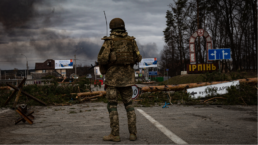
The claim is already being made that if Ukraine hadn’t given up its nuclear weapons in the mid-1990s, Putin would not have attacked that country. Nukes, we are told, would have deterred him, and so, we should cast our lot — even more than at present — with nuclear weapons so as to deter would-be aggressors.
History argues otherwise, namely, that nuclear weapons do not prevent wars. During and after the Cold War, each side engaged in much conventional warfare and military arm-twisting: the Soviets, for example, in Hungary (1956), Czechoslovakia (1968), and Afghanistan (1979–1988); the Russians in Chechnya (1996–2009), Georgia (2008), Ukraine (2014-present), as well as in Syria (2015-present). The United States in Korea (1950–1953), Vietnam (1962–1974), Beirut (1982), Grenada (1983), Panama (1989), the first Gulf War (1990–1991), in the former Yugoslavia (1999), Afghanistan (2001–2021), and Iraq (2003–2016), to mention just some of the more prominent cases.
Nor did the threat presumably posed by the US nuclear arsenal deter aggressive maneuvers by the Soviet Union when it was not yet a nuclear power. In 1948, the US had a nuclear monopoly, which didn’t inhibit Stalin from initiating the Berlin Blockade, one of the USSR’s most provocative Cold War actions. In fact, the Soviets were most aggressive vis-à-vis the US between 1945 and 1949, when only the US had nuclear weapons. It was during that time that Stalin, in violation of the promises he had made to Roosevelt and Churchill during their Yalta summit, consolidated Soviet control over its Eastern European satellites.
Recent Posts

Abolish the Board of Peace. Try the Table of Peace.
Take Action Now I asked people to pretend to be the United States Congress for 10 seconds. (Many of them were disgusted at the thought but I assured…

Black Power, White Heat, and the Work of Solidarity
Take Action Now What a history of the 1960s can teach us about organizing in an authoritarian ageBy Alexandria Shaner, Z Network There is a…

ICE Bans Hugging Inside California’s Largest Detention Center. Families Are Fighting Back
Take Action Now In the California City facility, ‘contact visits’ are strictly forbidden – but detained residents aren’t staying quiet. Are officials…
Tyrant Trump Is Lucky in the Cowardice of His Enemies
Take Action Now Democratic leadership’s refusal to pursue impeachment signals to Trump that he has two-plus unchallenged years to ravage the lives…