
Israel’s ethnic cleansing of southern Lebanon and Gaza has reached a scale unseen since the Nakba. The history of Israel’s offensives shows how depopulation is soon followed by annexation.
By Gilbert Achcar, Jacobin
To fully grasp what has been going on since October 7, 2023, in the territories newly reoccupied by Israel in Gaza and Lebanon, it is necessary to examine the pattern of these occupations against previous ones conducted by the Zionist state. As is well known, the very birth of Israel was inseparable from occupation. The new state proclaimed on May 15, 1948, spanned over 56 percent of British Mandate Palestine between the Jordan River and the Mediterranean Sea — the territory attributed to the “Jewish State” by the partition resolution adopted by the United Nations General Assembly in November 1947. By the end of the first Arab Israeli war in 1948–49, Israel ended up controlling 78 percent of that area.
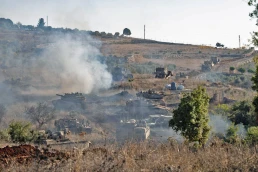
During that war, the exodus of Palestinians fleeing for fear of harm at the hands of Zionist mainstream and fringe armed forces encompassed 80 percent of the Arab population of the lands seized by Israel. Many fled in the belief that they would be able to come back to their homes once the fighting was over. Many others were forced to leave. Palestinian refugees were never allowed to return across the boundaries of the new state. To literally bury the very possibility of their return, most of the four hundred depopulated Palestinian Arab towns and villages were destroyed and rendered uninhabitable. An initial pattern of occupation was thus enacted, specific to the establishment of the Israeli state, which the Palestinians and Arabs have ever since called the Nakba (disaster): a combination of “ethnic cleansing” and destruction of the built environment in order to take full control of a territory.
The next major instance of Israeli occupation did not conform to that pattern. In 1967, Israel did not reenact the Nakba’s ethnic cleansing in the Palestinian territories that it occupied during the Six-Day War. Or, more accurately, it did not reenact it on the same scale: cases of forcible depopulation and destruction of the built environment did occur and are still occurring, but not yet to the point of constituting an episode of ethnic cleansing comparable to the Nakba. One key reason for this was that the bulk of the population of the newly occupied Palestinian territories (OPTs) — the West Bank and the Gaza Strip — clung to their land and homes, knowing too well after the experience of 1948 what their fate would be if they fled.
Recent Posts

Replace Chuck Schumer—Honor an Election of Change
Take Action Now Schumer never invested in Louisiana, where Democrats lost by less than two points after July and September polls showed they were…
1.4 Million People in Gaza Live in Tents. Winter Storms Can Be a Death Sentence.
Take Action Now Making unlivable conditions even more dire, flooding in Gaza is just the first disaster of a long winter to come.By Shahad Ali,…

Schumer, Who’s More Unpopular Than Trump, Gets a Challenger for Majority Leader
Take Action Now Trump has hit record low approval ratings during his second term, but even fewer Americans approve of Schumer.By Sharon Zhang,…
Populism Without A Party Or Why Senator Chuck Schumer Should Not Be Majority Leader Of The Senate
Take Action Now The 2026 election was a rebuke to the GOP more than an embrace of the Democrats, a rejection of corruption, an expression of…