
An interview with Israeli academic, left-wing activist and resister Idan Landau (he has been jailed three times in military prison for refusing to serve in the Israel Defense Forces reserves), who says that Israel is “a paranoid modern-day Sparta, with ultra-Orthodox, intolerant and persecutional internal regime.”
By Idan Landau and CJ Polychroniou, Z
One year after the Hamas’s October 7 terror attacks, and with most of Gaza literally destroyed and the conflict in the Middle East growing, one may wonder what the mood is inside Israel. Israel’s populace has supported the war in Gaza, opposes the two-state solution, but now also seems to offer enthusiastic support for the attacks in Lebanon and even a strike on Iran. In fact, Netanyahu’s popularity has been boosted following the Hezbollah attacks and his Likud party is back at the top of national surveys.
What has happened to Israel? What has happened to the Israeli peace movement? Why is the country on an increasingly illiberal, violent, and destructive path? In the interview that follows, Idan Landau sheds light into the current political and social environment inside Israel. Landau is full professor of linguistics in the Department of Linguistics at Tel Avid University and writes a political blog (in Hebrew) on Israeli affairs.

C. J. Polychroniou: The October 7 attacks by Hamas’ military wing — the al-Qassam Brigades — and several other Palestinian armed groups shook Israel to its core, and the nature and scope of the operation, called Al-Aqsa Flood, which resulted in the deaths of nearly 1200 people while some 250 were taken as hostages to Gaza prompted the extreme far-right government of Benjamin Netanyahu to embark on a maniacal campaign against Gaza which has led so far to a Palestinian death toll that has risen to over 41,000 although the true death toll is undoubtedly much higher. Indeed, the utter destruction of Gaza was a stated objective as Israel’s war cabinet had vowed to wipe Hamas off the earth. Now, it’s been said that the attacks created a strong sense of solidarity among Israelis, with the overwhelming majority supporting the military response against Hamas, including limiting humanitarian aid to Gaza, but that old divisions have returned and that Israeli society is divided about the lessons of October 7. Can you give us a sense of the mood in Israel today, especially since Israel is pressing forward now on two fronts?
Idan Landau: Probably the single most divisive issue in Israel concerns the fate of the hostages. By now it is clear that the military “pressure” (a euphemism for rampant killing of Gazans) not only fails to facilitate the release of the hostages but directly contributes to their death. So the terms of the dilemma have grown more brutal: Are you or aren’t you willing to sacrifice the lives of the Israeli hostages for Netanyahu’s promise of “absolute victory”? Note how the human aspect has been removed; their lives are no longer considered the ultimate end, to which different means may be deployed. Their lives are one more strategic means, along with others, like holding on to the Philadelphi road, or using 2,000 pound bombs, etc. This reflects the increasing dehumanization that affects not just Israel’s victims but Israelis themselves.
Recent Posts

‘Act of Collective Punishment’: Netanyahu Condemned Over ‘Full Lockdown’ of Occupied West Bank
Take Action Now The reaction to a shooting incident in Hebron, said one Palestinian critic, “represents an alarming escalation in Israel’s policies…
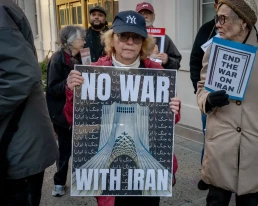
‘Stop The War on Iran’: Brooklyn Peace Activists Urge Jeffries to Help End Conflict
Take Action Now Democrats have a golden opportunity to capitalize on this issue, win big in November, and take real action on AI data centers to…

A Blue Wave Won’t Wash Away Our Oligarchy Problem
Take Action Now The massive election spending by Elon Musk and other billionaires is a huge problem, even if many of the superwealthy’s favorites…

Democrats Should Get Behind a National AI Data Center Moratorium
Take Action Now Democrats have a golden opportunity to capitalize on this issue, win big in November, and take real action on AI data centers to…