
In the California City facility, ‘contact visits’ are strictly forbidden – but detained residents aren’t staying quiet. Are officials listening?
By Sam Levin, The Guardian
Teresa Reyes drove 300 miles to be with her son on his 32nd birthday in May, but she couldn’t give him a gift, share a meal with him or give him a hug. She couldn’t even touch him.
Her son, Guillermo, a tattoo artist from San Jose, is locked up in the California City immigration detention center, California’s largest Immigration and Customs Enforcement (ICE) facility, and the only way he can see his mother is behind a thick pane of glass.
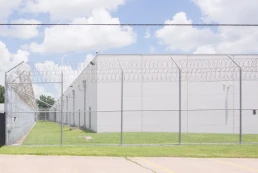
The detention center, housing roughly 1,600 people in a desert region north of Los Angeles, has denied contact visits to all people held inside since the Trump administration opened the site one year ago. That means no one inside the facility, which is run by the private prison firm CoreCivic, can sit with or embrace family members who travel to the remote site for visits. Instead, families are left talking through phones while their relatives sit in an adjacent room, separated by glass barriers.
“I want to hold my son, I want to touch him, I want to assure him everything is going to be OK, but I can’t,” said Reyes, 63, speaking in Spanish. “When I see him, I have to hold back tears. I have to pretend to be strong, because I don’t want him to think I am suffering.”
The total denial of contact visits is an extreme restriction for any prison or detention site where people are locked up long-term, particularly a facility holding people accused of immigration violations. Prisons across the US housing people convicted of serious criminal offenses typically operate visitation rooms where families can sit at tables, only temporarily barring contact visits when there are safety concerns.
The harsh policy, advocates say, is part of the Trump administration’s strategy of placing more and more people in crowded facilities while their cases drag on, subjecting them to prison-like conditions and restricting their connections to the outside – all of which can increase pressure to accept deportations.
In California City, detained residents aren’t staying quiet, instead working with advocates to launch a public campaign, pleading with their warden to let them hug their relatives. Is he listening?
Six months of ‘isolation’
Allen Tayson, 37, spoke over the loud clangs and shouts behind him. The father of two from Gilroy, a California city south of San Jose, was appearing on a video call from inside the California City facility, his face going in and out of focus, with the ICE messaging app blurring the background behind him.
Recent Posts

‘Stop The War on Iran’: Brooklyn Peace Activists Urge Jeffries to Help End Conflict
Take Action Now Democrats have a golden opportunity to capitalize on this issue, win big in November, and take real action on AI data centers to…

A Blue Wave Won’t Wash Away Our Oligarchy Problem
Take Action Now The massive election spending by Elon Musk and other billionaires is a huge problem, even if many of the superwealthy’s favorites…

Democrats Should Get Behind a National AI Data Center Moratorium
Take Action Now Democrats have a golden opportunity to capitalize on this issue, win big in November, and take real action on AI data centers to…

Another Way Out: Public Execution Is an Everyday Reality—Livestreamed or Not
Take Action Now For some, the Trump administration’s plan to livestream an execution was unacceptable because it wouldn’t happen behind closed doors……