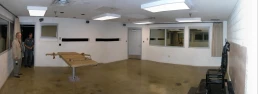
For some, the Trump administration’s plan to livestream an execution was unacceptable because it wouldn’t happen behind closed doors
By William C. Anderson, Prism
“There are people, who in good faith ask this question: How would it be possible to live without government? And they conclude saying that a supreme chief, a crowd of officials, large and small, such as ministers, judges, magistrates, legislators, soldiers, jailers, policemen, and executioners, are necessary.” –Ricardo Flores Magón
When Secretary of Defense Pete Hegseth announced the now-canceled plan to livestream the execution of Nidal Hasan, a former Army psychiatrist who killed 13 people in 2009 at Fort Hood, Texas, the response was mixed. A Washington Post-ABC-Ipsos poll revealed that 8 in 10 people believed “the execution should not be live-streamed to the public.” However, “a narrow 53 percent majority of Americans support executing Hasan by firing squad.” All of this information has to be digested in relation to the fact that livestreamed executions are an everyday reality in the U.S. The Trump administration’s plan wasn’t necessarily abnormal, but many found its formalization shocking. This is a problem the U.S. public has yet to overcome: It often decries atrocities when they are announced plainly, while ignoring the fact that they are a part of the society’s culture.
President Donald Trump is the embodiment of this sort of conundrum, as someone liberals commonly denounce for not being “a real American.” However, Trump, like public execution, represents much of what’s at the core of the U.S., and we only have to look around to understand why.
In my 2023 essay, “Police killings are public executions,” I argued that extrajudicial killing is so normalized that it has failed to register with onlookers as a propagandistic broadcast. This is how the “psychological augmentation of the police state” becomes deeply ingrained in us “as accepted fascistic violence.” I highlighted that it was so regular that people like Tyre Nichols and Keenan Anderson referenced the public execution of George Floyd as they themselves were executed. Take this into account along with the practice of spectatorship, the recording of police murders that then go viral, and the institutional faux accountability measure of police body cameras. Combined, we have much of what we need to create a readymade meal for societal conditioning. Those who watch the murder have digested it to such an extent that they become desensitized, avoidant, and disempowered. That’s what makes the livestream execution debacle particularly curious.
Recent Posts
Schumer, Jeffries Odds Rise Despite Democrats’ Push for Leadership Change
Take Action Now The Democratic coalition remains divided about whether Schumer and Jeffries, both New York Democrats, should remain party leaders, or…
Why California’s Government Isn’t Working
Take Action Now Bloated by corporate cash, let down by a rotten political system and a perversion of direct democracy, what’s the way back for a…
10 Reasons Hakeem Jeffries Should Not Be the Next Speaker of the House
Take Action Now More than any single vote, contribution, or appointment, the problem with Hakeem Jeffries is the establishment politics he…

More Pressure Needed to STOP the Trump EGO Arch
Take Action Now Representative Don Beyers from Northern Virginia already has 80 co-sponsors of House Resolution H.R. 9047 to stop the Arch. Call…