
In case of a Russian invasion of Ukraine, the DeFazio letter points out that Article I of the Constitution and the War Powers Resolution together clearly require congressional authorization.
By Charles Lenchner
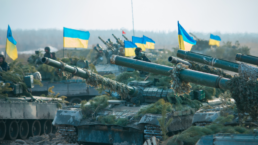
A bipartisan letter underscoring Congress’s authority over any armed conflict with Russia is being circulated by Reps. Peter A. DeFazio and Warren Davidson. The letter is an effort to slow down the rush to war by insisting as clearly as possible that President Biden consult with Congress before any decision is made to engage the U.S. military as it relates to the crisis in Ukraine.
Progressives, among others, are making sure that any armed conflict that does emerge will not include the United States or NATO unless it is preceded by a robust debate. By itself, this might not make or break the drive to escalate tensions; but the law is so clear on this particular point, it might well slow things down long enough for diplomacy to work.
Dear Mr. President:
As you evaluate your possible course of action to address the potential conflict between Russia and Ukraine, we write to reassert the war powers vested in Congress under the U.S. Constitution and the War Powers Resolution of 1973. To date, you have rejected calls to station U.S. Armed Forces in Ukraine, stating that such an effort is “not on the table.” However, if the ongoing situation compels you to introduce the brave men and women of our military into Ukraine, their lives would inherently be put at risk if Russia chooses to invade. Therefore, we ask that your decisions comport with the Constitution and our nation’s laws by consulting with Congress to receive authorization before any such deployment.
Specifically, Article I of the U.S. Constitution grants Congress the power to finance and declare war, while Article II names the President as Commander-in-Chief of the U.S. Armed Forces. This crossover was intentionally written by the framers of the U.S. Constitution so Congress and the President would be required to cooperate on our nation’s military affairs. In addition, the War Powers Resolution of 1973 was passed into law after multiple presidential administrations failed to receive congressional approval for over a decade of unauthorized involvement by U.S. Armed Forces in hostilities in Southeast Asia. The purpose of this resolution was to reinforce the objective of the U.S. Constitution by ensuring that “the collective judgment of both the Congress and the President” would be utilized before the “introduction of United States Armed Forces into hostilities, or into situations where imminent involvement in hostilities is clearly indicated by the circumstances.”
Our nation’s laws are highly relevant to the ongoing situation in Ukraine. Your administration has repeatedly asserted that a Russian invasion of Ukraine is “imminent.” While your administration has recently rescinded that characterization, were an attack by Russia to be imminent or underway, the War Powers Resolution would clearly require congressional authorization before the President may command U.S. Armed Forces to engage in hostilities.
The War Powers Resolution does not require authorization for the U.S. to advise and assist missions that do not involve hostilities. However, if there becomes an imminent or active attack by Russia, Section 8(c)[1] of the War Powers Resolution will compel you to seek specific Congressional authorization if you aim to leave current U.S. advisers, trainers, or special forces in areas of these imminent or active hostilities. You must also receive congressional approval before initiating any pre-emptive strike.
We strongly urge your administration to respect the separation of powers, U.S. law, and Congress’s constitutional war powers authority. Should your administration seek to introduce U.S. Armed Forces into hostilities or decline to remove troops currently deployed inside Ukraine from unauthorized hostilities or imminent hostilities, Congress stands ready to deliberate over the potentially monumental implications of such scenarios. The American people, through their representatives in Congress, deserve to have a say before U.S. troops are placed in harm’s way or the U.S. becomes involved in yet another foreign conflict.
Thank you for your attention to this important matter.
Sincerely,
Peter A. DeFazio
Member of CongressWarren Davidson
Member of Congress
[1] Section 8(c) of the War Powers Resolution provides additional clarity on what can constitute the “introduction of United States Armed Forces” into hostilities, stating that it “includes the assignment of members of such armed forces to command, coordinate, participate in the movement of, or accompany the regular or irregular military forces of any foreign country or government when such military forces are engaged, or there exists an imminent threat that such forces will become engaged, in hostilities.
Recent Posts
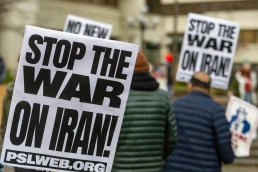
Take Action October 20 to End the Illegal U.S.-Israeli War on Iran, #PeaceWithIranNOW
Take Action Now The war is not just illegal, but massively unpopular with the U.S. public, and Trump and his Republican enablers may take a deserved…
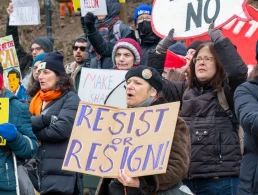
Chuck Schumer Hasn’t Said a Word About Trump’s Attempt to Deport Ilhan Omar
Take Action Now Ethics lawyers say the raid violated the Hatch Act. Schumer has been silent.By Sharon Zhang , Truthout Days after the Trump…
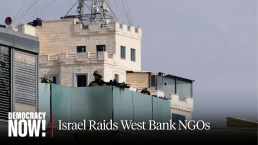
“Propaganda Show”: IDF Raids Palestinian NGOs in the West Bank Ahead of Israeli Elections
Take Action Now “The raid onto the city center Ramallah is not a lonely activity. It happens every day that they raid different villages,…

ICE Planning $100 Million ‘Nightmare’ Domestic Spy Program
Take Action Now Under ERO ONE, Immigration and Customs Enforcement plans to hire 142 intelligence contractors with top secret clearances and deploy…