
By Jeff Cohen
If you get your news about politics from corporate media, you’re getting myths from journalists and pundits instead of clarity.
At Thursday’s boisterous news conference with House Speaker Nancy Pelosi, a reporter used the phrase “the two biggest spending bills of this Congress” to describe the Bipartisan Infrastructure Bill (BIF) and the Democrat-only Build Back Better (BBB) reconciliation proposal. The phraseology about “the two big” or “biggest” spending bills is a common media refrain. And it’s a myth.
The supposedly $1.2 trillion infrastructure bill that passed the Senate in August and was delayed yesterday in the House actually would provide only $550 billion in new spending — and that’s over a period of 5 years — to modernize infrastructure like roads, bridges, ports, airports, transit systems, Internet and water systems.
The proposed BBB bill — routinely prefaced with the adjective “massive” in corporate news outlets (whether liberal or conservative) — would spend $3.5 trillion over 10 years to address the climate crisis and to expand healthcare, childcare and the social safety net in general . . . though still leaving our country far behind almost all other developed nations.
Meanwhile, although it received far less media coverage than the BBB and was rarely labeled “massive,” the U.S. House broke all records last week by voting to spend $768 billion in the next year on the military. Since it’s an annual expenditure, this spending dwarfs the multi-year BBB and BIF bills combined. Yet no reporter shouted a question about it at Pelosi’s news conference.
To put this exorbitant military spending in perspective, the Biden White House called for an increase in Trump’s already-bloated military budget, but that apparently wasn’t big enough for Pelosi and other House leaders of both parties, who added $25 billion to the Pentagon’s annual budget above what Biden requested. The military bill passed with bipartisan support: 181 Democrats and 135 Republicans.
Even after the Afghan war has finally ended, the establishment’s appetite for unbridled military spending seems insatiable.
A corollary myth in mainstream media is that Capitol Hill progressives like Alexandria Ocasio-Cortez are the profligate spenders and budget busters in Washington, not corporate Democrats or Republicans. But it was Pelosi and the House leadership — allied with a unified GOP — who defeated a progressive amendment introduced last week by AOC to cut 10 percent from the Pentagon budget. Only 86 Democrats and no Republicans supported the budget cut.
As Truthout reported, Democrats who voted against the 10 percent Pentagon reduction received nearly 4 times more campaign donations from the military-industrial sector than those Democrats who voted for the cut.
Tough scrutiny of corporate influence over Congress members is almost as absent in mainstream media as scrutiny of military spending.
Which bring us to more media mythology, this time revolving around Senator Joe Manchin — who is constantly labeled a “moderate” Democrat and not a “corporate” or “corporatist” Democrat. Mainstream journalists take at face value Manchin’s claims that he opposes the Build Back Better initiative because of its price tag and because it expands the “entitlement mentality.”
But as any awake journalist should know, given Manchin’s close relationship with corporate lobbyists, his objection is less about the price tag’s impact on budget deficits or about entitlements (he’s always fought for government welfare to the fossil fuel industry) than it is about the taxes included in the BBB. Indeed, the BBB package would be heavily paid for by increased taxes on big corporations and the wealthy.
By contrast, the Bipartisan Infrastructure Bill that Manchin helped craft is not paid for by any new taxes (while it subsidizes dirty energy projects).
The BBB reconciliation proposal would save taxpayer money by cutting subsidies to oil and gas and would raise money by increasing fees — for example, a fee on emissions of methane, a horrific contributor to global warming.
If mainstream journalists focused more on Manchin’s corporate alliances and the specifics of who benefits and who gets taxed in these bills, it would help clarify why Manchin supports BIF but not the BBB. Bloomberg News offered some rare clarity: “Manchin’s campaign and leadership political action committees received almost $400,000 from the oil and gas industry since 2017, and he was the sector’s top recipient in Congress through the first six months of 2021 with $179,450, according to the Center for Responsive Politics.”
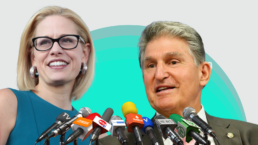
According to journalists for independent outlets like The Intercept and Sludge, Manchin has made more than $4.5 million from his family’s coal businesses since he joined the Senate in 2011.
Asked by an MSNBC anchor about the opposition from Manchin and “centrist Democrats,” progressive Congress member Katie Porter offered the kind of clarity that corporate journalists tend to avoid:
“There are a huge number of corporations that pay zero taxes, and by making savvy revenue choices — for example, using a real corporate profit approach to dealing with those corporations that pay zero — we could generate 700 billion. . . . We can generate the revenue so that this isn’t about $3.5 trillion in spending. . . . I have the will to do it. The question is: does Senator Manchin? Or is he more concerned about his corporate donors including large corporations, the oil and gas industry, the big pharmaceutical industry, and others who are getting away with paying nothing under our current tax system?”
Rep. Porter continued:
“I’d like to see Senator Joe Manchin come out in favor of fully funding the IRS, in favor of having a fair global corporate tax system. . . . I think it’s dead-on fiscally irresponsible for Senator Manchin to refuse to raise revenue and at the same time out of the other side of his mouth — maybe the side of his mouth that he uses to talk to his corporate donors — complain that we can’t pay for the things that American families desperately need.”
Jeff Cohen is co-founder of RootsAction.org, a retired journalism professor at Ithaca College, and author of “Cable News Confidential: My Misadventures in Corporate Media.” In 1986, he founded the media watch group FAIR.
Recent Posts
Trump Says He’s Banning CNN, MS NOW, and Politico From the White House
Take Action Now “These outrageous attacks only demonstrate how scared he is of an informed public,” said one press freedom advocate.By Stephen…

Bases Without Names: How Governments Rebrand the U.S. Military Presence
Take Action Now Across Asia, Europe and the Middle East, governments use an expanding vocabulary to describe sites that accommodate U.S. troops,…
Getting Into ‘Good Trouble’ Over Arc de Trump
Take Action Now A retired Army colonel flew in from Hawaii to make sure Trump’s arch doesn’t go up quietlyBy Jonathan Capehart, Substack On the…
AIPAC’s Network Has Already Spent $67.2 Million to Shape the Midterm Elections
Take Action Now The giant influx from American Israel Public Affairs Committee PACs is a case study in money distorting politics.By Derek Seidman,…