
A new report highlights the health benefits of getting rid of combustion engines.
By Max Graham, Grist
Moving away from gasoline-powered cars won’t just help with climate change. It also could have major health benefits, according to a new report by the American Lung Association.
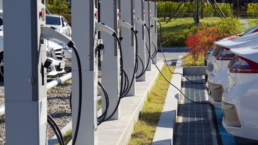
The United States could save 89,000 lives and nearly $1 trillion in health costs by mid-century if drivers stop buying conventional combustion-engine cars and if the country cleans up its power grid by 2035, the organization found.
“There’s a real significant health benefit to be achieved and significant suffering to be avoided — premature deaths to be avoided, children having asthma attacks avoided — by making this transition to technology that exists today,” said William Barrett, who works on clean air and climate policy at the American Lung Association and authored the report.
The gasses and particles spewed from tailpipes are linked to a range of illnesses, including asthma, lung cancer, and heart disease. The potential health benefits of electric vehicles stem from the fact that they don’t produce the same toxic byproducts, like smog-forming oxides of nitrogen, as combustion engines. Although there have been relatively few real-world studies on EVs and air pollution, the American Lung Association’s report aligns with research showing that cars without combustion engines pollute less and lead to fewer respiratory illnesses than their gas-powered counterparts.
The association’s findings come as states adopt policies to phase out gas-powered cars. Seven states, such as California and Oregon, have set targets to make all passenger vehicle sales by 2035 “zero-emissions” — meaning EVs, hydrogen fuel-cell cars, or plug-in hybrids. And the Environmental Protection Agency this spring proposed tailpipe emissions standards that could make electric vehicles two-thirds of all new cars sold by 2032.
While the report’s authors note these developments and credit two pieces of legislation passed in recent years — the Inflation Reduction Act and the Infrastructure Investment and Jobs Act — with spurring production of EVs and helping decarbonize the power grid, they said stronger state and federal standards are still needed to achieve the health gains outlined in the report. The report calls on more states to adopt regulations pioneered by California that promote zero-emissions vehicles while strengthening rules to slash pollution from gas-powered cars.
To be sure, EV sales have grown rapidly in recent years but still only make up about 6 percent of the U.S. market. With an average cost of about $60,000, new electric cars are still a luxury purchase. In California, for instance, they’re concentrated mainly in wealthy, majority white and Asian neighborhoods.
Key to saving the 89,000 lives projected in the report is an assumption that the whole country will be running on clean energy.
“The assumption of having a clean grid is really important for these calculations,” said Sara Adar, an epidemiologist at the University of Michigan who studies environmental health, including traffic pollution, and was not involved with the Lung Association’s report. “If we fail in our attempt to clean the grid and we are still generating electricity based on coal, I think those estimates will no longer be accurate,” Adar added.
Adar also offered a solution that didn’t come up in the report: “Not driving is absolutely the way to go.”
Recent Posts

The Courage to Keep the Oath
Take Action Now Why We Must Stand with Major Jason WatsonBy Jeffrey Sterling For almost two months, an Air Force officer has been sitting alone in…

‘Act of Collective Punishment’: Netanyahu Condemned Over ‘Full Lockdown’ of Occupied West Bank
Take Action Now The reaction to a shooting incident in Hebron, said one Palestinian critic, “represents an alarming escalation in Israel’s policies…

‘Stop The War on Iran’: Brooklyn Peace Activists Urge Jeffries to Help End Conflict
Take Action Now Democrats have a golden opportunity to capitalize on this issue, win big in November, and take real action on AI data centers to…
A Blue Wave Won’t Wash Away Our Oligarchy Problem
Take Action Now The massive election spending by Elon Musk and other billionaires is a huge problem, even if many of the superwealthy’s favorites…