
In only half a year of Donald Trump’s presidency, he and his allies have turned deportation into an explicitly political threat against opponents and critics. The latest and most high-profile is Zohran Mamdani.
By Branko Marcetic, Jacobin
Every country carries out deportations, the end point of a bureaucratic process that determines someone’s eligibility to stay in a country. Sometimes — say, if they’ve committed a terrible crime — that process will play out while they’re behind bars. In many other cases, it’ll be in a series of hearings in front of immigration judges in between the person continuing to live their life. Deportation is the very last stop on the train, the end of the line if someone’s case for staying in the country proves unpersuasive, when all appeals have been exhausted.
What deportation is not meant to be is a punishment or a threat, and certainly not one made against your political opponents. You would struggle to find examples of deportation being treated like this anywhere in the Western world and certainly in the United States in its recent history.
Yet in only half a year of Donald Trump’s presidency, that’s exactly what deportation has suddenly become: a threat that American politicians and their supporters now casually and regularly make against their political opponents, with only the thinnest pretext that they’re motivated by any actual violation of the law. And in fact, it’s gone beyond just a threat and is being actively, explicitly wielded as a form of punishment against people for their political speech.
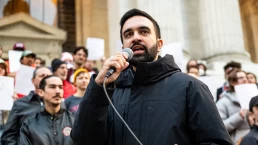
The latest and most high-profile example of this happened just yesterday, when Donald Trump obliquely threatened to deport the winner of the New York Democratic primary for mayor, Zohran Mamdani. Noting that Mamdani, a US citizen, vowed to bar Immigration and Customs Enforcement (ICE) from arresting people in the city, a reporter asked Trump for his “message to communist Zorhan [sic] Mamdani.”
“We’re going to be watching that very carefully, and a lot of people are saying he’s here illegally,” replied Trump. “We’re going to look at everything.”
To be clear, no people have been saying that: Mamdani, who was born in Uganda before his family legally immigrated to the United States more than two decades ago, has been a US citizen ever since he was naturalized seven years ago. Trump’s made-up reference to Mamdani being undocumented wasn’t just a stray insult; it followed his warnings that, because of Mamdani’s stance on ICE arrests, “we’ll have to arrest him” and cut off federal funds to New York in retaliation. The subtext is so clear it’s barely subtext: Mamdani wants to defy me, so maybe we’ll deport him.
Recent Posts

AI Doesn’t Need ‘Superintelligence’ or Evil Intent to Start a Nuclear War
Take Action Now Neither extraordinary machine intelligence nor malicious intent is required for catastrophe to result.By Paul Slovic and Herbert…

30 Months After Uproar Over Jonathan Glazer’s Oscar Speech, What Do His Pro-Israel Denouncers Say Now?
Take Action Now Given all that has happened, I recently contacted some signers of the open letter to ask whether they still fully believe in its…

Midterms Have Revived Universal Healthcare Debate. These States Are Ahead of Everyone.
Take Action Now States have often served as laboratories to test health policies later implemented nationally.By Markian Hawryluk, KFF Health……

Nobel Peace Prize Turns Toward Peace in 2026
Take Action Now To have finally acknowledged someone whose work in any way addressed the horrors of Zionism is an encouraging sign from the Nobel…