
Millions of innocent Gazans are in danger. Half are children who’ve lived through five wars already.
By Phyllis Bennis, OtherWords
The violence in the Middle East is bringing horrifying new levels of human suffering to both Israelis and Palestinians. We need an immediate ceasefire right now.
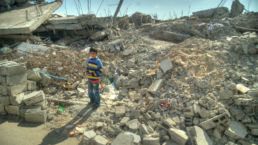
Both sides have committed heinous violations of international law. But if we’re serious about preventing such horrors in the future, we have to go beyond condemnation.
A lesson we ignore at our peril is that oppression undermines not only the rights, dignity, and lives of the oppressed, but eventually the security of the oppressors as well. The apartheid system that’s been suffocating Palestinians for so long is now also undermining the safety of Israeli civilians.
Since 2007, Gazans have lived under siege, prohibited from leaving their open air prison by a high-security militarized wall and platoons of Israeli soldiers.
For the last 16 years, starting long before the latest escalation, access to most goods was banned. Gazans couldn’t even get construction materials to repair the homes, hospitals, water treatment facilities, and places or worship that Israel bombed repeatedly — in 2008, 2012, 2014, 2018 and 2021.
Israel often denied emergency medical permits to leave the Strip, leaving many Gazans to die without care.
Electricity was already limited. A 72-year-old woman in Gaza told a reporter last January, “It is hard to imagine, but we used to experience 24 hours of electricity each day in Gaza; now we are lucky if we get six.” Now there is none.
Water was already unavailable except through expensive purchases from Israeli water companies. And food has long been scarce — by the age of two, 20 percent of Gaza’s children are already stunted.
Now that long-running siege is much worse.
On October 9, Israeli Defense Minister Yoav Gallant called for a “total siege” of Gaza. “No electricity, no food, no water, no gas — it’s all closed,” he said. For Gaza’s already impoverished and malnourished population, that’s not just collective punishment — it’s genocide.
Hospitals are unable to treat patients. Families will starve or die of thirst. Al-Ahli Arab Hospital in Gaza City, filled with patients, wounded, and Gazans seeking shelter from Israeli bombs, was struck on October 17. Hundreds of people were reported killed.
Human rights experts, UN officials, faith leaders, and others warned for years that the systemic oppression which rights groups now identify as apartheid would one day be too much to stand. Resistance was inevitable.
For decades, Palestinian resistance has taken overwhelmingly non-violent forms, including the Great March of Return in 2018-2019, a peaceful Gaza protest that was met with overwhelming lethal violence by Israeli forces.
But the world didn’t answer. When the UN warned in 2012 and 2015 that by 2020 Gaza would be “unlivable” without a “herculean effort” by the international community, the world didn’t respond.
This time the resistance took a violent form, including Hamas targeting civilians in horrifying ways that are illegal under international law. Those illegitimate acts must be condemned. But that cruelty must not be used to justify more brutality against millions of innocent Gazans, half of whom are under 19 and have lived through at least five Israeli wars already.
If we’re serious about preventing violence, we need to change the conditions from which this brutality sprang. Sending more bombs, warplanes, guns and bullets won’t solve the problem.
American taxpayers have supplied about 20 percent of Israel’s military budget for years. But our government hasn’t put any conditions on how that aid is used — even as Israel enforces a brutal siege and indiscriminately bombs Gaza today.
We need an immediate ceasefire right now. And we need to hold our own government accountable — which includes stopping Washington’s enabling of Israel’s oppression of Palestinians.
Palestinians have been paying the price for this apartheid system for generations. In the recent attacks, innocent Israelis paid a huge price as well. It’s time to end it, starting with a ceasefire — right now.
Phyllis Bennis is a Middle East expert at the Institute for Policy Studies and an international adviser for Jewish Voice for Peace. This op-ed was adapted from an earlier version at InsideSources.com and distributed by OtherWords.org.
Recent Posts
The Pentagon Asked OpenAI for Artificial Intelligence Designed to Rarely Say No
Take Action Now The U.S. military’s desire for an AI tool with “minimal refusal rates” was revealed through a FOIA lawsuit filed by The Intercept.…
Real History: After 9/11, the ‘War on Terror’ Was a War of Terror
Take Action Now Through it all, the ongoing war effort that began in autumn 2001 had an implicit throughline in dominant media and politics: while…
Abolish the Board of Peace. Try the Table of Peace.
Take Action Now I asked people to pretend to be the United States Congress for 10 seconds. (Many of them were disgusted at the thought but I assured…
Black Power, White Heat, and the Work of Solidarity
Take Action Now What a history of the 1960s can teach us about organizing in an authoritarian ageBy Alexandria Shaner, Z Network There is a…