
The 20-year war in Afghanistan is often spoken of as a well-intentioned failure. In fact, it was a major crime originating in bloodlust and an indifference to Afghan lives. The U.S. bears a major responsibility for the present suffering of Afghans and has an obligation to undo the damage it has inflicted.
By Nathan J. Robinson and Noam Chomsky, Current Affairs
“the oppressed people of Afghanistan will know the generosity of America and our allies.” — George W. Bush, oct. 7, 2001
The 9/11 attacks could have been dealt with as a crime. This would have been sane and consistent with precedent. When lawbreaking occurs, we seek the perpetrators, rather than starting wars with unrelated parties. When the IRA set off bombs in London, nobody called for air strikes on West Belfast (or on Boston, where a great deal of IRA funding came from). When the Oklahoma City bombing was found to have been perpetrated by a white supremacist associated with ultra-right militias, there was no call to obliterate Idaho or Montana. Instead, the attacker was searched for, found, apprehended, brought to court, found guilty, and sentenced.
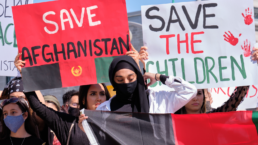
This was not the approach taken by the Bush administration. Rather than seek out and punish the guilty—and only the guilty—it swiftly launched a “global war on terror” that led to the deaths of millions.1
After the attacks, the Bush administration demanded that the Taliban immediately hand over Osama bin Laden to the United States. The Taliban, in response, offered to put bin Laden on trial, if the United States provided evidence of his guilt. Bush refused. Nor did he consider the Taliban’s offer to give up bin Laden to a neutral third country. His demand, he said, was nonnegotiable. He would not provide the requested evidence (in fact, he had none at the time). He would not enter into talks. Historian Carter Malkasian notes that Bush “did not instruct Powell to open a line to the Taliban to work things out, which would have been the normal diplomatic course of action to avoid a war.”
In fact, long before 9/11, the Taliban had reached out to the United States and offered to put Bin Laden on trial under the supervision of a “neutral international organization,” but the United States government showed no interest and did not respond. Milton Bearden, a CIA station chief who oversaw U.S. covert operations in Afghanistan in the 1980s, told the Washington Post after 9/11 that the Taliban had long been signaling to the United States that they “wanted to get rid of” bin Laden, and probably “set up bin Laden for capture by the United States” but the United States responded to the signals with threats. Relations between the Taliban and bin Laden’s Al Qaeda were, in fact, “deeply contentious,” and the Taliban had repeatedly placed bin Laden under house arrest.
Recent Posts

Bases Without Names: How Governments Rebrand the U.S. Military Presence
Take Action Now Across Asia, Europe and the Middle East, governments use an expanding vocabulary to describe sites that accommodate U.S. troops,…
Getting Into ‘Good Trouble’ Over Arc de Trump
Take Action Now A retired Army colonel flew in from Hawaii to make sure Trump’s arch doesn’t go up quietlyBy Jonathan Capehart, Substack On the…

AIPAC’s Network Has Already Spent $67.2 Million to Shape the Midterm Elections
Take Action Now The giant influx from American Israel Public Affairs Committee PACs is a case study in money distorting politics.By Derek Seidman,…

Ed Sheeran’s Craven “Neutrality” Is a Watershed Moment for Mainstreaming Palestine Solidarity
Take Action Now Ed Sheeran’s entire tour quitting in solidarity with Palestine and Macklemore proves the logic of BDS.By Natasha Lennard, The…