
Trump’s Pentagon hike would send war spending to nearly 70 percent of discretionary funds. Most would benefit weapons contractors.
By Hanna Homestead and Lindsay Koshgarian, Institute for Policy Studies
Congressional negotiations over the federal budget for Fiscal Year (FY) 2027 are well underway. While FY 2027 begins October 1, Congress passed a continuing resolution (CR) on September 1 that funds the government at current levels through December 11, punting the debate over next year’s budget to after the midterm elections. By December 11, they will need to either pass full-year appropriations bills (including for the military), pass another CR, or risk a government-wide shutdown.
President Trump and Secretary of War Pete Hegseth have requested a truly shocking $1.5 trillion war budget for FY 2027, a nearly 50 percent increase over the current $1 trillion war chest. Any increase to the war budget will greenlight continued U.S. war crimes in Iran — killing thousands of civilians and raising gas and food prices for U.S. families during the worst affordability crisis in recent history — and will be paid for with more cuts to SNAP, Medicaid, and rural hospitals.
Nearly 300 humanitarian, labor, and environmental organizations from across the country have signed a letter urging Congress to reject this excessive war spending and reinvest in meeting basic needs in our communities at home.
GOP members of Congress want to pass the $1.5 trillion war budget through multiple legislative vehicles: a $1.15 trillion base war budget passed through the regular process, and a potential “reconciliation” bill that could pass on a simple party-line majority in both the House and Senate and would add another $350 billion, to total $1.5 trillion.
On top of this, the Trump administration has asked for an additional supplemental spending bill for the Iran war, which would provide another $73 billion to the U.S. military as soon as it passes.
The good news: a $1.5 trillion war budget is far from assured. Legislators in both parties are pushing back on this outrageous request and the unpopular war on Iran that it will enable. Below are three charts explaining why the $1.5 trillion topline is a disaster for working families, and why every vehicle for higher Pentagon spending must be defeated.
CHART 1: Trump’s proposed $1.5 trillion war budget will starve our communities of the resources they need, fueling endless violence and war profiteering instead.
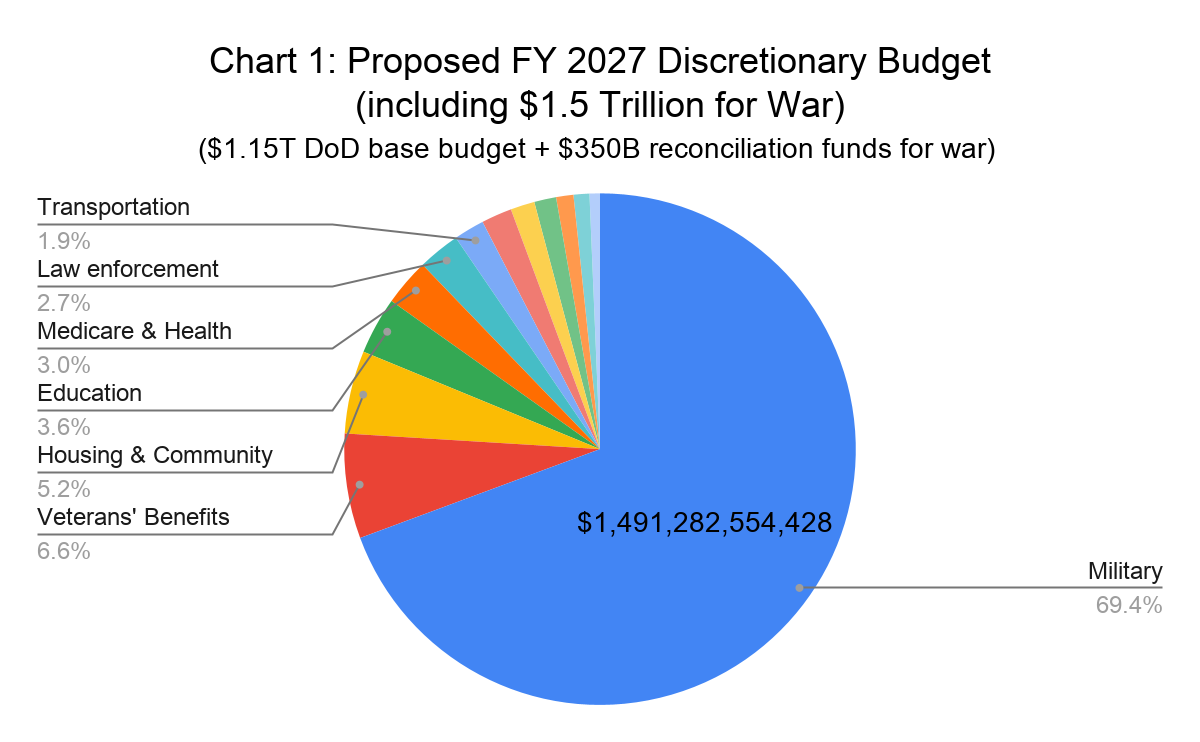
What will this budget do? Fuel endless violence and war profiteering at the expense of our communities. The massive human and financial costs of Trump’s wars are already hurting working people at home and globally, and will continue to climb for years to come. The proposed $1.5 trillion budget would mean close to 70 percent of the total $2.15 trillion discretionary budget is dedicated to war — robbing domestic programs and regulatory agencies of resources they need to function. On top of record-high wealth inequality, the gutting of public services is contributing to a decreasing quality of life for the majority of U.S. taxpayers.
(A small aside for those paying very close attention: the $350 billion in reconciliation funds, if passed, would technically be mandatory, not discretionary funds — see here for the difference. But since this is happening entirely as a political workaround and not for any substantive reason, we’re reassigning those funds back to discretionary funds where they should be. We’re still excluding about $30 billion in Pentagon funds that are ordinarily considered mandatory. Including those brings the total war budget to $1.53 trillion.)
The $1.5 trillion request comes on the heels of last year’s H.R.1, the so-called “One Big Beautiful Bill,” which pushed the annual Pentagon budget over a trillion dollars for the first time while cutting critical services to millions of families. The Pentagon hasn’t even been able to spend all that money, yet they are now asking for even more.
If passed, allocating $1.5 trillion for war would mean:
- 19 times more tax dollars are spent on war than on Education, as U.S. student reading and math scores continue to decline;
- 69 times more tax dollars are spent on war than on discretionary Energy & Environment programs (like the Environmental Protection Agency), even while the U.S. lags behind in clean energy technologies that would make utilities greener and more affordable; and
- 105 times more tax dollars are spent on war than on discretionary Food & Agriculture programs (like the National School Lunch Program and WIC), even while childhood hunger is increasing and 1 in 5 kids across the country do not currently have enough to eat.
CHART 2: The majority of the $1.5 trillion war chest would be spent on costly weapons systems that enable war crimes — from the U.S. war on Iran, to Hegseth’s illegal boat strikes, to Israel’s genocide in Gaza.
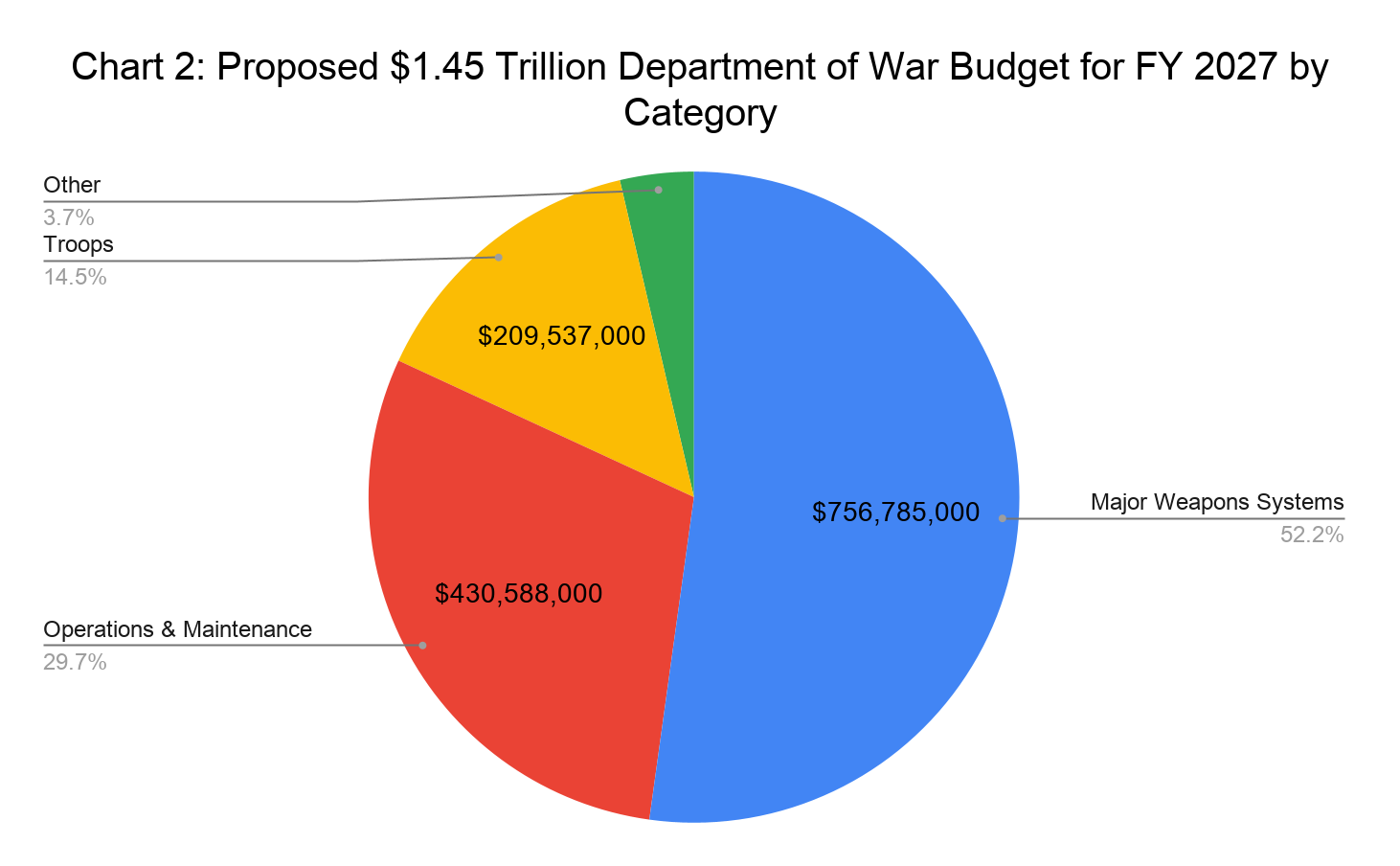
What is the majority of the proposed budget for? Weapons, many of which might be used to commit war crimes. Of the $1.5 trillion total for the military, the vast majority, $1.45 trillion, is for the Department of Defense/War (DoD/W). The majority of Trump’s proposed DoD/DoW budget is for weapons development and purchases — and most of the non-DoD/DoW spending goes to the Department of Energy for nuclear weapons and related costs.
Together, the DoD/W’s Procurement (purchases of major weapons) and RDT&E (Research, Development, Testing & Evaluation, and weapons development) categories together constitute 52 percent of the total funding requested for the Department of War. That includes purchasing and developing new aircraft, warships, killer robots, and munitions used in the illegal U.S. war on Iran, to support Israel’s genocide and war crimes in Gaza and Lebanon, and to facilitate the administration’s unconstitutional, deadly strikes in the Carribean and Eastern Pacific. Each missile the Pentagon buys to commit war crimes abroad could fund critical services at home.
If the administration and war hawks in Congress get their way, Trump’s record-setting weapons budget would be accompanied by a new policy that will further integrate the Pentagon’s military technology within Israeli firms, further enabling Israel’s war crimes out of sight of the American public.
And since these budgets are often justified as supporting the troops, everyone should know that only 14 percent of the total requested $1.5 trillion budget would go toward the troops via spending on Military Personnel (paychecks and benefits) and military family housing. As of this writing, at least 18 U.S. troops have died in the U.S. war on Iran, and hundreds injured — all in a war that the U.S. never should have started in the first place.
CHART 3: A $1.5 trillion war budget benefits corporate war profiteers — not troops or the American people.
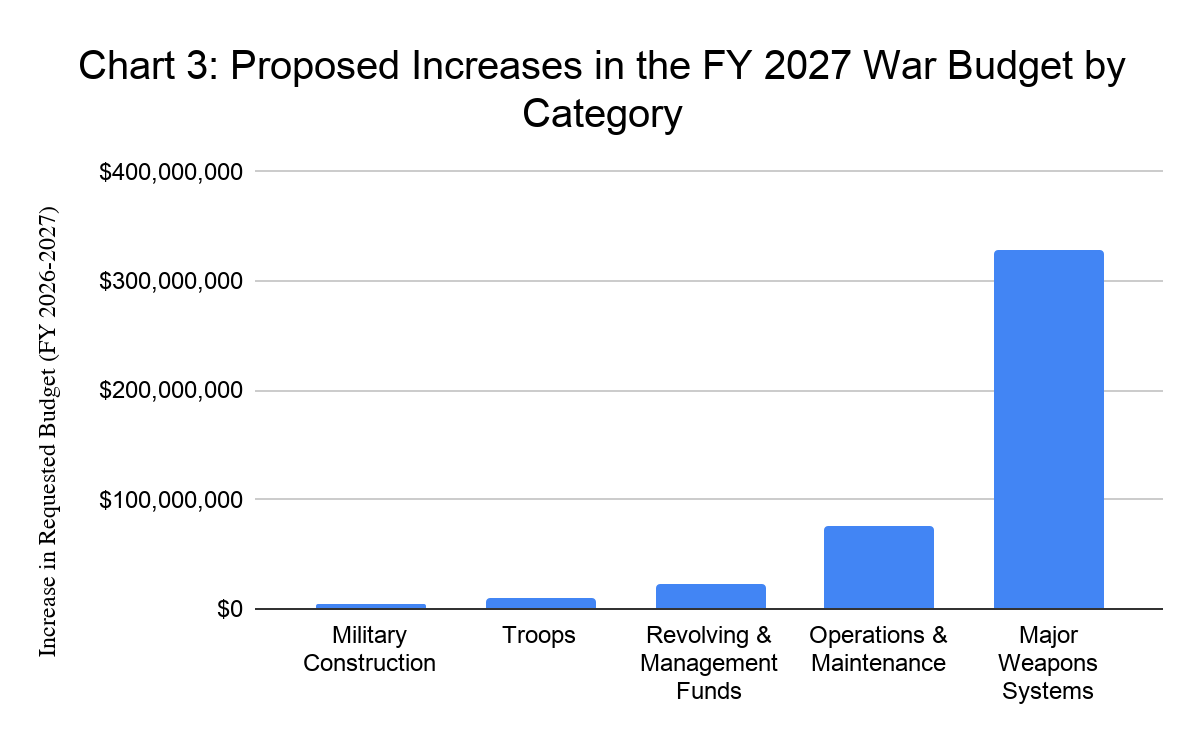
Who will benefit most from this budget? Corporate war profiteers. A $1.45 trillion DoD/DoW budget would be $441 billion above FY 2026 spending levels, a 43 percent overall increase in one year. Major weapons systems alone account for 74 percent of the total increase. By far, the largest dollar increase is for weapon systems that benefit war profiteers, not troops or the American people.
If enacted, this budget will be a boon to war profiteers who already receive more than half of all Pentagon spending. In fact, if Pentagon contracts were a federal agency, they would already be the biggest federal agency. Trump’s proposed budget would increase total spending on major weapons systems (Procurement and RDT&E) by 77 percent from FY 2026 levels, while spending on troops (Military Personnel and Family Housing) would increase by only 5 percent.
A report from Taxpayers for Common Sense and the Project on Government Oversight (POGO) shows we could actually cut $500 billion from major weapons systems while strengthening national security.
Rather than subsidizing weapons contractors who are already raking in record profits by helping the U.S. government commit war crimes around the globe, Congress could reallocate funding from the Pentagon to solve the national teacher shortage, build high-speed rail, expand healthcare services, or a myriad of other efforts to address the worsening cost of living crisis. This would be in line with what the majority of Americans on both sides of the aisle want: our tax dollars spent supporting families at home, not bombing them abroad.
Download
Recent Posts

Israeli Settlers Killed His Constituent. Fetterman Is Sole Democrat Against Investigating Them.
Take Action Now Despite support from other Democrats, the Senate voted 51–47 against a resolution to force U.S. probes on killings of Americans in…

The Movement to Abolish ICE Is Gaining Momentum
Take Action Now As activists rally around federal legislation to dismantle ICE, Amnesty International joins the call for abolition.By Mike Ludwig,…

Wanted: An Organized Political Movement to Counter the AI Oligarchs
Take Action Now History teaches us that the American people are capable of building great movements against powerful corporate interests. Let’s hope…

New Polling: 84% Of Voters Support Van Hollen Resolution To Investigate Israel’s Killing of U.S. Citizens
Take Action Now 83% of Democrats, 86% of Independents, and 82% of Republicans back resolutionBy IMEU Policy Project Polling released Monday,…