
“The United States is more eager for this war to end than Iran is,” says professor Vali Nasr, who teaches at the Johns Hopkins School of Advanced International Studies.
By Amy Goodman, Nermeen Shaikh, and Vali Nasr, Democracy Now!
The United States and Iran have officially signed a memorandum of understanding aimed at ending the war in Iran. The 14-point agreement includes an immediate end to fighting on all fronts including Lebanon, an end to the U.S. naval blockade on Iran and the full resumption of maritime traffic through the Strait of Hormuz. It also proposes easing oil sanctions on Iran, unfreezing Iranian assets and launching a $300 billion investment fund to rebuild Iran, all while tabling the question of Iran’s nuclear program, which is instead set to be negotiated over in the coming months.
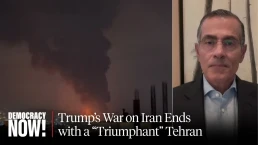
“The United States is more eager for this war to end than Iran is,” says professor Vali Nasr, who teaches at the Johns Hopkins School of Advanced International Studies. “In Iran, they’re very triumphant.” We discuss the long-term effects of the war, from the growing U.S. distrust of Israel, to the new generation of political leaders in the Islamic Republic, to the evolution of Iran into a major power player in an increasingly multipolar world.
Transcript
NERMEEN SHAIKH: The United States and Iran have officially signed a memorandum of understanding aimed at ending the war in Iran. The signing came a day ahead of schedule. President Trump signed the agreement at a dinner at the Palace of Versailles hosted by French President Emmanuel Macron. Iranian President Masoud Pezeshkian signed the agreement in Tehran.
The 14-point agreement calls for an immediate end to fighting on all fronts, including Lebanon; the full resumption of maritime traffic through the Strait of Hormuz; the lifting of the U.S. blockade; the easing of sanctions on Iran; the unfreezing of Iranian assets; and a $300 billion investment fund to rebuild Iran.
AMY GOODMAN: But the deal also leaves many major questions unresolved about Iran’s nuclear program. Iran’s lead negotiator, Mohammad-Bagher Ghalibaf, said, quote, “Everything we sought to achieve through military action, we obtained several times over through negotiation; it was not even comparable,” he said. Just hours before signing the deal, President Trump spoke at the G7 summit and issued a new threat to Iran.
PRESIDENT DONALD TRUMP: It’s a memorandum of understanding. And if I don’t like it, we’ll go back to shooting at them, dropping bombs on their head. If I don’t like it, if they don’t behave, we’ll go right back to dropping bombs right smack in the middle of their head.
AMY GOODMAN: We’re joined now by Vali Nasr, an Iranian American professor of international affairs and Middle East studies at Johns Hopkins School of Advanced International Studies. He recently co-authored a piece in Foreign Affairs headlined “Iran’s New Grand Strategy: How a Remade Islamic Republic Will Reshape the Middle East.” He’s also author of the book Iran’s Grand Strategy: A Political History.
Professor Nasr, it’s great to have you back. If you can start off by responding to this memorandum of understanding that President Trump signed in Versailles, obviously meant to bring us back to the end of World War I? The Iranian president, of course, signed remotely. But talk about the significance of what we have finally learned are the 14 points.
VALI NASR: Thank you very much for having me back.
I think, first of all, the most important part is that President Trump decided to sign this himself rather than have Vice President JD Vance do it, which then now means that he basically owns this document. I think it’s important in the sense that it ends this war. It closes the parenthesis on a hundred days of both hot war and economic war that has devastated the global economy.
At face value, and the way in which the political commentary, particularly in the West and the United States, is interpreting it, is that this is a major strategic setback for the United States. The U.S. started this war with the belief that it will destroy the Islamic Republic within days. President demanded the utter surrender for Iran. And now he has to settle for an agreement.
And the way this agreement reads, it looks like that the United States is more eager for this war to end than Iran is. The United States has given Iran a great deal of economic incentive in order to agree to sign this agreement, end the war, and then agree to negotiate over the larger issues which supposedly caused the war in the first place.
And also, it’s very clear that in Iran, they’re very triumphant. They think this is a big victory for them, not only that they survived the war, but that they forced the president to sign this agreement. And more importantly, everything the president said yesterday was breaking taboos: Iran can have enrichment; Iran can have missiles; Israel cannot destroy buildings in Lebanon at will, or should not; and that Iran is entitled to have its own frozen assets taken back — given back to the country.
NERMEEN SHAIKH: And if you could comment, Professor Nasr, on the fact that Lebanon figures in the very first point of this memorandum, and the fact you’ve called this agreement a success for Iran because it’s created, as you said, a fissure between the U.S. and Israel? If you could elaborate on that, and what you see as the risks, given that Israel had — was not consulted on this agreement, and it’s very unclear that it will go along with it?
VALI NASR: Well, first of all, the war was a moment of triumph for Israel, because it convinced the United States to basically go to war to realize what is essentially, and at its core, Israel’s strategic aims, which was the destruction of the Islamic Republic through military means. The war did not pan out the way that President Trump understood it would, and that already was a fissure. Now, the president trying to get out of this war the best he can has led him down a path that accepts the continued existence of the Islamic Republic, giving money to the Islamic Republic, talking to the Islamic Republic, all of which are basically strategic setbacks for Israel, and particularly for Prime Minister Netanyahu.
And Iran is actually asking for a price for accommodating President Trump, and the price that Iran is asking is deliberately trying to expand that fissure between the U.S. and Israel. But Iran, by insisting that Israel needs to back away from its maximal position on Lebanon and settle for a ceasefire now, and perhaps, as Iran is demanding, even leave south Lebanon, essentially, first of all, asserts the fact that Iran is coming out of this war believing that it has more leverage than before it went into this war, but also creates greater tension between Washington and Tel Aviv. And so, the Iranians are playing this in a very important way for them.
But also, we have to think that one outcome of this war is friction between Israel and the United States, period, because the Israeli strategy of deploying the U.S. to destroy Iran has backfired, and ultimately there will be a reckoning in the U.S. as to why did we go into this war, what were the premises of thinking that will be successful, and who is responsible. And even though it’s not said loudly, it’s very clear, in the undertone of what President Trump says, that he’s lost trust in what President — what Prime Minister Netanyahu tells him, and that he’s somewhat angry because he’s receiving blowback for a war that was, essentially, an Israeli strategic agenda, and now he has to carry the political cost of it.
NERMEEN SHAIKH: Professor Nasr, I want to ask about this piece that you co-wrote with Narges Bajoghli, “Iran’s New Grand Strategy,” in which you detail the changes that have taken place within Iran from last year, the first U.S.-Israeli attack on Iran in June 2025, to now, when this invasion took place, February 26th. You say the Iranian state underwent something of a transformation. You write, quote, “More institutional change took place in those eight months than in the previous ten years combined.” If you could elaborate?
VALI NASR: Well, yesterday in Évian, President Trump kept saying multiple times that there has been regime change in Iran and a more pragmatic leadership has taken over. Setting aside the second part of his statement, that whether it’s pragmatic or not, there definitely has been regime change. I mean, Israel and the United States, between the June 2025 war and this recent war, have killed over 130 Iranian leaders. And by doing so, they’ve eliminated a whole class of the country’s leadership, which has been replaced by a new generation that has come up through the ranks, generation that has been born in Iran after the revolution, the generation that was born not as revolutionaries that were fighting against a state, but actually as children of that state and in a bureaucracy, in a system that took place.
And they have a different attitude towards statecraft, towards how to manage the country, and particularly how to manage the war. I mean, one of the things that surprised the United States in this war is the aggressiveness of the new Iranian leadership. The president, as he referred yesterday multiple times, killed General Soleimani, put maximum-pressure sanctions on Iran, bombed Iran’s nuclear facilities in June. And what he got from the previous leadership in Iran was tepid, conservative, restrained answer. And now he’s facing a leadership that doesn’t answer the same way. It answers very, very aggressively, and, therefore, was able to turn the tables on the United States by closing the Strait of Hormuz, by attacking American bases.
In addition, one of the big surprises of this war is how quickly Iran reorganized itself between finding itself on the defensive in June, and then facing a massive social uprising in Iran in January, that it was compelled to suppress very bloodily and brutally, and led to the conclusion around the world that the Iranian regime was really, really weak. How is it that this really, really weak regime, at war with its own people, and having just suffered massive bombardment in June, was able to reorganize itself to survive a very direct, massive attack by the world’s premier military superpower and the Middle East’s most powerful military, and not only survive it, but actually come out of the war with strategic wins, like the control of the Strait of Hormuz, like a chokehold on the global economy, and force the American president into retreat to settle for far less than what he had thought?
So, if we take stock of this, regardless of whether you like the Islamic Republic or not, or how heinous they’ve been with their own people, you have to account for the fact that Iran, Iran’s new leadership, achieved the feat of reorganizing the state, reorganizing their military, managing their economy in a way to be able to achieve what they did in the eight months between the two wars and then during the course of the hundred-day war.
AMY GOODMAN: You write that the view now from Tehran is that, quote, “the United States’ decade-long containment of Iran has come to an end. The new regional order will be defined less by American primacy than by multipolarity, with China an increasingly central player and Iran an integral rather than a marginal actor.” As we begin to wrap up, Professor Nasr, if you can explain that shifting geopolitics and how exactly what Trump has achieved, what is the difference between February 27th, before Israel and the U.S. attacked, and now?
VALI NASR: What Trump has achieved is to end Iran’s containment. First of all, Iran destroyed about 16 to 17 U.S. bases, some of them completely. So, it ended, if you would, the military encirclement of Iran. It created doubt in the mind of the Gulf countries about the wisdom of partnering with the United States in containing Iran. I think yesterday in Évian the president made clear that even the sanctions regime against Iran is going to come down. So, economic and military containment of Iran is gone.
During this war, both in the Middle East and globally, the United States’ standing has been diminished. It has lost strategic ground. This was very evident in the president’s visit to China. So, multipolarity is a big winner against the president, who asserted American domination around the world but tried to show it in a war with what he thought was a second-rate, third-rate military and a country on the verge of collapse, has come up short. So, he has been cut at the knees, if you would. And what will come, obviously, is a greater assertion of power by various regions of the world, by China and Russia, and the United States that will find it more and more difficult to compel the rest of the world to basically follow the U.S.’s lead.
AMY GOODMAN: Vali Nasr, we want to thank you for being with us, professor of international affairs and Middle East studies at Johns Hopkins School of Advanced International Studies. We’ll link to your piece in Foreign Affairs, “Iran’s New Grand Strategy: How a Remade Islamic Republic Will Reshape the Middle East.”
Coming up, we speak to the head of Oxfam International about the G7 summit. Stay with us.
[break]
AMY GOODMAN: “For All My Sins” by Marco Cinelli.
Recent Posts
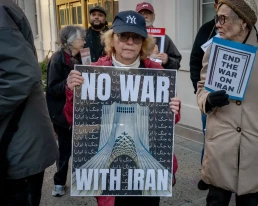
‘Stop The War on Iran’: Brooklyn Peace Activists Urge Jeffries to Help End Conflict
Take Action Now Democrats have a golden opportunity to capitalize on this issue, win big in November, and take real action on AI data centers to…
A Blue Wave Won’t Wash Away Our Oligarchy Problem
Take Action Now The massive election spending by Elon Musk and other billionaires is a huge problem, even if many of the superwealthy’s favorites…

Democrats Should Get Behind a National AI Data Center Moratorium
Take Action Now Democrats have a golden opportunity to capitalize on this issue, win big in November, and take real action on AI data centers to…

Another Way Out: Public Execution Is an Everyday Reality—Livestreamed or Not
Take Action Now For some, the Trump administration’s plan to livestream an execution was unacceptable because it wouldn’t happen behind closed doors……