Elect Democrats to stop MAGA, but don’t surrender progressive accountability. Jeffries’ rejection of Medicare-for-All raises a serious question about who should lead the House.
By Egberto Willies, Egberto Off the Record
Summary
The Democratic Party absolutely needs unity to defeat an increasingly authoritarian Republican Party, but unity cannot become a demand that working people surrender their policy priorities to Washington’s corporate establishment. In the attached exchange, House Democratic Leader Hakeem Jeffries explicitly says he does not currently support Medicare for All, even though he previously co-sponsored Medicare-for-All legislation. That position deserves scrutiny at a moment when progressive economic policies are demonstrating substantial public support.
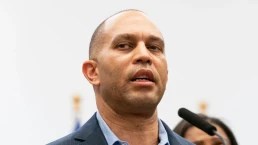
- Jeffries changed course on Medicare for All. He had co-sponsored Medicare-for-All legislation from 2013 through 2021, but after becoming Democratic leader, he stopped doing so and now says he does not support the current legislation.
- The 65% number is defensible, but it needs attribution. A November 2025 Data for Progress survey found 65% of likely voters supported Medicare for All, including 78% of Democrats and 71% of independents. Support remained 63% even after respondents were told it would replace most private insurance, raise taxes, and eliminate most copays and deductibles.
- More recent polling reinforces the broader argument. An August 2026 Reuters/Ipsos poll found 60% of independent registered voters supported government-provided health coverage for all Americans, a policy Reuters explicitly connected to Medicare for All.
- The electorate is moving toward economic populism. Reuters reported that progressive proposals including universal health coverage and higher taxes on corporations and billionaires are winning substantial support among independents—the voters establishment Democrats repeatedly claim require ideological caution.
- Unity must work both ways. Electing Democrats rather than Republicans, while simultaneously insisting that Democratic voters retain the right to demand better leadership after Democrats win power, is essential. That distinction is central: defeating Republicans does not require giving establishment Democrats permanent immunity from accountability.
Democrats should unite to defeat Republicans in November. But after the election, Democratic leaders must understand that voters did not elect them simply to manage an intolerable status quo more politely. A party that claims to represent working people cannot treat universally affordable healthcare as politically inconvenient while protecting a system built around premiums, deductibles, corporate profits, and medical debt.
Premium Content (Complimentary)
Democrats must defeat Republicans in this election. That should not be controversial among anyone who understands the danger posed by an increasingly authoritarian MAGA movement. But Democratic unity cannot mean surrendering every progressive demand to politicians who preach party loyalty while protecting the economic arrangements that continue squeezing working Americans.
That contradiction came into focus when House Democratic Leader Hakeem Jeffries appeared on Meet the Press. Kristen Welker reminded him that he had co-sponsored Medicare-for-All legislation from 2013 through 2021 and asked whether he would put Medicare-for-All to a vote if Democrats regained the House. Jeffries initially avoided the question. When Welker pressed him directly—did he personally support Medicare for All?—his answer was no.
That answer matters.
It matters because Jeffries could become Speaker of the House. It matters because healthcare remains one of the largest financial burdens working families face. And it matters because politicians continue pretending Medicare for All represents some fringe ideological fantasy rejected by ordinary Americans.
The data tell another story.
A November 2025 Data for Progress survey found that 65% of likely voters supported a Medicare-for-All system that would cover every American and replace most private insurance. That included 78% of Democrats, 71% of independents and even 49% of Republicans. When pollsters explicitly informed respondents that Medicare for All would eliminate most private plans, replace premiums with higher taxes, and eliminate most copays and deductibles, support remained at 63%.
That distinction matters because opponents constantly weaponize the word “tax” while hiding what families already pay.
Workers currently pay insurance premiums. Employers divert compensation into health benefits. Families face deductibles before insurance pays much of anything. Patients make copayments and coinsurance payments. Employers and employees alike subsidize an enormous private insurance bureaucracy whose business model requires collecting more money than it pays out.
A rational debate would ask one question: How much does healthcare cost a household in total?
If a universal system replaces premiums, deductibles and many out-of-pocket charges with taxes that leave most families spending less overall, then screaming “tax increase” tells only half the story.
And the political argument that Democrats must retreat toward corporate centrism grows harder to defend with each passing month.
An August 2026 Reuters/Ipsos poll found that 60% of independent registered voters supported government-provided healthcare coverage for all Americans. Reuters explicitly noted that progressives such as Michigan Senate nominee Abdul El-Sayed have advanced that concept as Medicare for All. The same poll found 64% of independents supported increasing taxes on corporations and billionaires.
Those are not numbers from a radical-left convention. Those are independent voters.
Democratic leaders should absorb the lesson.
Voters are not necessarily demanding ideological labels. They are demanding material improvements. They want healthcare they can afford. They want corporations and billionaires to pay more. They want government to work for people who earn wages rather than primarily function as an insurance policy for concentrated wealth.
That does not mean progressives should sabotage Democrats in November. We must explicitly reject that strategy and argue for electing Democrats because the Republican alternative would be worse.
But unity cannot be a one-way street.
Democratic voters can elect Jeffries to Congress while still concluding that he should not become Speaker unless his agenda reflects the economic transformation voters increasingly demand.
The Democratic establishment often tells progressives to compromise for the good of the coalition. Fair enough. But establishment Democrats must compromise too.
If leaders remain unwilling to execute the popular will because corporate donors, insurers, pharmaceutical companies, or conventional Washington wisdom object, then those leaders should step aside.
This election requires unity.
The government that follows must require something more: courage.
Recent Posts

Decoding Pro-Israel Buzzwords in a Time of Genocide
Take Action Now Support for Israel has declined steeply among Americans, but its defenders continue to maintain a siege of buzzwords against…
Tax the Rich and Slash the Military Budget
Take Action Now The Left is often asked how it proposes to pay for programs like universal childcare, Medicare or All, and a green jobs program.…

Israeli Mob Beats Washington Post Journalist, Burns Olive Trees In West Bank
Take Action Now “They just kept kicking me and kicking me,” photojournalist Heidi Levine recalled from a hospital bed after the attack.By Ryan…

Take Action October 20 to End the Illegal U.S.-Israeli War on Iran, #PeaceWithIranNOW
Take Action Now The war is not just illegal, but massively unpopular with the U.S. public, and Trump and his Republican enablers may take a deserved…