
Picasso’s monumental anti-war mural uses cubism and historical tragedy to empower the public against totalitarianism and creative oppression
By Hannah Gemeny, Mutual Art
Pablo Picasso lived a rich life spanning the late 19th century to the end of his life in the 1970s. Through this time, countless historical events took place, applying mountains of pressure on the very fabric of society. Artists like Picasso were influenced by this never-ending storm of chaos, enduring both world wars, and the ever-evolving technology that permeated our world. It is no wonder why Picasso’s Guernica remains one of the most chilling and influential anti-war paintings in history.
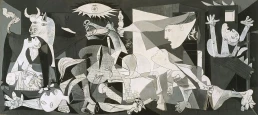
The oil painting stands over eleven feet tall and is over twenty-five feet long (roughly 3.49 meters by 7.76 meters). Unlike some of Picasso’s other well-known paintings, it is monochromatic, relying on varying grey, black, and white values. The painting’s composition is quintessential cubism, relying on geometric shapes and abstractions. While most of the canvas is filled with distorted figures there are several identifiable symbols: a sun, a lightbulb, a bull, and a horse. Guernica has been reproduced over the years, including a mural in the town of Guernica itself. The tiled wall adds much more texture to the piece than the original painted canvas. This is made apparent by the gridded lines running through the composition; the painting becomes a puzzle of assorted pieces, organizing the chaos into comprehensive segments.
It is impossible not to speak of Guernica by just grazing the surface. The painting is rich with historical context. Guernica is the Spanish spelling of the town Guernika, a town in the province of Biscay. The community is extremely small, a slice of a principality within the Basque country (a somewhat autonomous region of Northern Spain). Guernica fell victim to a massive bombing as a result of a civil war in 1937. Air forces decimated the land, commanded by Nationalist and dictator Francisco Franco.
Pablo Picasso was in Paris when he discovered what had happened to this small town. As a man born in Spain, one can only imagine what he must have felt upon reading the news. Interestingly, this added distance had an influence on the work. One could argue that this would be a detriment; he wasn’t there when it happened, how could Picasso encapsulate the raw emotion and carnage? The painting answers that and more. The monochrome colors become not just a tone of horror and distraught, but also present the image as a historic news piece. Like a war photographer, he goes beyond reporting and deep into the dread and despair of the moment.
When asked what an artist is, Picasso famously responded:
“He is a political being, constantly aware of the heart breaking, passionate, or delightful things that happen in the world, shaping himself completely in their image. Painting is not done to decorate apartments. It is an instrument of war.”
Recent Posts
Decoding Pro-Israel Buzzwords in a Time of Genocide
Take Action Now Support for Israel has declined steeply among Americans, but its defenders continue to maintain a siege of buzzwords against…
Tax the Rich and Slash the Military Budget
Take Action Now The Left is often asked how it proposes to pay for programs like universal childcare, Medicare or All, and a green jobs program.…
Israeli Mob Beats Washington Post Journalist, Burns Olive Trees In West Bank
Take Action Now “They just kept kicking me and kicking me,” photojournalist Heidi Levine recalled from a hospital bed after the attack.By Ryan…
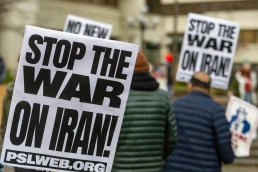
Take Action October 20 to End the Illegal U.S.-Israeli War on Iran, #PeaceWithIranNOW
Take Action Now The war is not just illegal, but massively unpopular with the U.S. public, and Trump and his Republican enablers may take a deserved…