
As Trump threatens Iran yet again, Congress continues to abdicate its responsibility to rein in war.
By Hanieh Jodat, Truthout
As Iranians rise in protest, Donald Trump’s rhetoric has become a study in contradictions. One day, he threatens “very strong action” against the Islamic Republic to defend Iranian protesters; the next, he praises the very regime he condemned and suggests the possibility of negotiations. His language and behavior are driven by self-interest, not genuine concern for the Iranian people. This theatrical show of menace and bravado is a calculated move, shaped by political ambition, military considerations, and the shifting tides of his support base. While Trump performs on the world stage, ordinary Iranians are left to face the consequences. Parents search mortuaries and hospitals for their loved ones, their grief and struggle reduced to the backdrop of a geopolitical drama.
The protests, which began on December 28, erupted in Tehran’s Grand Bazaar and rapidly spread across the country. While these protests have been organic, they are not spontaneous. They have been fueled by economic collapse: Iran’s currency has lost close to 90 percent of its value against the dollar in a year, and inflation is skyrocketing. People from all income groups and generations joined in, making a variety of demands that increasingly included the downfall of Iran’s current regime.

Iran’s uprising was met with brutality by the government, which shut down communications and cut Iranians off from the outside world. The strategy was not only to stop the protests, but to erase them from public view.
The human costs of these protests have been catastrophic. Across Iran, morgues and mortuaries have overflowed with the number of dead bodies, and hospitals have been collapsing under the weight of injuries. Trucks carrying body bags have been turned away and abandoned at gates, as facilities ran out of space to hold the deceased. The estimated number of casualties has varied substantially due to internet shutdowns. According to the Iranian government, more than 3,000 people have been killed, while the Human Rights Activists News Agency has verified over 6,000 deaths. Ongoing investigations into an additional 17,000 cases could raise the death toll substantially. Meanwhile, according to Amnesty International, tens of thousands of people, including children, have been detained by Iranian authorities.
Amid the crackdown, Washington has drifted into an all-too-familiar and dangerous posture, one that threatens war and bloodshed at the cost of Iranian lives. At the beginning of the protests, Donald Trump warned Iran’s government that if there were casualties, he would send “help” to Iranians in the form of “very strong action.” Yet just a few days later, he commended Iran’s government for ostensibly stopping a spate of executions while raising the possibility of diplomatic talks.
While Washington sends these mixed rhetorical signals, outlets including Al Jazeera and Reuters have continued to report on U.S. military assets being repositioned in the Middle East, allies placed on heightened alert, and American personnel being withdrawn from some locations. Additionally, the U.S. has begun moving a massive armada, led by carrier USS Abraham Lincoln, towards Iran. This naval operation adds roughly 5,000 additional troops to the region, where more than 30,000 American servicemembers are already stationed. This development comes as Trump has vowed that Iran’s resistance to come to the negotiating table over the nuclear program could provoke an attack “far worse” than the previous strike.
Recent Posts
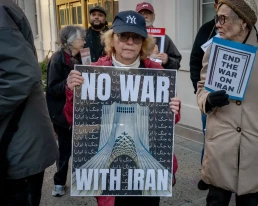
‘Stop The War on Iran’: Brooklyn Peace Activists Urge Jeffries to Help End Conflict
Take Action Now Democrats have a golden opportunity to capitalize on this issue, win big in November, and take real action on AI data centers to…

A Blue Wave Won’t Wash Away Our Oligarchy Problem
Take Action Now The massive election spending by Elon Musk and other billionaires is a huge problem, even if many of the superwealthy’s favorites…

Democrats Should Get Behind a National AI Data Center Moratorium
Take Action Now Democrats have a golden opportunity to capitalize on this issue, win big in November, and take real action on AI data centers to…

Another Way Out: Public Execution Is an Everyday Reality—Livestreamed or Not
Take Action Now For some, the Trump administration’s plan to livestream an execution was unacceptable because it wouldn’t happen behind closed doors……