An in-depth discussion with Jeremy Brecher on the strategy, potential, and challenges of mass social strikes following the Minnesota ICE murder
By , Z Network
As authoritarian politics harden in the United States, familiar channels of resistance are proving dangerously inadequate. Elections are constrained, courts are under siege, and dissent is increasingly met with repression in the streets. In this moment, questions of power — who has it, how it is exercised, and how it can be withdrawn — are no longer abstract. They are immediate and practical. Labor historian and longtime organizer Jeremy Brecher has spent decades grappling with these questions, and in a recent series of reports, culminating in “Social Strikes: Can General Strikes, Mass Strikes, and People Power Uprisings Provide a Last Defense Against MAGA Tyranny?,” he argues that large-scale noncooperation may be one of the few strategies capable of halting an authoritarian slide.
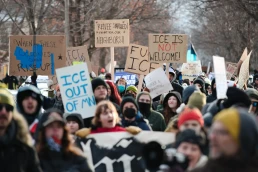
From escalating resistance to ICE to a growing call for a Jan. 23 Minnesota shutdown following the killing of Renée Nicole Good, forms of mass refusal — to work, to comply, to carry on as usual — are moving from theory into practice. Drawing on historical examples of people power uprisings and on his recent work examining how general strikes and broader “social strikes” are built, in this conversation Brecher reflects on where the U.S. is now, what conditions make such actions possible, and what strategic groundwork is required to turn diffuse outrage into sustained, democratic power.
This interview is co-published by ZNetwork.org, Waging Nonviolence, and the Labor Network for Sustainability.
Could you give a definition of what you mean by social strikes?
Social strike is a broad term that encompasses a wide range of activities that use the withdrawal of cooperation and mass disruption to affect governments and social structures. I use the term “social strikes” to describe mass actions that exercise power by withdrawing cooperation from and disrupting the operation of society. Social strikes represent the withdrawal of cooperation and acquiescence by a whole society, manifested for example in general strikes, political strikes and mass popular “people power” uprisings. The goal of a social strike is to affect not just the immediate employer, but a political regime or social structure. In all their varied forms they are based on Gandhi’s fundamental perception that “even the most powerful cannot rule without the cooperation of the ruled.”
Why is this a winning strategy, and as you put it, a “defense against MAGA tyranny”?
The power of the powerful ultimately depends on the acquiescence and cooperation of those they rule. Social strikes have been one way that people have exercised the power to withdraw that acquiescence and cooperation.
Social strikes provide a possible alternative when institutional means of action prove ineffective. In many countries, where democratic institutions have been so weakened or obliterated that they are unable to disempower tyranny, such methods have been used effectively. My report on “Social Strikes” recounts examples that have brought down tyrannical regimes in Poland, the Philippines, Brazil, Puerto Rico, and most recently South Korea. These large-scale nonviolent direct actions — often referred to as “people power” uprisings — made society ungovernable and led to regime change. In all these cases, popular mobilization and the threat of general social disruption were so great that the autocrat’s supporters abandoned or turned against him and forced him to resign.
Of course there are no guarantees that social strikes can win in the U.S. today or in any other situation. But as MAGA tyranny drives more and more individuals, constituencies and institutions into opposition, its power is being progressively undermined. Historical experience around the world has shown social strikes are a powerful means to manifest that withdrawal of acquiescence and the refusal of the people to cooperate. Indeed, widespread forms of mass resistance like the Tesla and other boycotts, the No Kings Day-type national protests, and the on-the-ground resistance to ICE are already hamstringing the Trump administration’s freedom of action. Social strikes would represent a significant intensification of what I have called “social self-defense” against Trumpian tyranny. They have the potential both to further impede MAGA depredations and to contest for support from the majority of the population.
Recent Posts

Congress Finally Passed a Housing Bill. It Isn’t Enough.
Take Action Now The ROAD to Housing Act fails to address the commodification of housing driving our affordability crisis.By Layla Sayed and Logan…

Trump EPA Aims to Exempt Data Centers from Disclosing Air Pollution, Advocates Warn
Take Action Now Trump administration proposes new rule to dismantle requirement for datacenters to publicly report air pollutionTom Perkins, The…
An Important But Limited Win Against Data Centers in Pennsylvania
Take Action Now The order removes all AI data center proposals from the state’s fast-track permitting process and prohibits the use of nondisclosure…

‘Lawless Killing Spree at Sea Resumes’ as U.S. Announces Fresh Boat Bombings
Take Action Now With the latest two casualties, the Trump administration’s boat bombing spree has now claimed the lives of at least 223 people.…