
By Astra Taylor, The Guardian
Since campaign season began, experts have assured us that Donald Trump had “no ground game”, a phrase that generally refers to a campaign’s effort to mobilize voters through local outreach offices, phone calls, text messages, and door knocks. Pundits, politicos, and partisan observers repeated this charge and scoffed at his ramshackle, amateur, and fraud-riddled efforts, with some seasoned Republican operatives even sounding the alarm.
A slew of articles and commentary unfavorably compared Trump’s “paltry” get-out-the-vote operation to the Democrats’ supposedly well-oiled and professionally managed machine. Alex Floyd, the Democratic national committee’s rapid response director, issued a confident statement in April: “Donald Trump’s Maga takeover of the [Republican national committee] has left the Republican party in shambles, lacking the ground game and infrastructure to compete this November.”
We all know how that story ended.
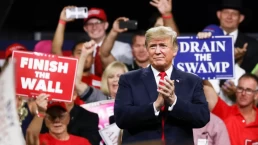
And yet many Democrats remain reluctant to reassess their views, both of Trump’s ground game and, perhaps more importantly, of their own. Soon after the election, Tom O’Brien, chair of the Democratic party in Lancaster county, Pennsylvania, told the New York Times that Republicans “really didn’t have a ground game”. The Democratic strategist Christy Setzer went further, telling the Hill that “Trump had no ground game and ran only on rambling hatred”, while insisting that the loss “wasn’t the fault of Kamala Harris”, who had “the best campaign any of us has ever seen”. But if that’s true, why did Trump succeed where Harris failed?
Trump succeeded, at least in part, because he is a man who will say anything and do anything to win. And of course he was boosted by conservative media – by Fox News talkshows, conspiratorial podcasts, manosphere influencers, deceptive deepfakes, targeted ads, and “First Buddy” Elon Musk’s transformation of Twitter into X. But he also won because he had a strong ground game, even if it occasionally blundered and often looked different from what observers and experts expected from a get-out-the vote drive, including its use of “untraditional” and “micro-targeted” strategies aimed at reaching low- and mid-propensity voters who didn’t fit the usual Republican profile, including Latinos, Black men, and Asian and Arab Americans. The rocky launch of Musk’s new political action committee, America Pac, which hired canvassers in key areas, became a punchline, but it was last-minute outreach that supplemented other efforts. (And America Pac is no joke: Musk has invested $120m in the project and is already planning for the 2026 midterms and beyond.)
Recent Posts
Tyrant Trump Is Lucky in the Cowardice of His Enemies
Take Action Now Democratic leadership’s refusal to pursue impeachment signals to Trump that he has two-plus unchallenged years to ravage the lives…
The Consequence of Lost Voting Rights Will be Massive Acts of State Violence
Take Action Now The death-cult mentality of US fascism has stumbled upon an ingenious epiphany – the tepid commitment of American voters can be…
Democratic Voters Say They Want Change, But the Party Just Elevated More Hawks
Take Action Now Party leaders are ignoring the three-quarters of registered Democrats who oppose providing military aid to Israel.By Stephen…

The U.S. Bombed a Wedding in Iran. It’s Not the First Time
Take Action Now The Iranian Red Crescent Society has asked the International Criminal Court to investigate the U.S. strike, saying that if the…