
By Ahmed Nabil, Foreign Policy In Focus
Donald Trump’s victory in the presidential elections on November 5 wasn’t good news for most professionals who work in international security. The return of Trump means not only the return of populism to the U.S. foreign policy but also the resumption of an unpredictable foreign policy that could lead to wars.
Although there is no consensus on the exact influence of populism, scholars agree on the baseline that populist leaders watch world order with distrust as a hostile place. They prioritize what they see as the “people’s interest” and anti-elite policies. Trump, as a role model of the populist leader, has promoted policies of economic protectionism, anti-immigration, and unilateralism. These policies are attached to features such as uncertainty and distrust of the foreign policy institutions. This combination may lead to risky situations in today’s anarchic world order.
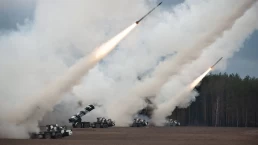
Trump’s past record serves as a guide to his future conduct.
On June 6, 2017, for instance, Trump tweeted to support the blockade that the Arab quartet (Saudi Arabia, Egypt, UAE, and Bahrain) had imposed on Qatar for supposedly supporting terrorism. On the same day, the State Department spokesperson didn’t adopt Trump’s position and recognized the Qatari efforts to counter terrorism. Another official talked anonymously to the media to deny that the United States took sides in this crisis. It gradually became clear that State Department, the Department of Defense, and other foreign policy institutions didn’t share Trump’s view on the Arab rift. They also worked hard to change Trump’s position to end this rift as it harmed the U.S. strategic interest and impeded regional Gulf cooperation to face the Iranian threat.
Trump clearly doesn’t consult his foreign policy advisors before expressing his initial responses to international affairs publicly. Trump also may change his position afterward; hence international parties must be cautious about his messages on U.S. policy to avoid misleading impressions.
Trump’s approach didn’t evolve over the course of his first term. On October 24, 2020, Trump called the Sudanese prime minister to congratulate him on the normalization of relations between Sudan and Israel. Trump raised an unexpected topic during this call which was the trilateral dispute between Egypt, Ethiopia, and Sudan on the building of the Ethiopian Grand Renaissance Dam (GERD.) He suggested that Egypt might “blow up” the GERD if there were no solution to this dispute. Trump’s administration was frustrated after the last-minute Ethiopian withdrawal from the negotiations brokered by the U.S. secretary of treasury in February 2020 to reach an agreement on the Blue Nile water share. Ethiopia accused Trump of inciting war. This is another example of how Trump has sent dangerous messages internationally.
Recent Posts

Ed Sheeran’s Craven “Neutrality” Is a Watershed Moment for Mainstreaming Palestine Solidarity
Take Action Now Ed Sheeran’s entire tour quitting in solidarity with Palestine and Macklemore proves the logic of BDS.By Natasha Lennard, The…
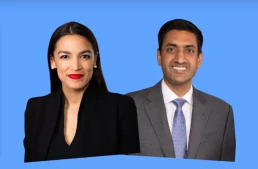
Why Ro Khanna and AOC Should Run for President in 2028
Take Action Now This week, RootsAction teamed up with Progressive Democrats of America to announce that we will jointly launch, just after the…
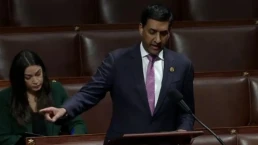
‘Proven Leaders and Voices of Clarity’: Progressives Urge Ocasio-Cortez and Khanna to Enter 2028 Presidential Race
Take Action Now “AOC and Khanna… have shown a willingness to blaze unusual and much-needed trails on Capitol Hill beyond the constraints of the…

‘Hit the Brakes’: Anthropic CEO’s Push to ‘Pace’ AI Development Called Latest Sign Congress Must Act
Take Action Now “When the future of humanity is at stake we need a PAUSE on advanced AI development and a ban on artificial superintelligence,” said…