
The Biden administration is right to resist calls to deepen American military involvement in Ukraine. No one wins that game.
By Tom Z. Collina, The New York Times
In his stirring address to Congress on Wednesday, President Volodymyr Zelensky of Ukraine asked the United States for more help as his nation defends itself against a brutal and unjustified Russian invasion. Invoking the attacks on Pearl Harbor and the World Trade Center, Mr. Zelensky said simply, “I call on you to do more.”
Given the stakes, the United States can and should do more to end the war and help alleviate human suffering in Ukraine. We were already providing weapons for the Ukrainians to defend themselves, such as Stinger antiaircraft missiles and Javelin antitank missiles, as well as hitting Russia with huge economic sanctions. And soon after Mr. Zelensky’s speech, President Biden announced that the United States would send an additional $800 million in military assistance to Ukraine, as part of a $14 billion support package he had already approved.

But there is a limit to how far we should go. Even as our hearts go out to the brave Ukrainian people, the Biden administration is right to resist calls to deepen American military involvement in Ukraine, because the consequences of a direct confrontation between NATO and Russia could be unimaginably dire. If Mr. Biden bows to public pressure and, for instance, attempts to create a no-fly zone in Ukraine, we could be stepping on the path to nuclear war. As the U.N. secretary general, António Guterres, said this week, “The prospect of nuclear conflict, once unthinkable, is now back within the realm of possibility.”
A product of the Cold War, Mr. Biden well understands that direct U.S.-Russian conflict could escalate to nuclear war. The Soviet Union may have disappeared 30 years ago, but its nuclear weapons did not, and neither did ours. If they are used, the consequences would be horrific — instant death for people in the immediate blast area followed by environmental destruction, possible famine and more death as the radiation spread. It could mean the end of civilization as we know it.
The Biden administration is keenly aware of the risks. Mr. Biden said on March 11: “We will not fight a war against Russia in Ukraine. Direct conflict between NATO and Russia is World War III, something we must strive to prevent.” The administration has rightly ruled out sending U.S. troops to Ukraine for now, sending them instead to NATO states, which the administration has vowed to defend. And Mr. Biden has wisely refused to consider anything that might provoke direct conflict with Russia, not only rejecting a no-fly zone but also resisting a Polish offer to provide Soviet-era MIG fighter jets to Ukraine.
But as the humanitarian toll in Ukraine increases, so, too, will the pressure to do more. For many here in the United States, it will be deeply frustrating that the threat of nuclear war limits what we do. President Vladimir Putin of Russia warned that “anyone who tries to interfere with us” will suffer “consequences you have never faced in your history.” He is, in effect, using his nuclear arsenal as a terrorist weapon to hold Ukraine hostage and keep other nations out. Is he bluffing? Maybe. But given the potential consequences, we can’t afford to be wrong.
What can we do? First, we must stay the course and end this brutal war. The sanctions that have already been imposed on Russia and the weapons that the Pentagon is sending to Ukraine are meant to raise the cost of the conflict to Mr. Putin, so that he will eventually see the wisdom of a political settlement. Both of those efforts must go on while the White House continues to avoid direct conflict between NATO and Russian troops. The longer the war lasts, the more painful it will become for both sides. As difficult as it may be to watch as Ukraine suffers, escalating the war could make it much worse.
Next, we must change our attitude toward nuclear weapons, understanding that the old ways of thinking are not only outdated but also dangerous. The U.S. nuclear arsenal does nothing for us in this conflict. It did not keep Mr. Putin out of Ukraine. Because he is willing to use the threat of nuclear war to deter intervention in Ukraine, the existence of nuclear weapons, if anything, helped enable him. He is the only one suggesting a willingness to use nukes as a cover to brutalize weaker states. We must continue to stigmatize and limit nuclear weapons to reduce the chances that Russia will do this again.
The Biden administration can help by changing its nuclear policies accordingly. Mr. Putin is threatening to use nuclear weapons first in this conflict. The Biden administration should rule out first use and seek to build an international consensus around the idea that the sole purpose for nuclear weapons is to deter their use by others. Mr. Biden has supported this position for years. In addition, the United States should start now to build international support for the deep reduction and eventual elimination of nuclear weapons so they cannot be used by strongmen and autocrats to enable their atrocities.
Recent Posts
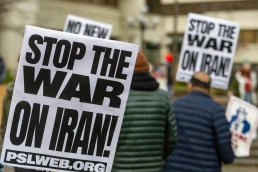
Take Action October 20 to End the Illegal U.S.-Israeli War on Iran, #PeaceWithIranNOW
Take Action Now The war is not just illegal, but massively unpopular with the U.S. public, and Trump and his Republican enablers may take a deserved…

Chuck Schumer Hasn’t Said a Word About Trump’s Attempt to Deport Ilhan Omar
Take Action Now Ethics lawyers say the raid violated the Hatch Act. Schumer has been silent.By Sharon Zhang , Truthout Days after the Trump…

“Propaganda Show”: IDF Raids Palestinian NGOs in the West Bank Ahead of Israeli Elections
Take Action Now “The raid onto the city center Ramallah is not a lonely activity. It happens every day that they raid different villages,…

ICE Planning $100 Million ‘Nightmare’ Domestic Spy Program
Take Action Now Under ERO ONE, Immigration and Customs Enforcement plans to hire 142 intelligence contractors with top secret clearances and deploy…