
There will surely be turf wars and palace intrigue within the administration, but there is little reason to think that its core figures will fracture in the pursuit of their basic goal: to break the twentieth-century state.
By Daniel Luban, Dissent
The onslaught of the first weeks of Donald Trump’s second term was predictable, if no less unsettling for that. It was always clear that the goal was to overwhelm the opposition with a blitzkrieg of executive action—“flood the zone” and “shock and awe” were the terms floated by Trump’s allies—before momentum bogged down in Congress and the courts. On a psychological level it has been effective. On the question of long-term institutional success, the answer is murkier.
The most surprising element has been the leading role played by Elon Musk’s Department of Government Efficiency (DOGE), which has been the tip of the spear in the war against the federal government. Prior to the inauguration, smart money held that DOGE would be more bark than bite, a glorified blue-ribbon commission designed as a safe landing spot for an important but volatile Trump ally. It has been apparent that DOGE would be something far more significant since news broke at the beginning of February that Musk’s team had gained access to the Treasury Department’s payments system. In exchange for over $250 million in campaign contributions, Musk may have purchased de facto fiscal sovereignty over the U.S. government—even if the scope and durability of DOGE’s cuts remain uncertain.
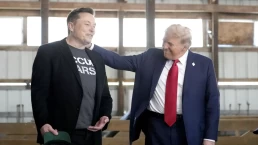
Musk’s unexpected prominence within the administration is only the most visible symbol of the much-discussed emergence of the “tech right.” In recent months, a great deal of commentary has focused on the supposed split between this cohort and the older MAGA populists. Dissension spilled into public view in late December with a dispute over H-1B visas for high-skilled immigrant workers. Musk and his allies won that battle to keep the program intact, although Vivek Ramaswamy’s impolitic comments about the laziness of American-born workers helped trigger his ouster as co-head of DOGE. More recently, Trump’s former advisor Steve Bannon has taken to the airwaves as an outspoken champion of the populists and scourge of the techies. The two camps laid out their narratives in dueling New York Times podcast interviews with Bannon and venture capitalist Marc Andreessen (who, unlike Bannon, was eager to downplay any enmity).
Trump’s opponents have an understandable desire to find internal fissures within his administration. And here the contrasts write themselves: Middle America versus Silicon Valley, workers versus billionaires, protectionism versus libertarianism, Fordist nostalgia versus Promethean futurism. These contrasts speak to some real tensions, above all between the predatory capitalism of Trump’s policy agenda and the class composition of his electoral coalition.
But an exclusive focus on fissures can cause us to lose sight of what binds the administration together. For most of the key figures slotted into one or the other camp share a deep set of personal connections and ideological commonalities. And the notion that Musk and the tech right represents a sharp break from true MAGA populism rests on a misunderstanding about what MAGA has been from the beginning.
Recent Posts

AI Doesn’t Need ‘Superintelligence’ or Evil Intent to Start a Nuclear War
Take Action Now Neither extraordinary machine intelligence nor malicious intent is required for catastrophe to result.By Paul Slovic and Herbert…
30 Months After Uproar Over Jonathan Glazer’s Oscar Speech, What Do His Pro-Israel Denouncers Say Now?
Take Action Now Given all that has happened, I recently contacted some signers of the open letter to ask whether they still fully believe in its…

Midterms Have Revived Universal Healthcare Debate. These States Are Ahead of Everyone.
Take Action Now States have often served as laboratories to test health policies later implemented nationally.By Markian Hawryluk, KFF Health……
Nobel Peace Prize Turns Toward Peace in 2026
Take Action Now To have finally acknowledged someone whose work in any way addressed the horrors of Zionism is an encouraging sign from the Nobel…