
The president’s latest salvo against the Constitution shouldn’t survive the judiciary’s scrutiny. But these days, you never know.
By Matt Ford, The New Republic
The president of the United States does not have the lawful power to end birthright citizenship. That did not stop President Donald Trump from trying to do just that in one of his first executive orders on Inauguration Day. The order itself is strangely written—partly out of necessity and partly out of ideology. If the Constitution’s words still matter, it will fail in the federal courts.
The order, titled “Protecting the Meaning and Value of American Citizenship,” seeks to redefine the Fourteenth Amendment. The amendment’s language on citizenship is straightforward: “All persons born or naturalized in the United States, and subject to the jurisdiction thereof, are citizens of the United States and of the State wherein they reside.” The “subject to the jurisdiction” exception is typically taken to mean the children of foreign diplomats.
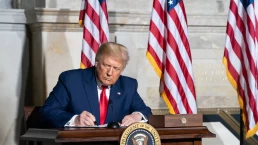
In the Trump administration’s telling, however, everyone’s been getting it all wrong for the last 150 years. “The Fourteenth Amendment has always excluded from birthright citizenship persons who were born in the United States but not ‘subject to the jurisdiction thereof,’” the order stated. “Consistent with this understanding, the Congress has further specified through legislation that ‘a person born in the United States, and subject to the jurisdiction thereof’ is a national and citizen of the United States at birth.” Accordingly, it laid out additional categories of American-born citizens whom it hopes to exclude.
The first and most important thing to note about the order is that it is not retroactive. Nobody currently living in the United States is affected by it at this moment, no matter their parentage or lawful presence. Instead, it says that it “shall apply only to persons who are born within the United States after 30 days from the date of this order.” In other words, the first children affected by it will be born on or after February 19.
From there, the order says it applies to any child whose mother “was unlawfully present in the United States” or “whose mother’s presence in the United States was lawful but temporary,” so long as the father is also neither a U.S. citizen nor someone with lawful permanent status. In other words, a child born to at least one parent with lawful permanent residence or U.S. citizenship would be unaffected by its restrictions. (The emphasis on the mother’s presence may be meant for cases where a father is not listed on birth records.)
Recent Posts

“Propaganda Show”: IDF Raids Palestinian NGOs in the West Bank Ahead of Israeli Elections
Take Action Now “The raid onto the city center Ramallah is not a lonely activity. It happens every day that they raid different villages,…
ICE Planning $100 Million ‘Nightmare’ Domestic Spy Program
Take Action Now Under ERO ONE, Immigration and Customs Enforcement plans to hire 142 intelligence contractors with top secret clearances and deploy…
Postpone the AI Public Offerings Until Congress Acts
Take Action Now A company should not disclose a risk of catastrophe to humanity and then sell its shares to the public before any public authority…
Congress Has The Power to Fix the Trump-Saudi Nuclear Deal
Take Action Now Congress has at least 9 months and considerable leverage to make things right.By Alan J. Kuperman, Bulletin of the Atomic…