Two proposals—one in California, one in Congress—could finally do it. The alternative is an ever-more-powerful billionaire class that threatens democracy itself.
By Conor Lynch, In These Times
Last year’s Republican tax bill, the self-styled Big Beautiful Bill, continued a decades‑long trend in which the top 1% have seen their tax burdens decline steadily from the high levels of the mid-20th century.
Since tax-cutting became the raison d’être of the Republican Party in the 1980s, the tax rate paid by the richest Americans has fallen sharply. According to research by economists Gabriel Zucman and Emmanuel Saez, during the postwar era — when top marginal income tax rates hovered between 70% and 91%, and the statutory rate on corporate profits ranged from 48% to 52% — the wealthiest households paid an effective rate of around 50%. Today, they pay about half that.
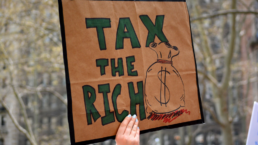
The further up the economic pyramid one goes, the more the effective tax rate tends to decline. In a paper published last summer, Zucman and Saez found that the total effective tax rate paid by the 400 richest Americans now averages 23.8% — down from an already low 30% before the Trump tax cuts were first passed in 2018. In addition to lower marginal income tax rates, the drop in the corporate tax to its lowest level since before World War II cut the top four hundred’s tax payments by roughly one‑third.
The richest of America’s oligarchs — Elon Musk, Larry Ellison, Mark Zuckerberg, Jeff Bezos — typically pay the lowest rates of all, often going years without paying a single dollar in any income taxes.
While declining tax rates for the top 1% largely reflect forty years of Republican tax cuts and other policy changes, members of the top 0.01% like Musk and Zuckerberg avoid paying taxes because most of their actual income comes from asset appreciation, which is un-taxable as long as gains remain unofficial. The so-called realization requirement is what enables the ultrarich to pay hardly any taxes even as their paper net worth soars into the stratosphere. Instead of selling assets to fund their lavish lifestyles, many billionaires simply take out non-taxable loans against their appreciating assets, following the “buy, borrow, die” strategy that was first spotlighted by ProPublica in 2021.
Recent Posts
DNC Shoots Down Resolutions Calling Out AIPAC and Limiting Arms to Israel
Take Action Now The party just kicked the can down the road again on Israel, deepening the divide between party members and their leaders.By Matt…

Tax Day 2026: The Average Taxpayer Paid $4,049 for War and Weapons
Take Action Now Wars don’t just cost taxpayers at the pump. Here’s what the average taxpayer spent for different priorities in 2025By…

Bombshell Report Reveals Trump Was Begging for Iran to Join Ceasefire
Take Action Now This contradicts everything the president has said about the war.By Malcolm Ferguson, The New Republic Recent reporting from the…

Massive Israeli Assault on Lebanon Threatens U.S.-Iran Ceasefire
Take Action Now Over 250 people were killed in what the Israeli military said was the “largest coordinated strike” on Lebanon since March 2.By…