
The 2026 World Cup has become a rebuke to Trump’s homogeneous vision of America, revealing a tournament – and a US team – shaped by migration and diversity
By , The Guardian
Following the Department of Homeland Security on social media is a bit like wandering through a casino at 4am. Sooner or later, you’ll see something that makes you go: How did we get here?
There was one of those moments earlier this month. Days after the US opened their World Cup campaign with a 4-1 romp over Paraguay, DHS marked the occasion by posting an image of Chris Richards, Sergiño Dest and Folarin Balogun exulting beneath the headline “DEFEND THE HOMELAND” and the caption “OUR SOIL”.
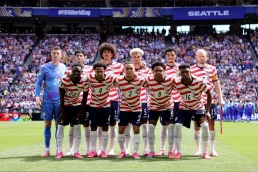
The irony of the message – posted on the emancipation holiday Juneteenth, of all days – was unmissable. The same department that turned back a leading referee from Somalia, that has kept Iran’s players on a day-to-day visa footing in this tournament, that has in effect tried to sabotage the conditions under which this World Cup takes place, now finds itself reveling in it.
The same administration that is currently mounting a hare-brained challenge to the 14th Amendment in the Supreme Court is making American exemplars of Dest, a Netherlands-born Brooklynite; Richards, a military brat raised in Europe; and Balogun, the British Nigerian who owes his American passport to birthright citizenship. Indeed, World Cup fever appears to have overcome the Make America Great Again crowd. It can only end in disappointment.
That’s not a knock on the USMNT, who, despite a 3–2 loss to Turkey on Thursday, have advanced to play Bosnia and Herzegovina in a last-32 matchup next Wednesday. It’s to say that Americans who loudly dismiss soccer as a “sissy sport” real sports fans couldn’t care less about, and then jump on the bandwagon when momentum shifts, have long had the wrong idea about the World Cup. To them, the tournament is simply another arena to project an image of American strength. What they struggle to appreciate is that the same tournament that presents itself as a contest between monolithic nation-states is, in truth, a monument to global migration.
It isn’t just the USMNT who resist the jingoistic framing. The Netherlands’ nine goals in the tournament so far have been scored or assisted by players of African or Indonesian descent. Belgium’s roster is stuffed with sons of Congolese, Senegalese and Ghanaian immigrants who face racist abuse whenever they thwart expectations. The face of Spain’s national team is Lamine Yamal – a ridiculously gifted teenager who proudly touts his Moroccan and Equatoguinean ancestry, and is hardly an outlier in an increasingly global squad. France, despite pushback from extremist corners, have tripled down on the Black-Blanc-Beur experiment that netted World Cup triumphs for Les Bleus in 1998 and 2018.
A good portion of England’s players, it seems, could have opted to play for Ireland or countries in Africa or the Caribbean. That depth, in turn, is part of what allowed the USMNT to land a fine young striker in Balogun – who was born in New York and bypassed US residency and the grassroots soccer pipeline on his way to becoming the team’s leading scorer at this tournament.
If anything, the USMNT’s commanding start pales in comparison to the real story of the tournament: the power of the diaspora. During England’s match with Ghana, fans on social media said the quiet part out loud – that no game between colonizer and former colony can ever be “just a game”. Morocco, South Africa, Côte d’Ivoire, Cape Verde (!) and possibly Senegal advancing to the round of 32 is yet more confirmation of the extraordinary talent flowing from Africa into Europe’s top leagues.
Even DHS policies that have restricted travel to the US for the World Cup have ended up revealing the rich diversity already within its borders: Haitian, Congolese and Cape Verdean fans overwhelming stadiums in Philadelphia, Houston and Miami, flags flying proudly in the stands. I was minding my business in downtown Atlanta on Wednesday when I ran into a horde of Morocco fans pregaming before their match against Haiti – and judging from their numbers and the sprinkling of American accents, there was no chance all of them crossed the Atlantic for the occasion.
Recent Posts

Midterms Have Revived Universal Healthcare Debate. These States Are Ahead of Everyone.
Take Action Now States have often served as laboratories to test health policies later implemented nationally.By Markian Hawryluk, KFF Health……
Nobel Peace Prize Turns Toward Peace in 2026
Take Action Now To have finally acknowledged someone whose work in any way addressed the horrors of Zionism is an encouraging sign from the Nobel…

64 Groups to Congress: Start Preparing Tough and Effective Oversight Right Now
Take Action Now The question is not whether the public wants accountability, but whether Congress can conduct the meaningful oversight that exposes…
“Abolish ICE”: Protests Erupt in NYC After ICE Agents Shoot Father With 5-Year-Old Son in Car
Take Action Now “Candidates should seek support from the AI industry at their own peril.”By Amy Goodman, Darializa Avila Chevalier, and Carmen De…