
Lawsuits by an oil giant and Cuban-American hardliners could help corporate interests recoup hundreds of millions in expropriated Cuban assets if Trump delivers regime change.
By Blake Burdge, The Lever
As President Donald Trump gestures towards regime change in Cuba, the U.S. Supreme Court, with Trump’s urging, has agreed to hear lawsuits that could help corporate interests recoup hundreds of millions of dollars in long-expropriated Cuban assets if the United States seizes control of the nation.
One of those lawsuits involves an oil giant claiming damages from Cuban companies for decades-old revolutionary asset seizures. The other, which one of the plaintiffs calls the most important Supreme Court case on Cuba “in the past sixty years,” involves the scion of a fascist-friendly corporate empire who’s taken credit for Trump’s hardline stance on Cuba and is seeking compensation for a 122-year-old expired pier contract.
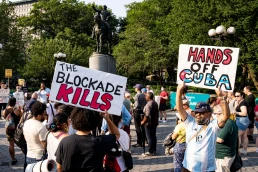
Together, they build on long-dormant anti-Cuban foreign policy weaponized by Trump and push the court to extend U.S. law beyond its borders to retroactively punish a foreign revolution — and deliver the spoils to profiteers.
“The Supreme Court is doing about seventy cases a year,” Robert Muse, a Washington, D.C.-based attorney who has long focused on Cuban legal matters, told The Lever. “The fact that it would devote two places on the docket to litigation arising under a statute that’s only produced about 50 cases in total — and where there’s no circuit split — is extraordinary.”
Over the past year, the Trump administration has ratcheted up tactics to deliver regime change in Cuba, which has weathered a comprehensive trade embargo for six decades and has been trapped in fuel, energy, medicine, and foreign exchange crises since the onset of COVID-19 pandemic.
Then, within hours of U.S. troops extracting Venezuelan President Nicolás Maduro on Jan. 3, Donald Trump asserted that “Cuba is ready to fall” because Cuba gets “all of their income” from Venezuelan oil. Secretary of State Marco Rubio, a prominent Cuban-American politician, soon echoed the warning, telling the Cuban government that it “should be concerned.” The following week, Trump doubled down on his threats, warning the Cuban government to “make a deal before it’s too late.”
Amid this backdrop, the Supreme Court will hear arguments for Exxon Mobil Corp. v. Corporación Cimex, S.A. and Havana Docks Corporation v. Royal Caribbean Cruises, Ltd. on Feb. 23. If the Supreme Court rules in favor of the corporate plaintiffs, it could create new avenues for private actors to capitalize on regime change in the country — and further boost the vulture capitalism that is already driving U.S. policy in Latin America.
Across the region, corporate interests have been turning political crises into legal clout. Hedge funds have for years prolonged austerity measures in Puerto Rico by pressuring the U.S. territory’s government to pay distressed debts in full. More recently, energy companies positioned themselves to profit from Trump’s Venezuelan regime change.
Recent Posts

Midterms Have Revived Universal Healthcare Debate. These States Are Ahead of Everyone.
Take Action Now States have often served as laboratories to test health policies later implemented nationally.By Markian Hawryluk, KFF Health……
Nobel Peace Prize Turns Toward Peace in 2026
Take Action Now To have finally acknowledged someone whose work in any way addressed the horrors of Zionism is an encouraging sign from the Nobel…
64 Groups to Congress: Start Preparing Tough and Effective Oversight Right Now
Take Action Now The question is not whether the public wants accountability, but whether Congress can conduct the meaningful oversight that exposes…

“Abolish ICE”: Protests Erupt in NYC After ICE Agents Shoot Father With 5-Year-Old Son in Car
Take Action Now “Candidates should seek support from the AI industry at their own peril.”By Amy Goodman, Darializa Avila Chevalier, and Carmen De…