The US Supreme Court’s ruling “implies that Trump’s recent order imposing tariffs on countries selling oil to Cuba exceeds the president’s statutory authority.”
By Julia Conley, Common Dreams
With the centerpiece of President Donald Trump’s economic agenda—his use of an emergency law to impose tariffs on countries around the world—struck down by the US Supreme Court on Friday, analysts said the sweeping ruling should promptly end the Cuba blockade that his administration has pressured other governments to take part in, leaving millions of Cubans struggling with shortages of essentials.
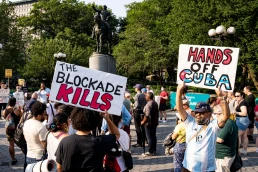
The court ruled that the 1977 International Emergency Economic Powers Act (IEEPA) does not empower the president to “unilaterally impose tariffs,” as Trump has on countries across the globe, insisting that doing so would boost manufacturing and cut the trade deficit—despite mounting evidence that the tariffs have instead raised costs on American households.
Trump also invoked the IEEPA last month when he issued an executive order accusing Cuba of supporting terrorism and posing a security risk to the US, and threatening to ramp up the use of tariffs against any country that sends oil, which Cuba’s economy relies on almost entirely for energy, to the island nation’s government.
US Secretary of State Marco Rubio has long pushed for regime change in the communist country his family immigrated from in the 1950s, and the administration called on the Cuban government to make “very dramatic changes very soon.”
With Trump’s use of the IEEPA struck down by the high court, some advocates and observers said that countries should quickly reverse their decisions to join the US in keeping oil from Cuba.
“As far as I can tell, this strikes down Trump’s ability to tariff countries that provide oil to Cuba. Hopefully a measure of relief,” said Michael Galant, a member of Progressive International’s secretariat and a researcher on sanctions. “The siege must be broken.”
Today’s Supreme Court decision ruling that the International Emergency Economic Powers Act does not give the president authority to impose tariffs also implies that Trump’s recent order imposing tariffs on countries selling oil to Cuba exceeds the President’s statutory authority. pic.twitter.com/IInMGNgdrS
— Francisco Rodríguez (@frrodriguezc) February 20, 2026
The court handed down the ruling as the manufactured crisis unfolding in Cuba largely faded into the background in the corporate media, but an article in the New York Times on Friday described how the lack of fuel shipments has left Cubans facing frequent blackouts, gas shortages, growing piles of trash in the streets of Havana and other cities as sanitation trucks aren’t running, soaring food prices, and suspensions of some medical care at hospitals.
Researcher Shaiel Ben-Ephraim also described how the “completely unprovoked” oil blockade that was started “with very little public discussion” has led to a “rising mortality rate among the elderly and those with chronic illnesses who cannot access life-support or specialized care” and a surge in diseases such as dengue fever and Orupuche virus, “which have become increasingly fatal due to the shortage of basic medicines and rehydration fluids.”
“All this has occurred within weeks. A sustained blockade could lead to hundreds of thousands of deaths. All with no debate, no approval from Congress and no provocation from Cuba,” said Ben-Ephraim.
Jorge Piñón, who researches Cuba’s oil supply at University of Texas at Austin, told the Times that the country’s fuel reserves could be entirely depleted by mid-March.
Trump issued his executive order on Cuba weeks after invading Venezuela, abducting President Nicolás Maduro, and pushing for control of the South American country’s oil supply. Venezuela has long been a top provider of oil to Cuba. Trump’s tariff threat led Mexico, which became a lifeline for Cuba after the flow of oil from Venezuela stopped, to halt its shipments.
Galant noted that Trump will likely “continue to do all that he can to starve the island,” and the president said soon after the Supreme Court announced its ruling that he would use different executive powers to impose a 10% global tariff, suggesting he was not prepared to back down on the tariffs he imposed before taking aim at Cuba.
But critics urged countries that have tried to help Cuba since Trump’s executive order, as Mexico has by sending humanitarian aid packages, to reverse their decisions to halt oil shipments to the island.
“So which countries are gonna start sending fuel to Cuba now?” asked organizer Damien Goodmon.
Recent Posts

The Quiet Way Trump Has Made Life Easier For Polluters
Take Action Now It’s not just about environmental rollbacks: Trump and Lee Zeldin have presided over a striking decline in the EPA enforcing existing…
Coalition Demands Schumer, Jeffries Step Down Over Failure to Fight ‘War-Crazed’ Trump
Take Action Now “Schumer and Jeffries have shown that they cannot be trusted to prevent more wars, more threats of wars, or the transfer of another…
Coalition of Antiwar Groups Launches National Campaign Calling for Jeffries and Schumer to Step Aside from Leadership
Take Action Now “Schumer and Jeffries have failed their party and country through wobbly leadership when firmness and clarity are needed in opposing…
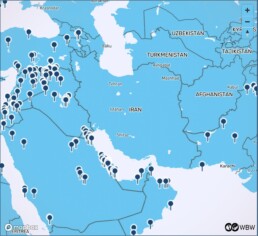
The Bases Basis for the Iran War
Take Action Now The economic impact of this war — through oil, tourism, and otherwise — is likely to continue to rub Gulf nations’ faces in the…