
“The idea that the Trump administration wants to hold human beings inside of warehouses like packages at logistic facilities like this might shock a lot of people, but this is the explicit language that the administration is using.”
By Maximillian Alvarez, The Real News Network
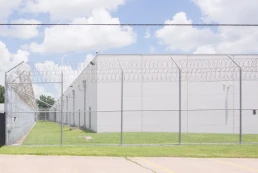
The Trump administration is moving forward with its plan to convert former industrial warehouses around the US into massive immigration detention facilities capable of holding thousands of people at a time. In rural Western Maryland, near Hagerstown, the Department of Homeland Security purchased a giant warehouse for over $100 million and claims the retrofitted facility will hold upwards of 1,500 human beings. In this on-the-ground report filmed outside the Hagerstown warehouse, immigrant data expert Austin Kocher breaks down the chilling truth about ICE’s detention reengineering program.
Additional links/info:
- Austin Kocher Substack, Facebook page, Bluesky page, and Instagram
- Project Salt Box, Substack, “A 1,500-bed detention facility is coming to rural Maryland. We’re calling on ICE to account for what that means — and asking you to do the same”
- Austin Kocher, Substack, “92% of ICE detention growth in FY 2026 driven by immigrants with no criminal convictions”
- Marina Dunbar, The Guardian, “Ice director wants to run deportations like ‘Amazon Prime for human beings’”
- PBS NewsHour, “ICE spending billions to turn warehouses into migrant detention facilities”
Credits:
- Filmed by Maximillian Alvarez
- Post-Production by Maximillian Alvarez and Cameron Granadino
The following is a rushed transcript and may contain errors. A proofread version will be made available as soon as possible.
Austin Kocher:
I’m Austin Kocher, a research professor at Syracuse University, and we are standing in front of the Hagerstown warehouse where ICE plans on holding upwards of 1700 people or more as part of its massive immigrant detention re-engineering program. The government has already spent over a hundred million dollars acquiring this facility and $30 million on design services to refigure the facility to hold human beings. The utilities are not at all equipped. There’s so far two bathrooms and two water fountains in this giant facility, totally not equipped to hold human beings in. So one of the longstanding strategies of ICE when it comes to building immigrant detention facilities is they like to locate them in rural parts of the country where the American public cannot see what’s going on. Now, this warehouse is located in rural Maryland, far from Baltimore, far from Washington DC, near Hagerstown with only about 2000 people living in the local area.
This is not a place that a lot of Americans would drive by and see, but it’s a place that will have huge consequences to people who will go through these facilities and not have access to basic social services, basic legal services. And if it’s like other facilities in the country, may not have access to even basic medical care or food. So one of the things we’ve seen over the first year of the Trump administration is a massive growth of immigrant detention. There were less than 40,000 people in immigrant detention facilities at the start of the Trump administration. There’s now over 70,000 people in detention facilities across the country. And even that, the Trump administration says is not enough people in detention. That’s why they asked Congress for almost $50 billion, basically a blank check to expand immigrant detention. And to scale up rapidly, they’re using existing warehouses that were originally designed near logistical networks and corridors for shipping and packaging to put human beings, human beings in cages.
It actually takes a long time to build a new facility for immigrant detention, and that could take years for zoning, permitting, subcontracting, and so forth. So the Trump administration, based on their timeline, knowing that they’re likely to lose the House in the midterms, knowing that these policies are widely unpopular and may cost the Republicans the next presidential election, are trying to do as much as fast as they can. Their solution is to acquire warehouses already built for shipping and for logistics and repurpose them to hold human beings as if they were packages. A lot of Americans who might believe the rhetoric coming out of the administration might think that immigrant detention is really about keeping public safety threats and national security threats locked up in prison-like conditions. That’s just not the case. The Trump administration has claimed that it’s going after the worst of the worst, claiming that they’re focusing on significant threats to public safety, but this is just not the case.
The data that I look at that comes straight from immigration and customs enforcement shows that virtually all of the growth over the last five months of people in detention comes from people with no criminal conviction whatsoever, and the vast majority of them don’t even have criminal charges. So for all the money that’s been spent on facilities like this one, over $140 million spent on acquisition and redesign so far, the vast majority of people who are going in this facility at great expense to the taxpayer are people who have nothing more than the civil immigration violation and are not threats to public safety or national security. So the idea that the Trump administration wants to hold human beings inside of warehouses like packages at logistic facilities like this might shock a lot of people, but this is part of the explicit language that the administration is using.
They’ve said that the best way for them to accomplish their mass deportation and mass detention agenda is to adopt a model like Amazon Prime. That’s their model for what they want to do with detention. This model of using Amazon Prime to inspire the immigrant detention and deportation infrastructure is actually not specific to the Trump administration. I spoke to high level officials under the Biden administration who actually told me the same thing, that they wanted to adopt an Amazon prime kind of shipping model using the logistical networks and data and technology to speed up the deportation process. And so what we’re seeing, even though it’s expanding at a pace that we’ve never seen before under this administration, this idea actually transcends both the Biden administration and the Trump administration. And we’ve seen that facilities across the country are facing a lot of pushback from local communities.
Even in heavy Republican voter areas like Social Circle, Georgia, where I’ve done a lot of research, we saw that community has come out and fought transforming a local warehouse like this one into a detention facility. We’ve seen Republicans come out saying they don’t want this in their neighborhood. They don’t want this in their districts because it’s unpopular, it’s expensive. People who are hardworking Americans living here in the rural communities may not like the fact that there’ll be children, pregnant women, families potentially held right across the street who are not a threat to public safety. And so a lot of people are standing up and pushing back. One of the reasons that lots of communities across the country are pushing back against ICE’s detention warehouses is that once the federal government acquires these facilities, it’s taken out of the local tax base. This facility behind me, now that ICE has acquired it, takes upward of $800,000 a year out of the local tax resources for the community, which means hits on schools, local infrastructure, clearing snow in the winters that we have here in Maryland.
So this is a real negative hit on communities. Basically, it’s a free write off for the federal government that local taxpayers have to absorb. So even though this facility is on track to eventually become one of those detention warehouses that ICE is trying to build across the country, it’s not inevitable and because a lot of local folks are standing up and getting organized across party lines, across class lines against these facilities, it’s entirely possible that this facility could face enough pushback that it would not become one of those facilities.
Recent Posts

Critics Slam Meeks, Jeffries Pushing Off War Powers Bill Just as It Gets Enough Votes to Pass
Take Action Now “Each day we delay increases the risk of deeper US involvement and more lives lost,” said one progressive policy adviser. “Failing to…
The SAVE America Act Would Rig Our Elections
Take Action Now The bill would prevent millions of eligible Americans from voting — all to pave the way for authoritarianism and bigotry.By Jordan…
The Theft of Bodily Autonomy is Central to the Authoritarian Playbook, and Texas Has Been Its Proving Ground
Take Action Now Texas houses the country’s only family detention centers and has one of the highest maternal mortality rates in the U.S., but it is…

Humanity Owes Cuba: Unilateral Coercive Measures and the Politics of Punishment
Take Action Now “There can be no clearer example of a violation of human rights than the economic embargo imposed by the United States against……