A few words from a poet might chip away at the frozen blocks that support illegitimate power. And we might gain strength from the clarity that a few lines can bring.
By Norman Solomon
Two centuries ago, Percy Shelley wrote that “poets are the unacknowledged legislators of the world.” Yet elite power has routinely vetoed their best measures. Still, the ability of poetry to inspire and nurture is precious, including when governments are on protracted killing sprees.
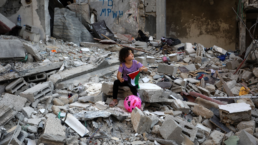
In Gaza, more than 11,000 civilians have been killed since early October. Children are perishing at an average rate of 10 deaths per hour. The ongoing slaughter by Israeli forces — supported by huge military aid from the United States — follows Hamas’s atrocities on Oct. 7 in Israel, where the latest estimate of the death toll is 1,200 including at least 846 civilians in addition to some 200 hostages.
But numbers don’t get us very far in human terms. And news accounts have limited capacities to connect with real emotions.
That’s where poetry can go far beyond where journalism fails. A few words from a poet might chip away at the frozen blocks that support illegitimate power. And we might gain strength from the clarity that a few lines can bring.
Stanley Kunitz wrote:
In a murderous time
the heart breaks and breaks
and lives by breaking.
It is necessary to go
through dark and deeper dark
and not to turn.
“In a dark time,” Theodore Roethke wrote, “the eye begins to see.”
Bob Dylan wrote lines that could now be heard as addressing Prime Minister Benjamin Netanyahu and President Biden:
You fasten all the triggers
For the others to fire
Then you sit back and watch
When the death count gets higher
You hide in your mansion
While the young people’s blood
Flows out of their bodies
And is buried in the mud
June Jordan wrote:
I was born a Black woman
and now
I am become a Palestinian
against the relentless laughter of evil
there is less and less living room
and where are my loved ones?
In the United States, far away from the carnage, viewers and listeners and readers can easily prefer not to truly see that “their” government is helping Israel to keep killing thousands upon thousands of Palestinian children and other civilians. “I call it cruel and maybe the root of all cruelty / to know what occurs but not recognize the fact,” a poem by William Stafford says.
Don’t accept that what’s happening
Is just a case of others’ suffering
Or you’ll find that you’re joining in
The turning away. . . .
Just a world that we all must share
It’s not enough just to stand and stare
Is it only a dream that there’ll be
No more turning away?
Franz Kafka wrote: “You can hold yourself back from the sufferings of the world, that is something you are free to do and it accords with your nature, but perhaps this very holding back is the one suffering you could avoid.”
Norman Solomon is national director of RootsAction.org and executive director of the Institute for Public Accuracy. He is the author of many books including War Made Easy. His latest book, War Made Invisible: How America Hides the Human Toll of Its Military Machine, was published in summer 2023 by The New Press.
Recent Posts

64 Groups to Congress: Start Preparing Tough and Effective Oversight Right Now
Take Action Now The question is not whether the public wants accountability, but whether Congress can conduct the meaningful oversight that exposes…
“Abolish ICE”: Protests Erupt in NYC After ICE Agents Shoot Father With 5-Year-Old Son in Car
Take Action Now “Candidates should seek support from the AI industry at their own peril.”By Amy Goodman, Darializa Avila Chevalier, and Carmen De…

Voters in Key States See AI Campaign Cash as More Politically Toxic Than AIPAC: Poll
Take Action Now “Candidates should seek support from the AI industry at their own peril.”By Jake Johnson, Common Dreams Polling data released…
Everything You’ve Been Told About Lethal Injection Is a Lie
Take Action Now Death by drugs is brutal—and designed for political optics. Christa Pike’s failed execution pulled back the curtain.By Arianna…