The road to Trump was paved with Democratic Party elites.
By RJ Eskow and Norman Solomon, The Zero Hour
In this conversation Norman Solomon and I discuss his new book, The Blue Road to Trump Hell: How Corporate Democrats Paved the Way for Autocracy.
Norman is the Co-Founder of Roots Action and the Executive Director of the Institute for Public Accuracy. This conversation explores the book’s basic themes: the Democratic Party’s repeated failures—from Hillary Clinton to Biden to Harris—and how neoliberal leadership, corporate dependence, and contempt for the working class paved the way for Donald Trump’s victories and the rise of an increasingly fascistic politics.
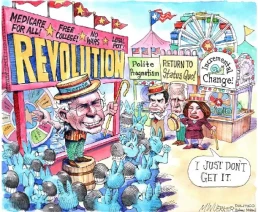
My main takeaways from the book and conversation? First, that the Democratic Party’s corporate alignment and structure repeatedly undermines its own electoral prospects—and that Dems would rather lose to a Donald Trump than win with a Bernie Sanders. (I recently wrote about that myself for The Nation.) Second, that progressive critiques of the party have consistently been accurate—and have consistently been ignored. And third, as Norman says, social movements must lead and politics must follow.
The transcript is below.
TRANSCRIPT
(Text has been lightly edited for clarity.)
Richard Eskow
So tell us a little bit about—I’m sure you’ve given this spiel before, but tell us a little bit about the book and the thinking behind the book, putting it together.
Norman Solomon
I think for one thing, about how we have been told that everybody believed there were weapons of mass destruction before the invasion of Iran, Iraq, which is the rewriting of history. The anti war movement was saying there’s no evidence. And we also hear, well, everybody thought that it would be plausible to have Joe Biden run for re election as president.
No. Many people were screaming at the top of their metaphorical lungs for years before the disaster debate in the middle of 2024, which includes our team@rootsaction.org that launched Don’t Run Joe campaign 18 months before that debate. I think there is that tendency that’s very strong in the mass media and mainstream politics to pretend that progressive analysis doesn’t matter, that critiques around class don’t matter, that the politics of genuine progressive populism is just not popular enough when the polling says the opposite.
I know you’ve worked for many, many years on issues like supporting and enhancing Social Security, how we need enhanced Medicare for all this stuff, polls through the roof. And yet the pretense at the time and then ongoing in retrospect from mass media and the powers that be on Capitol Hill is, well, you know, we can’t do these left ideas because they’re not popular.
So this is a mythology. And there’s also the idea that, well, y in retrospect, we saw xyz, that Biden running free election would be a disaster, that maybe Harris shouldn’t have been anointed automatically to run. But nobody knew this at the time. Well, I’m sort of leading up to the fact that this book was written in real time between 2016 and just a few weeks ago, especially during the years of 2016 through 2024.
And so I make it a point at the start of the book in the introduction to say this is not hindsight. I didn’t go back and edit it. This is what I was writing at the time, week by week. And I think this is important not to just not to pat myself on the head.
What’s important is that progressives, not just commentators, authors, writers, not just people doing media, but activists, saw this car crash, this train wreck coming year after year after, because the leadership of the Democratic Party is aligned with Wall street and thumbs its nose at the interests and concerns on Main Street.
Richard Eskow
And you know, we can both do this. Somebody once suggested if I did the same thing, I should call it “I was effing “right,” and I should have suggested that to you. But the fact is—you know, I don’t mean to in any way disparage for those of us that have been looking at this for a while from a perspective of, I guess you could describe it different ways in terms of the relationship with the Democratic Party, with a certain objectivity as well as a certain value system.
It’s been clear for a while. It’s not like nobody warned us. And there’s been a resistance to (looking at elections) retrospect as well. And that’s one of the things I was thinking about reading, let’s say the first third or quarter of your book. I remember so well, after Hillary Clinton lost, everything that was going back and forth within a couple months of the election.
If you said, “ell, you know, there was too much emphasis on economic neoliberal solutions,” or whatever you wanted to say, you’d hear “I’m tired of re litigating the 2016 election.”
Remember that? First of all, we never litigated it, so we can’t re-litigate it. But secondly, when you don’t win, it’s always struck me that if you didn’t have that perception beforehand that this might cause you to lose, you ought to do a kind of assessment, an inventory, and say, “What did we do wrong?”
Instead, some of us were treated like a nuisance for trying to do that work. And I’m wondering how often you’ve reflected on that.
Norman Solomon
Yeah, it’s a repetition/compulsion,disorder where, “Oh, we’re like a taxi driver in New York City, stereotypically. Just don’t look in the rearview mirror, just keep going and hopefully you won’t crash into anything.” In the book,I quote from an autopsy that Roots Action did in 2017 about the Hillary Clinton disaster … (By the way, that’s online at DemocraticAutopsy.org). Now you fast forward to two presidential election cycles, and in many ways if you took out the name Hillary Clinton and you put in Kamala Harris, it’s the same critique. It’s the same problem. It’s the same repetition that is coming from the so called leadership of the party.
And it’s really crystallized by something that Chuck Schumer said back in 2016. I quoted in the book. He said smugly, “For every vote we lose in eastern Pennsylvania for Hillary Clinton among the poorer people of color we’ll pick up two in the suburbs in western Pennsylvania.”
Well, how did that work out?
And it was the identical attitude that in the closing weeks of the Kamala Harris campaign in 2024, we were hearing, “oh, we’re gonna go after the moderate suburban voters, we’re gonna go after the Republicans who hate Trump. We’re gonna take Liz Cheney around and we’ll scoop up those votes.”
And really, the leadership of the Democratic Party is so arm’s length from its base it turns around and says, “Gee, we didn’t get the turnout. It’s mystifying.”
It’s not mysterious when you shaft the base of your party, when you tell them, only rhetorically, that you have their back (but) you’re really not fighting for them. There’s a quote that I use in The Blue Road to Trump Hell from Bernie Sanders, and it was only hours after the election was called against Kamala Harris. He said, “It’s no surprise that the working class would abandon the Democratic Party after the Democratic Party abandoned the working class.”
I know you have worked very closely with Bernie Sanders. You were his main chief speechwriter in the 2016 campaign. And I don’t know who wrote this one maybe was Bernie.
But he also said years ago, “Let’s face it, he said there are people in the Democratic Party leadership who don’t mind being on the Titanic as long as they have first class seats.”
Richard Eskow
Yeah, that’s exactly right. And. And that’s something it kind of gets me to, as a lead in, to the purpose of the book, the intent of your book… I think I compared the institutional Democratic Party to a corporation, an organization that has its own imperatives.
Right? There are thousands upon thousands of people in the Democratic Party orbit who depend upon billionaire and corporate contributions, large contributions that fund campaigns, that fund campaign consultants, that fund policy advisors, think tanks. There’s this enormous nexus of people who would rather lose to a Donald Trump than to win with a Bernie Sanders who might cut off the revenue flow that keeps them alive.
That gets me to, if we’re going to review in real time what we knew—which in a sense is what your book does, I think—(we can) remind ourselves of everything that went wrong as it went wrong. And as you and others tried to raise a warning flag. What do you hope that will motivate people to do? What’s the desired outcome?
Norman Solomon
That’s something I address at the outset in the book. It’s not only about getting clarity about what happened in the past. It’s about understanding how we can prevent past disasters from being replicated in the future. And it’s very specific: Do we want the Republicans to retain Congress in 2026? Well, if it’s the same attitude and priorities and the spending focus and messaging from the Democratic Party leadership as in the past, we’re not going to get the turnout that we need.
And there’s been this very facile attitude that Hillary Clinton had, that Joe Biden had, and also Kamala Harris—basically that Donald Trump is so terrible that all we have to do is mainly talk about how terrible he is and people will vote for us. Well, I don’t know what the math would be, but you can take a negative times a negative and get a positive?I don’t think that generally works. And we’ve seen, like it or not, that this is the history of the Democratic Party and presidential elections. People are generally driven by what they see as so called pocketbook issues.
There’s the Orwell saying that those who control the past control the future—those who control the present control the past, or something like that. And we’re seeing that again and again. So The Blue Road to Trump Hell is a way of saying this sort of neoliberalism, this affinity with corporate power, this refusal to fight the power of huge corporations and the wealthy—that is what paved the way for Donald Trump twice to go into the White House.
That has to change. And that means energizing from the base and changing the politics of the party.
Richard Eskow
I think that’s a great summary, Norman. And I think the other element of it is that when you base your entire, essentially your entire campaign around how awful Donald Trump is, I do believe that there’s a kind of energy. That shifts the energy to Trump. And when people are disaffected with elites and disaffected with the system, as they rightfully and understandably are, they say, “Look, all these elite people”—and not just Democrats, but the fact that they brought in a Liz Cheney, John Kasich from Ohio, whoever it might be—”if all these elite people who ignored us all these years hate (Trump) then hey, this guy may deserve my vote. I hate the way things are now. So what the heck?”
I think that was a factor here and continues to be. Don’t you?
Norman Solomon
Yeah, it’s sort of a feeling. It’s gut level. The so-called low information voters share (this feeling) to a large degree—that there’s this chess game being played way above us and it’s time to kick over the board. We just don’t like it.
Now that was a terrible mistake by the electorate in 2016 and 2024. And we have basically we can say a fascistic politics coming out of the Oval Office controlling the executive and legislative branches, largely controlling, not entirely, but the highest, up you go in the judicial branch, up to the Supreme Court, mostly holding sway there too.
So, this is where a big needle has to be threaded in a very concerted and organizing way. On the one hand, we might have people listening to us right now, Richard, who say, well, you know, this guy’s a fascist. Why are we talking about the Democratic Party? Because that’s the way to stop him electorally. So just going along to get along with the so-called leadership of the Chuck Schumers and the Hakeem Jeffries (is) a prescription for more disaster. That has to be fought.
At the same time, there are some people who have said—and this was true in 2016 and 2024, including many who lived in swing states—the hell with (Democrats). I hate both of these parties. They’re all pigs. And then so they’re going to stay home, so to speak, not vote in the presidential race or vote for Jill Stein or something like that.
Well, that’s a disaster too. You know, that’s sort of this fantasy world, this kind of imagining, wishful thinking that doesn’t comport with the real world. I mean, if you want to fight the fascists, then you don’t want them to win elections. And only hallucinations will tell us that you’re going to elect a president who is not a Republican and not a Democrat.
To wind up this little soapbox oration here: In 40 years, the Green Party has never come close to electing one member of Congress. That ought to tell us something—like it or not, and I don’t like it—about the future of fighting fascism and the future of progressive politics in this country at the federal electoral level. I’m not talking about municipalities, talking about Congress and the presidency. We are entwined with the Democratic Party and so we better fight like hell to change it.
Richard Eskow
Well, that’s persuasive, Norman. I will tell you that there are a lot of people listening who will make certain counterarguments that we should explore. And by the way, I didn’t vote for Kamala Harris in 2024, but—
Norman Solomon
By the way, I live in California. I didn’t vote for her either.
Richard Eskow
Oh, okay, there you go. First of all, obviously for both of us it wasn’t going to change the outcome. You know, I now live in Maryland.
Norman Solomon
They’re totally blue states.
Richard Eskow
Yeah, yeah. And except for our governorship, which is a whole other conversation. But … let me go at it a different way. For one thing, I think it’s important to talk to all voters from a position of respect. Right? And here I’m not addressing you so much as many Democrats, rank-and-file Democrats as well as electeds, who have spoken for years now to Green voters with contempt and blame.
I don’t think you win anybody over that way. And again, I’m, I’m not saying you.
Norman Solomon
Yeah, it’s not about contempt or blame. It’s about efficacy. It’s about let’s think, let’s analyze, let’s be clear and not be in fantasy world.
Richard Eskow
Yeah, but I think that’s left a scar on people like on Green Party voters—the years of abuse that they’ve taken.
Norman Solomon
Yeah, that’s right.
Richard Eskow
And I’m always tough on politicians. Maybe it’s because I’ve worked on campaigns. But you know what? “You (politicians) are in a sales job. You didn’t make the sale. You effed up.”
And of course, activists also have, like us, have to decide and journalists and so on, writers, observers like us have to make our, you know, we’re called upon to make our recommendations…
(Trump) learly is imposing fascism. I don’t challenge that for a moment. But, but it’s a tough argument to make on the national level—especially after what went on with Gaza, with the active participation of Joe Biden and Chuck Schumer—including the a suppression of freedom of speech on campuses and elsewhere around the issue of Palestine.
Norman Solomon
Absolutely. That’s right. And people, for understandable emotional reasons, in swing states for example, (said), Why vote for Kamala Harris? Of course I, I agree. How bad does it have to get with domestic repression before people say that? But no, we don’t conflate the two parties. We don’t pretend that the Joe Biden treatment of poor people in this country … SNAP and so many other examples. We could spend hours.
How long would we, how bad would it have to get before people recognize that we’re in he danger of fascism in this country? How bad would it have to get if it’s not bad enough now? I just can’t imagine how bad it would have to get before people say, you know, it really would be better to have a garden variety, even Democrat in the White House than the fascists we have running the executive and legislative branches now.
I just think it’s sort of self-evident. You know, magical thinking is great in literature. I just don’t think it works in politics.
That doesn’t in any way, in the slightest get the Democratic Party leadership off the hook, because it’s abysmal. And it’s doing two things that are—well, many things—that are horrific. One is it’s aiding and abetting de facto the consolidation of fascist power in the federal government. But it also is laying out and continuing to reinforce a politics that does not challenge the kind of corporatocracy we have that is so terrible for people’s lives, let alone the militarism.
And this is where, again, I think we need to make a distinction. It was hard to believe that anybody in the White House could be worse than Biden in assisting genocide, with direct complicity. I mean, let’s face it, Biden should be at the Hague right behind Netanyahu. So, no question. And it’s hard to find, except for issues like climate. There isn’t a lot of huge difference between the two parties in terms of foreign policy. But on domestic policy it would be preposterous to say that there’s no significant difference. There’s a huge significant difference. Just look at the Supreme Court decisions and how the votes are between who was appointed by Democrats and Republicans, just for instance, let alone nutrition and health care and so many other issues.
Again, not to let Democrats off the hook for their neoliberal failure to enact enhanced Medicare For All, and free public college, and so many other programs that we as progressives need to fight for.
To get back to The Blue Road to Trump Hell, I do want to say that we have a capacity now in this country. Every day, millions and millions of people are getting news and information from progressive sources. And that is crucial. I mean, we’re talking about. No, this isn’t hindsight. People could go back 1, 2, 3, 5 years and see clips from The Zero Hour.
And we were saying things then, you know, it’s not, it’s not hindsight. So we have been developing—not enough— but to counter, at least partly as much as we can, this right-wing Zionist pro-corporate craziness taking over outfits like CBS News. Now we can more and more sustain programs like this, The Zero Hour.
Don’t give your money to NPR when you can give it to the Zero Hour! Give it to Pacifica Radio, give it to Democracy Now and other outlets. So that’s important, at that level. And then we also have to combine it with action and organizing. And there’s been a shortage of resource, if that’s the term, use of resources to pair the infrastructure of progressive media with “We’ve got to organize.” You know?
Indivisible is not some radical left group, but credit where it’s due: they have organized. These No Kings days have been very important and so forth. And frankly a lot of the YouTube shows … I’m gonna, I’m gonna call ou—what’s the one that is so popular? The Young Turks. I mean, it becomes entertainment. No folks, this is not entertainment. The Blue Road to Trump Hell, the title of my book, is chosen because that road was paved by people who not only went along with the Democratic Party’s so-called leadership, but also by those who see politics as a passive entertainment activity.
And that has to change as a cultural thing. I think the left and progressives have improved in the capacity to say “No, this isn’t just something that you watch, it’s something that you change.” But we’ve got to increase that cultural change so that we see not just as a platitude, but reality.
If we don’t change history, it’s going to crush us.
Richard Eskow
Well, I think you’re absolutely right, and I think you make the case very well. And to me, what, what it brings up and what we can now pivot to is the future and the conclusion of the book. It brings up to me something that’s a little bit intangible but important, I think, which is, I think millions of good hearted, committed, passionate people have kind of retrofitted their vision to the Democratic Party as it exists because it’s the only vehicle that exists for them. And that’s why I wrote a piece—well, the headline they gave it was “Left-Populists, Unshackle your imaginations!”
To me, people do need community. They need solidarity. They need to be part of something that’s what part of what makes us human. But to me the only way to work with the Democratic Party is to be, like the Bible said of the world, “in it but not of it.”
Norman Solomon
Right, yeah. That’s great. Yeah.
Richard Eskow
There are the cases like Nebraska where an independent got 45 percent of the vote. Bernie’s endorsed him. I think the Democratic Party is now going to come to him and endorse him the next time around.
Norman Solomon
That could be the kiss of death in Nebraska. I don’t know if you want it.
Richard Eskow
I know. It really could, but it seems to me that’s where people like us come in. That’s where movement activists come in. That’s where it’s not enough, as so many Democratic politicians have—including privately in conversations I’ve had here at D.C.—it’s not enough to scold people for not voting Democratic.
We need to say to people, you want a better world, we want a better world. So if we suggest that you vote Democratic, it’s not because we think that’s the end state. It’s because—and you’ve expressed this in other conversations we’ve had very eloquently, Norman—it’s because to build the world we need to build, which looks different from this one, pretty freaking different, we have to preserve those freedoms or remnants of freedoms we have.
It doesn’t mean listening to all the lectures about “don’t let the perfect be the enemy of the good.” It means using the so-called “good” as a tool and discarding it when you can move closer to the perfect. Do you get what I’m driving at?
Norman Solomon
Yeah, yeah, yeah, very much. You know, there should be zero scolding, there should be solidarity, and there should be, “Hey, the future is with, pardon the saying, the working class.”
I mean, that’s where it is: the middle class, working class, however you want to define it, low-income people, the poor, the near poor, those who are struggling, which is most of the country, one way or the other.
So it has to be, frankly, an anti-rich, anti-corporate politics, where, no, it’s not fine to have billionaires. Bernie has said billionaires shouldn’t exist. Well, that’s anathema. That’s a sin to corporate media and politics. One of the points that I wanted to raise, which is very much, I think, Richard, what you’re referring to is that the traditional electoral politics view, including some of the best, quote, unquote, liberal elected officials, is that social movements should be a subset of electoral campaigns.
And it’s bass ackwards. Electoral campaigns should and must be a subset of social movements. And when you look at it historically that actually is what happened, whether it was FDR in 1932 and ‘36, the labor organizing, the activism really lifted that boat. It wasn’t that the elected officials lifted the boat of movements. It was the other way around. That is really a different sort of a language and lexicon that is just rejected.
The Democratic Party is led by people who are, as you referred to a few minutes ago, have their sinecure, they have friends, and they often themselves they’re getting huge consultant fees. Grassroots organizing is really not where it’s at for them. One of the things I talk about in the book is that this pathetic dynamic went on where in Pennsylvania and Philadelphia, for example, people in low and moderate income areas were begging for campaign materials. And meanwhile there was all this money being sunk into, what do they call it? The “collar counties” around Philadelphia where they could try to appeal to the affluent, suburban, often Republican people to turn away from Donald Trump.
Well, this is ridiculous. Every time we hear, Is it turnout election? Oh, yes, it’s a turnout election, but the behavior of the people running the party is that it’s not a turnout election from their base. You might say it’s a “turn away your base” so you can suck up to people who are not voting Democratic usually, anyway.
Richard Eskow
Yeah, absolutely. I think that’s exactly right. And let’s close with this then maybe as if you have a minute as a way to kind of tie it together: you write at the end of the book about Sohran Mamdani. He’s a fascinating (case study). Obviously, you can’t universalize any one politician, nor do I think movements should invest themselves 100% in any politician, even such a talented one. But the fact is Zohran Mamdani won in part, in a large part, because he was first and foremost associated with a movement. In his case, it was the Democratic Socialists of America. It doesn’t mean it always has to be. But he had already made set of allies, volunteers, supporters, advisors out of that, and it helped him immensely.
It scared mainstream Republicans. You write about, as we all remember, Chuck Schumer’s refusal to endorse him. That, of course, has been an irony to those of us who’ve been lectured about “Vote Blue, no matter who” for so many years. Then the speaker, I’m sorry, the minority leader in the Senate, won’t Vote Blue?
Their motto is, “Vote Blue, We’ll Tell you Who.” That’s what happened to Bernie. But now Mamdani is mayor-elect, which has been the best news we’ve had in a while. Now we have a self-described democratic socialist as mayor elect in Seattle as well. Not again … there will be different labels and different identities in different parts of the country for working people’s agenda.
But you wrote recently about—and it almost seems like it could be an appendix to the book or an addendum to the book about what everybody’s talking about now– Mamdani’s meeting with Donald Trump. And I, I’d love for you to summarize your thoughts about that briefly, in a way that ties it into what we’ve been talking about here.
Norman Solomon
I use the metaphor that just because a rattlesnake purrs doesn’t mean it isn’t a rattlesnake. Donald Trump is, to put it mildly, mercurial, and much more extreme than that. He makes stuff up as he goes along. You can’t depend on anything. And I point out that if he can vitriolically denounce Marjorie Taylor Greene, one of his foot soldiers of the MAGA forces, he can certainly do that to Mamdani.
And I’m sure that Mandani clearly knows that this guy is a nut. The President is a nut. But it’s a tactical thing. So I was really pleased that, right after that Oval Office meeting, mayor elect Mamdani went on Meet the Press and said, “Yes, he is a fascist.” I mean, so here’s a guy who is so rooted in a movement that he doesn’t change what he has to say, because it’s true. He’s not going to be a wind sock.
That’s why so many people have so enthusiastically supported Bernie Sanders over the years. You can go from one decade to the next to the next and he doesn’t change. There’s going to be derision towards the new mayor of New York from corporate media. “Oh, he says the same thing all the time.”
That’s the point, because the problems are the same and they have to be changed.
Overall, I think this is about flexibility. The cliche is “govern in prose after having campaigned in poetry.” But we want to have as deep and poetic governance as possible, with practicality: feet on the ground, eyes on the visionary horizon.
So it’s a challenge ahead. And we are not dead as progressives, as fascistic as this regime is. (But) we have a lot of work to do and it’s daunting. But it’s our potential future and it’s worth fighting for.
I do want to mention that I did give a lot of thought to, “Is there a point in doing this book in real time, writing over a ten-year period and looking ahead from there?” And one of the aspects I’m most glad about is that after writing 14 books, this one’s free. I was able to set it up so that from the very start, this book is free PDF eBook. All people have to do is to be able to go online and I want to invite people to do that.
Just go online to blueroad.info. There are various formats for you to read the entire book, which includes more than ten wonderful cartoons by the Pulitzer Prize winning progressive cartoonist Matt Werker. It was just fabulous. If people have been seeing progressive cartooning for decades, he’s been there. And so I encourage folks to also go and seethe cartoons. They look great on a screen of any sort.
And one more aspect: Activism is really the ultimate engine for the social changes we want. I love working with colleagues at rootsaction.org, and you can sign up for activism there. Just go to rootsaction.org.
Richard Eskow
Are a million other things I could ask you about, Norman, but they’ll have to wait for another time. Yeah, people should definitely check out the book.
And you know, you can’t know where you’re going unless you know where you’ve been.
Norman Solomon
Yeah. Yeah. Really.
Richard Eskow
As always, great to talk to you. And as always, thanks for coming on the program.
Recent Posts

Two Thirds of People Arrested by ICE in Minnesota Surge Had No Criminal Records, New Data Reveals
Take Action Now The White House had said all the thousands of people arrested were “dangerous criminal” immigrants.By Meghnad Bose and Luke…

BREAKING: Israel Approves Extreme Death Penalty Law Targeting Only Palestinians
Take Action Now Monday’s vote in the Knesset to impose a one-sided death penalty bill on Palestinians will further cement Israel’s system of…

‘Erasing The Lines’: How Settler Outposts Are Seizing New Regions of the West Bank
Take Action Now After decades consolidating their control over Area C, Israeli settlers are expanding into Areas B and A — nominally under…
Cory Booker Says Democrats Have ‘Failed This Moment’ And Calls For New Leaders
Take Action Now Senator’s comments come amid growing divisions within the party, which he says has ‘too small of a coalition’By José Olivares, The…