
Police killed more people last year than any other on record. Can reimagining city budgets make our communities safer?
by Sonali Kolhatkar, OtherWords
Last year was the deadliest on record for police killings in the United States. According to a Washington Post database, law enforcement officers shot and killed 1,096 people in 2022.
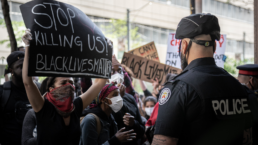
And that’s likely an understatement.
According to Abdul Nasser Rad, a research director at Campaign Zero, the Post “only captures incidents where a police officer discharges their firearm and the victim is killed.” This means that it wouldn’t count the 2020 killing of George Floyd in Minnesota, for example, which resulted from asphyxiation.
In contrast, Campaign Zero’s Mapping Police Violence project includes any action that a law enforcement officer takes that results in a fatal encounter. Rad’s project counted 1,158 police killings in 2021 compared to 1,048 for the Post. (Final results for 2022 are not yet available.)
The upshot is that in spite of the huge public attention to police violence since 2020, police are actually killing more people than before. We can expect 2023 to be even deadlier if the years-long trend continues.
Another clear conclusion is that communities of color face a much higher risk.
According to the Washington Post, Black Americans “are killed by police at more than twice the rate of white Americans.” Mapping Police Violence puts the figure closer to 3 times. Police killings of Latinos and Indigenous people are similarly disproportionate.
In the aftermath of George Floyd’s murder, some activists called for “defunding the police.”
They argued that over-funded police departments — which can often consume a third or more of city budgets — were using their resources to kill people. These advocates wanted to shift some of those funds to reduce poverty, improve mental health, and take other steps to make people safer.
That seemingly reasonable call was greeted with a reactionary backlash. Politicians across the spectrum, including President Joe Biden, promised to increase police funding instead. Biden even begged local governments to use federal stimulus funds to bolster their police departments in 2022.
But does giving police more money result in greater public safety?
One recent study analyzing funding for hundreds of police departments over nearly three decades concluded that “new police budget growth is likely to do one thing: increase misdemeanor arrests.”
These arrests do little to reduce violent crime. Instead, the authors explained, they lead to more police encounters that result in killings.
On the contrary, cities that took steps to reduce arrests for petty crimes saw a decrease in police killings, according to data scientist Samuel Sinyangwe, a cofounder of Campaign Zero. He also concluded that crime rates in those cities did not increase.
These issues needn’t be divisive. None of us should simply accept that police will continue to kill more and more people each year. Making sure our local budgets invest in real safety, not just deadly force, is one place to begin.
The Community Resource Hub has created a powerful internet tool, DefundPolice.org, to help communities put police spending into perspective and reimagine their city budgets. The site includes a detailed video tutorial on how to use tools like a “people’s budget calculator” to advocate for change locally.
We all want safer communities. To get them, we need to put our money toward people’s needs, not deadly deeds.
Sonali Kolhatkar is the host of “Rising Up With Sonali,” a television and radio show on Free Speech TV and Pacifica stations. This commentary was produced by the Economy for All project at the Independent Media Institute and adapted for syndication by OtherWords.org.
Recent Posts
Take Action October 20 to End the Illegal U.S.-Israeli War on Iran, #PeaceWithIranNOW
Take Action Now The war is not just illegal, but massively unpopular with the U.S. public, and Trump and his Republican enablers may take a deserved…
Chuck Schumer Hasn’t Said a Word About Trump’s Attempt to Deport Ilhan Omar
Take Action Now Ethics lawyers say the raid violated the Hatch Act. Schumer has been silent.By Sharon Zhang , Truthout Days after the Trump…

“Propaganda Show”: IDF Raids Palestinian NGOs in the West Bank Ahead of Israeli Elections
Take Action Now “The raid onto the city center Ramallah is not a lonely activity. It happens every day that they raid different villages,…
ICE Planning $100 Million ‘Nightmare’ Domestic Spy Program
Take Action Now Under ERO ONE, Immigration and Customs Enforcement plans to hire 142 intelligence contractors with top secret clearances and deploy…