
On the anniversary of Hiroshima and Nagasaki we ask 17 experts whether ‘deterrence’ is the real legacy. Or not.
Eighty years ago today, August 6, 1945, the U.S. military dropped an atomic weapon nicknamed “Little Boy” on the city Hiroshima, Japan, resulting in a blast equivalent of 15 kilotons of TNT, killing approximately 66,000 people immediately and some 100,000 more, the vast majority civilians, by the end of 1945.
Three days later, the U.S. deployed another nuclear bomb — this one “Fat Man” — on the Japanese city of Nagasaki, leaving upwards of 80,000 people dead by the end of the year.
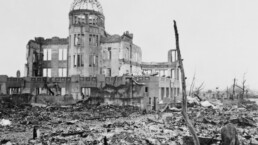
Japan surrendered in September, bringing a victory to the Allies in the Pacific theater and an end to World War II.
In the 80 years since, nine countries have acquired nuclear weapons arsenals, according to the American Federation of Scientists, which counts some 12,331 warheads (9,600 active) total. Russia and the U.S. have the most, with 5,449 and 5,277 respectively, as of 2023.
Despite fears to the contrary, no nuclear weapon has been used in conflict since Little Boy and Fat Man flattened two Japanese cities 80 years ago this week. This, despite a Cold War spanning decades between the world’s two great powers of the time, the United States and Soviet Union.
What primary lesson should we take away from this fact in our geopolitical history?
Does this mean nuclear deterrence among great powers actually works?
We asked a broad mix of historians, political scientists, anti-nuclear weapons activists and journalists this question, particularly as it relates to heightened fears of Great Power conflict and what appears to be a new era of nuclear proliferation today.
Emma Claire Foley, nuclear issues campaign director at Roots Action
My academic training, and my more general experience as a person who wants to understand the world, tells me that isolating and asserting specific causes and effects in a situation of infinite contingency — human life on Earth over an 80-year period — is junk thinking. Yet just this proposition, that eight decades with no nuclear war has proven that these weapons are a source of stability, not a profound liability, is constantly brought up as a justification for what appears to be a strong bipartisan consensus in the United States that nuclear weapons should exist into an indefinite future, and they should make us feel more, not less, safe.
A consideration of this question shaped by intellectual integrity and a serious consideration of the stakes of the question would instead acknowledge what we as a country and a world actually stand to lose should this ongoing case study we are all living through show that a world where nuclear weapons exist and countries are willing to use them will in fact experience nuclear war more often than one where they do not exist. Eighty years, by the standards of recorded human history and our much longer tenure on Earth as a species, is not very much time at all.
Recent Posts

Decoding Pro-Israel Buzzwords in a Time of Genocide
Take Action Now Support for Israel has declined steeply among Americans, but its defenders continue to maintain a siege of buzzwords against…

Tax the Rich and Slash the Military Budget
Take Action Now The Left is often asked how it proposes to pay for programs like universal childcare, Medicare or All, and a green jobs program.…

Israeli Mob Beats Washington Post Journalist, Burns Olive Trees In West Bank
Take Action Now “They just kept kicking me and kicking me,” photojournalist Heidi Levine recalled from a hospital bed after the attack.By Ryan…

Take Action October 20 to End the Illegal U.S.-Israeli War on Iran, #PeaceWithIranNOW
Take Action Now The war is not just illegal, but massively unpopular with the U.S. public, and Trump and his Republican enablers may take a deserved…