Hoping to pressure Starbucks to finally sign a contract with its 12,000 unionized baristas, Starbucks Workers United has called for a boycott of the company. It is asking individuals as well as organizations and unions to stop patronizing the coffee giant.
By Jenny Brown, Jacobin
No contract? No Starbucks coffee at the union hall.
Seeking to pressure Starbucks to finally sign a contract with its 12,000 unionized baristas, Starbucks Workers United announced a boycott of the chain August 25. In addition to individual customers, they are asking organizations and unions to stop patronizing the coffee giant, including avoiding catering and sponsorships, until they get a contract.
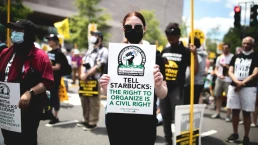
The AFL-CIO has already signed on, and the 25,000-strong Chicago Teachers Union voted to boycott on August 26.
Starbucks Workers United members conducted their largest and longest strike yet last November, demanding that the company resolve its 550 unfair labor practice charges and negotiate in good faith. Three thousand baristas in one hundred cities struck, in some cases staying out into January. They asked customers to delete their Starbucks phone app and avoid patronizing all stores.
The company seemed ready to bargain for a moment, but then went back to stonewalling, baristas said. “They will continue to stonewall and stall for as long as they believe they can get away with it,” said Campbell Marusa, a five-year barista in Greeley, Colorado.
Sporadic strikes have continued. August 15–16, workers in California, Missouri, Tennessee, and Pennsylvania walked off the job. The walkouts came during Unicorn Frappuccino weekend, when the stores briefly offered a complicated multicolored drink that spiked sales and exhausted workers. Baristas were told they had to work that weekend and could not take time except for emergencies.
In Nashville, baristas walked off August 15 to raise the alarm about a new blending powder the company rolled out in mid-July that became easily airborne and was giving workers sore throats, coughs, and headaches from breathing it.
Starbucks baristas have been fighting for a first contract for nearly five years. Workers started an organizing wave with union election wins in Buffalo, New York, in late 2021. Since then, over 700 stores have voted union — affiliating with the Service Employees International Union’s Workers United division — but that’s still fewer than 5 percent of the company’s 16,000 outlets in the United States.
To stop the union’s spread, the company has racked up the largest number of unfair labor practices in US history, with 550 still unresolved. Despite well-documented management intimidation, the union continues to grow by several stores a month.
Three at All Times
A key contract demand is around understaffing. Workers are demanding three people on the floor at all times, and they want available hours to go to current baristas, rather than the company’s prevailing practice of hiring more people and keeping established workers starved for hours.
Striking Nashville barista Baylor Baucom told the Nashville Banner that his store sometimes has only two workers. “That’s unacceptable, in my opinion, considering how many different positions we have on our floor — making drinks, making the food, taking orders, taking orders in the drive-through.”
Many longer-term baristas report that staffing has worsened in the last five years. “The working conditions and food service are getting worse while prices are getting higher,” said Marusa. Many workers report that even when they are available to work more, managers keep their hours below the number required to receive benefits.
Marusa said a coworker in Greeley keeps asking for more hours but is being kept at the minimum. “After asking the manager for more hours, my store manager told her that there are resources to help her budget her money,” said Marusa. “With the hours that she’s getting scheduled, she’s getting paid less than $800 a month. The issue isn’t how she’s budgeting her money; the issue is that she is being chronically underscheduled.”
Pay has improved since the union started organizing, but in forty-three states the starting wages are still below $16. The union is asking for $17 an hour starting pay and 4 percent annual raises.
Recent Posts
Democrats Should Get Behind a National AI Data Center Moratorium
Take Action Now Democrats have a golden opportunity to capitalize on this issue, win big in November, and take real action on AI data centers to…
Another Way Out: Public Execution Is an Everyday Reality—Livestreamed or Not
Take Action Now For some, the Trump administration’s plan to livestream an execution was unacceptable because it wouldn’t happen behind closed doors……
Senate Democrats Demand Trump Administration Reveal Full Costs of Iran War
Take Action Now “Americans deserve to know how much of their money is being burned on Trump’s war,” Sen. Elizabeth Warren said.By Chris Walker,…

Stealing Palestine, Stealing Enlightenment
Take Action Now The authors trace the origins of Zionism, at least in large part, to Evangelical Christians who, much like back-to-Africa racists in…