
St. Louis is the 16th US municipality to pass a resolution calling for ceasefire in Gaza.
By Frances Madeson, TruthOut
It’s been just shy of three months since Resolution 137 was first introduced by Rasheen Aldridge, the 30-year-old alderman from St. Louis’s 14th Ward who cut his political teeth in the streets of Ferguson in the aftermath of the August 2014 police killing of Michael Brown. Aldridge is the first to admit there’s been many a “Whereas” clause drafted and deleted since he first introduced a version of the resolution on October 20 to get the ceasefire discussion going at the city level, just days after a U.S. representative from St. Louis, Cori Bush, introduced her Ceasefire Now Resolution into the 118th Congress.
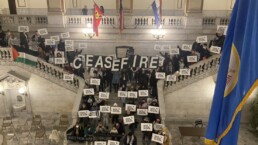
It took far longer than he expected, but on January 12, in a 12-0 vote, the St. Louis Board of Aldermen voted overwhelmingly to adopt the committee substitute that had emerged from the Legislation and Rules Committee earlier in the week, calling for a bilateral ceasefire in Gaza. With its passage, St. Louis became the 16th municipality in the country to call for a ceasefire — reminding itself to prize its humanity above all else, to “give it a front seat” as Congresswoman Bush might say.
Radiating warmth, Aldridge thanked the public for their guidance and support through a delicate process made more personally challenging by his mother suffering a massive stroke in the days leading up to the vote. Before the meeting was adjourned and the crowd dispersed, Aldridge repeated what’s become for him a kind of signature political mantra or catechism, telling them: “We see you, we hear you, we support you, we love you.”
Though its terms were hotly contested and concessions were extracted, overall the resolution supports a slate of humanitarian actions including hostage release, unfettered distribution of aid in Gaza, and restoration of the basic necessities of life including food, water, electricity and medical supplies. Even some of its stronger supporters described it in their public comments at committee as “the bare minimum” necessary to address the escalating crises. It’s worth remembering that Res. 137 beat out for consideration two competing resolutions introduced at the same time. One called for the board to stand in solidarity with Israel and another in solidarity with the “innocent civilian people of Israel and Palestine as they defend themselves against Hamas.”
Recent Posts

Massive Ivanka Trump Problem Triggers Existential Threat to GOP: ‘Rage Is Building’
Take Action Now Locals in Albania — where Ivanka and her husband Jared Kushner plan to transform one of the nation’s most important ecological sites…

Vance-Led Task Force Moves to Strip 760,000 People of ACA Coverage
Take Action Now Protect Our Care says about 8 million people have lost coverage since the start of Trump’s second termBy Ruth Milka, Nation of…
The Espionage Act Monster: How Washington Crushes Those Who Expose Its Crimes
Take Action Now As surveillance expands and the ability to communicate anonymously becomes increasingly difficult, the panel asks a fundamental…

Another U.S. Soldier Is Dead as Iran War Casualties Rise
Take Action Now An additional 66 U.S. personnel were wounded in action this month, pushing the official count of Iran war casualties above 850.By…