
With supply chains finally open, solar provided most of the nation’s new electricity capacity last year.
By Tik Root, Grist
Solar accounted for most of the capacity the nation added to its electric grids last year. That feat marks the first time since World War II, when hydropower was booming, that a renewable power source has comprised more than half of the nation’s energy additions.
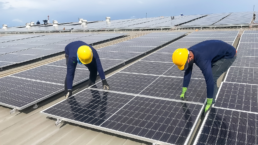
“It’s really monumental,” said Shawn Rumery, senior director of research at the Solar Energy Industries Association, or SEIA. The trade group announced the 2023 numbers in a report released today with analytics firm Wood MacKenzie. The 32.4 gigawatts that came online in the United States last year shattered the previous high of 23.6 gigawatts recorded in 2021 and accounted for 53 percent of new capacity. Natural gas was next in line at a distant 18 percent.
SEIA called 2023 the best year for renewables since the Second World War. Texas and California led a solar surge driven mostly by utility-scale installations, which jumped 77 percent year-over-year to 22.5 gigawatts. The residential and commercial sectors also reached new milestones. Only the relatively nascent community solar market missed its previous mark, though not by much, said Rumery. Overall he called it an “almost record setting year across the industry.”
One factor driving all that growth was an easing of supply chain constraints, which had slowed the delivery of solar panels. The problem arose in early 2022 after a small California manufacturer, Auxin Solar, filed a petition with the Department of Commerce accusing Chinese companies of circumventing U.S. tariffs by funneling panels through Southeast Asia. The government largely sided with Auxin, and new tariffs are set to take effect in June.
The dispute “really set back a lot of utility scale projects,” said Rumery. But, he explained, solar developers found workarounds that helped foster such strong 2023 growth, when projects slated to finish in 2022 finally wrapped up. While the boost from delayed installations will dissipate in coming years, and residential solar faces headwinds due to changes in net metering rules, experts generally expect renewable energy to keep on its torrent trajectory.
“It’s very likely to continue because solar and wind are now very well established,” said Rob Stoner, director of the MIT Energy Initiative. “Solar costs continue to fall far below where we ever thought they would.”
Despite its rapid ascendance, solar still makes up just 5 percent of the U.S. electricity mix. But today’s report projects that, over the next decade, the nation will add nearly 500 gigawatts of solar power. The authors warn, however, that deployment could shift dramatically depending on how policies and the market progress. Their bull scenario would see as much as a 17 percent increase from that base case, while their bearish outlook predicts up to a 24 percent decline — swings that could account for some 200 gigawatts of capacity.
Rumery says he’ll be watching the extent to which companies take advantage of funding from the Inflation Reduction Act, which includes significant incentives for renewable energy deployment. So far interest in solar appears to be strong, with one tally pegging utility-scale investment at $53 billion in 2023. But, according to Stoner, the biggest open question is how quickly projects can connect to the grid.
“Interconnect times are nationally very long for utility scale,” he said. “That’s a big problem.”
Rumery said companies are expecting wait times to grow from around five years to as long as a decade or more. He adds interest rates and state-level policies such as net metering rates, to the list of factors that could shape the future of solar. But, overall, he said, there’s just one direction the industry is headed.
“We certainly expect the solar industry to grow,” he said. The only question is by how much.
Recent Posts

British Support For Israel Is Shattering
Take Action Now There is not a single member of the Foreign and Commonwealth Office who believes that Israel, under any leadership, would allow a…

I’ve Covered Death Row Cases for Nearly a Decade. What Happened to Christa Pike Wasn’t an Anomaly.
Take Action Now Several states have faced questions about the competence of their execution teams as major medical organizations have opposed…

Angie Nixon Says the Fight for Black Voting Power Demands Elected Officials ‘Get Louder’
Take Action Now As Black Floridians confront shrinking representation and political disillusionment, Nixon says the moment demands persistence.By…

Progressives Saw Wins in DNC, But Battle for the Future of the Party Continues
Take Action Now Resolutions calling to abolish ICE and pushing to block arms sales are laying a progressive groundwork for 2028.By Sam Rosenthal,…