
“For far too long, this country has put profits ahead of its people,” said Rep. Barbara Lee. “Nowhere is that more apparent than in our Pentagon topline budget.”
By Jake Johnson, Common Dreams
Reps. Barbara Lee and Mark Pocan led a group of House Democrats this week in filing amendments that would slash current U.S. military spending by $100 billion and reverse recent efforts to add more money to President Joe Biden’s historically high Pentagon budget request for the coming fiscal year.
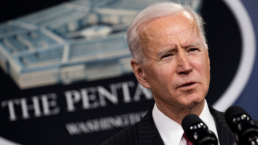
The proposed amendments to the National Defense Authorization Act (NDAA) for Fiscal Year 2023 were introduced days after lawmakers on the House and Senate Armed Services Committees—both controlled by Democrats—voted to pile $37 billion and $45 billion, respectively, onto Biden’s March request for $813 billion in military spending.
One of more than 1,000 amendments filed for the House version of the NDAA, the Lee-Pocan proposal to cut $100 billion from the current U.S. military spending topline of $782 billion points to a recent Congressional Budget Office study outlining several ways in which Congress could reasonably slice $1 trillion—or 14%—from the Pentagon budget over the next decade.
Lee and Pocan, the co-chairs of the Defense Spending Reduction Caucus, have repeatedly attempted to rein in U.S. military spending in recent years, but their efforts have been blocked by Republicans and members of their own party—some of whom are financed by weapons makers.
Last month, the pair introduced legislation that would take $100 billion from the U.S. military budget and redirect the funds to pressing domestic needs such as housing and healthcare.
“For far too long, this country has put profits ahead of its people,” Lee said. “Nowhere is that more apparent than in our Pentagon topline budget. Just last year, key priorities like Build Back Better were left on the negotiating table, while Congress approved a $782 billion defense budget—higher than the military even requested.”
“It is time that we realign our priorities to reflect the urgent needs of communities across this country that are healing from a pandemic, ongoing economic insecurity, and an international energy crisis—none of which will be resolved through greater military spending,” Lee added. “Taking this step to downsize our military budget by $100 billion will ensure that our national security truly centers on the American people, not weapons industry profits.”
Reps. Peter DeFazio (D-Ore.), Bonnie Watson Coleman (D-N.J.), Jared Huffman (D-Calif.), and Adriano Espaillat (D-N.Y.) are backing the Lee-Pocan NDAA amendment to reduce the current military spending topline by $100 billion.
Lee also introduced an amendment that would repeal the 2002 Authorization for Use of Military Force (AUMF) Against Iraq, which—following its original passage ahead of the catastrophic Iraq invasion—was used as legal cover by the Obama and Trump administrations to take deadly action overseas.
In 2020, for instance, the Trump administration invoked the 2002 AUMF to claim it was authorized to assassinate Iranian Gen. Qasem Soleimani, a decision that nearly sparked a full-blown war between the U.S. and Iran.
Recent Posts
The Next Coup Attempt … And How to Stop It
April 5, 2026
Take Action Now It is up to us to put two and two together: Trump will seek to exploit the war (or the next one) to alter the elections. We bear…
‘A Moral Obscenity’: Trump Budget Pairs Record Military Boost With Billions in Cuts to Social Programs
April 4, 2026
Take Action Now “To pay for his endless wars, he wants the biggest increase to military spending in 70 years,” said Rep. Greg Casar. “Hell no.”By…

Meet Leqaa Kordia: Palestinian Protester Freed After a Year in ”ICE Dungeon”
April 3, 2026
Take Action Now While in custody, Kordia experienced destitute conditions at the Prairieland Detention Center, including overcrowding, inedible food,…

The U.S. and Israel are Making Gaza-Style War the New Normal
April 3, 2026
Take Action Now In Iran and Lebanon, the US and Israeli militaries are bombing dense residential blocks, destroying civilian infrastructure,…