
The continued construction and deployment of killer robots is not inevitable. Indeed, a majority of the world would like to see them prohibited.
By Rebecca Gordon, Tom Dispatch
Here’s a scenario to consider: a military force has purchased a million cheap, disposable flying drones each the size of a deck of cards, each capable of carrying three grams of explosives — enough to kill a single person or, in a “shaped charge,” pierce a steel wall. They’ve been programmed to seek out and “engage” (kill) certain human beings, based on specific “signature” characteristics like carrying a weapon, say, or having a particular skin color. They fit in a single shipping container and can be deployed remotely. Once launched, they will fly and kill autonomously without any further human action.
Science fiction? Not really. It could happen tomorrow. The technology already exists.

In fact, lethal autonomous weapons systems (LAWS) have a long history. During the spring of 1972, I spent a few days occupying the physics building at Columbia University in New York City. With a hundred other students, I slept on the floor, ate donated takeout food, and listened to Alan Ginsberg when he showed up to honor us with some of his extemporaneous poetry. I wrote leaflets then, commandeering a Xerox machine to print them out.
And why, of all campus buildings, did we choose the one housing the Physics department? The answer: to convince five Columbia faculty physicists to sever their connections with the Pentagon’s Jason Defense Advisory Group, a program offering money and lab space to support basic scientific research that might prove useful for U.S. war-making efforts. Our specific objection: to the involvement of Jason’s scientists in designing parts of what was then known as the “automated battlefield” for deployment in Vietnam. That system would indeed prove a forerunner of the lethal autonomous weapons systems that are poised to become a potentially significant part of this country’s — and the world’s — armory.
Recent Posts

Rights, Faith Groups Urge Congress to Block $2.8B Bomb Sale to Israel
Take Action Now If the Trump administration moves forward with the transfer, dozens of groups are urging lawmakers to seek a joint resolution of…

Trump’s Finger Gets Closer to Nuclear Button
Take Action Now Not that Congress caresBy Ken Klippenstein, Substack The Pentagon is “increasing [nuclear] options available to the President for…

Impeachment Calls Grow as Dems Say Up to $20 Million in Taxpayer Funds Were Used for ‘Illegal’ Pro-Trump Ads
Take Action Now “We should not have to remind you that using government funding to create or air political ads like the ones that have been running…
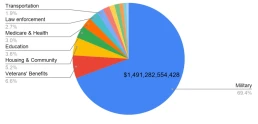
FACT SHEET: Trump’s Proposed $1.5 Trillion War Budget in Three Charts
Take Action Now Trump’s Pentagon hike would send war spending to nearly 70 percent of discretionary funds. Most would benefit weapons…