
The National Labor Relations Act still functions, just barely, for Starbucks workers. Employees at fast-food franchises face even worse odds under federal labor law.
by Brian Callaci, Dissent
On February 27, after over two years of gutsy and strategic organizing, Starbucks Workers United forced Starbucks to surrender to its workers’ wishes and recognize their legal right to a union under the National Labor Relations Act (NLRA). The baristas’ union and the company have agreed to a national framework for contract bargaining and for recognizing the wishes of workers at non-union stores to join the union. Earlier that month, after twelve years of similarly courageous fighting, workers in another union campaign against chain restaurants, Fight for $15, celebrated a different kind of victory: the creation of a tripartite Fast Food Council—bringing together workers, industry, and government—that will regulate wages in the fast food industry in California. The sector-wide minimum wage of $20 per hour went into effect on April 1.
While Starbucks workers still have a long way to go to win a good contract and organize thousands of remaining non-union stores, they have already achieved what in recent decades has been nearly impossible: unionizing a large national corporation from scratch under federal labor law. It seems that for employees of corporations like Starbucks, the NLRA still functions, barely, if the conditions are just right.
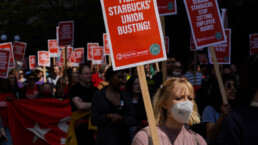
By contrast, the Fast Food Council was created entirely outside of federal labor law. In the years leading up to the council’s creation, the SEIU-led Fight for $15 won major gains for fast food workers. It transformed public policy around the minimum wage and secured massive legislative wage gains for millions of workers, and it is now setting up an entire wage-regulation apparatus, including worker representation, in the state of California. Yet all this was achieved without winning an NLRB-certified union election or bargaining a contract at a single fast-food restaurant.
Recent Posts

Accountability for the Gaza Genocide Can’t Focus on Netanyahu Alone
Take Action Now Getting rid of one bad leader won’t bring justice.By Jeet Heer, The Nation On Thursday, former US Secretary of State Hillary…

25 Years of War Was the Wrong Response to 9/11
Take Action Now Both Democrats and Republicans are responsible for these counter-productive choices, and the appalling human costs of these wars on…
How Status Quo Democrats Could Create Another Trump
Take Action Now A new study suggests Democrats’ broken promises won’t just cost them elections — they could fuel an even more dangerous MAGA…
The Pentagon Asked OpenAI for Artificial Intelligence Designed to Rarely Say No
Take Action Now The U.S. military’s desire for an AI tool with “minimal refusal rates” was revealed through a FOIA lawsuit filed by The Intercept.…