
What appears to be an opportunity to sideline Hezbollah is really a trap.
By Jennifer Kavanagh, Responsible Statecraft
Though Washington once opposed Israel’s invasion into Lebanon, reports have emerged that some inside President Joe Biden’s administration now see an opportunity as the Israel Defense Forces score tactical gains against Hezbollah.
Eager to take advantage of Hezbollah’s setbacks, they hope to use U.S. security assistance and training to upgrade the weak and underfunded Lebanese Armed Forces so that it can wrest control of the country’s security future from Iran’s proxy and assume responsibility for stabilizing Lebanon’s southern border with Israel.
If this plan sounds familiar, it should. The United States has been embarking on costly projects to build foreign militaries for decades, without much success. The spectacular collapse of the Afghan National Defense and Security Force after 20 years and $90 billion in U.S. investment is one of the more infamous security assistance failures, but it is certainly not alone.
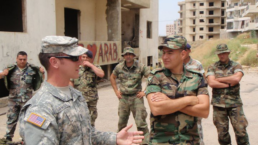
U.S.-trained forces disappointed in Vietnam in the 1970s and in Iraq in the 2000s. In the Sahel, U.S. partners, armed with U.S. weapons and military know-how, have led successful military coups. Even in Ukraine, once seen as a security assistance success story, questions have emerged about the relevance and contributions of U.S.-provided training.
Unchastened by its past failures, however, the United States is ready to try again, this time in Lebanon. There’s still time to abandon this proposal, however, and Washington should. Not only is the U.S. military consistently ineffective at training partner security forces, but taking on such an expensive and time-consuming project in Lebanon would not advance U.S. strategic interests and could do more harm than good for Lebanon’s long-term stability.
To avoid these high costs and risks for Washington and Beirut, the United States should stay out of Lebanon’s security future.
The U.S. military has many strengths but building foreign militaries is not one of them. The U.S. experience in Afghanistan is one of the most studied security assistance fiascos in recent history, but its mistakes are far from novel. Among many retrospective evaluations, the Special Inspector General for Afghanistan Reconstruction (SIGAR)’s 2023 report criticizes U.S. forces in Afghanistan for a range of errors, including “mirror imaging” that imposed U.S.-style military structure and tactics in a place where neither fit; reliance on advanced American military technology that Afghans could not operate without U.S. support; poorly trained U.S. advisors who rotated out before gaining the experience to make progress; and politically-driven timelines that led to unrealistic goals divorced from the situation on the ground.
Recent Posts
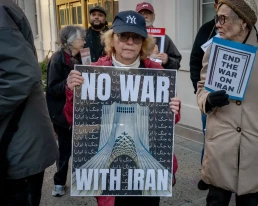
‘Stop The War on Iran’: Brooklyn Peace Activists Urge Jeffries to Help End Conflict
Take Action Now Democrats have a golden opportunity to capitalize on this issue, win big in November, and take real action on AI data centers to…

A Blue Wave Won’t Wash Away Our Oligarchy Problem
Take Action Now The massive election spending by Elon Musk and other billionaires is a huge problem, even if many of the superwealthy’s favorites…

Democrats Should Get Behind a National AI Data Center Moratorium
Take Action Now Democrats have a golden opportunity to capitalize on this issue, win big in November, and take real action on AI data centers to…

Another Way Out: Public Execution Is an Everyday Reality—Livestreamed or Not
Take Action Now For some, the Trump administration’s plan to livestream an execution was unacceptable because it wouldn’t happen behind closed doors……