
Thousands of striking autoworkers across the country are demanding the elimination of tiered wage and benefit scales—systems so unfair that even one of the industry’s top executives called for dismantling them years ago.
By David McCall, Independent Media Institute
A single mother, determined to provide the best for her family, poured her heart and soul into her job at the Cooper Tire plant in Texarkana, Arkansas.
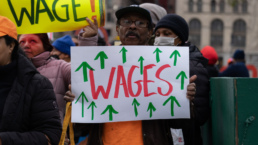
Yet, the United Steelworkers’s (USW) Kerry Halter recalled, the woman made thousands of dollars less every year than co-workers performing the very same job. Even worse, under the plant’s two-tier wage system—paying lower rates to more recently hired workers—she’d never catch up.
Fortunately, Halter and other members of USW Local 752L drew a line in the sand during contract negotiations in 2019 and forced the company to eliminate the capricious pay system, ensuring all workers at the plant began receiving equal pay for equal work.
Those USW members represented the leading edge of a movement now sweeping the country. In one industry after another, fed-up workers are fighting back against the two-tier systems that employers use to cheat and divide them.
In addition to wages, some employers use two-tier systems to give more recently hired workers lower-quality health care or retirement benefits than other workers or to impose unequal compensation systems on people performing the same work in different locations.
“Greedy corporations and CEOs like to see how much money they can save on the backs of their workers,” said Halter, the Local 752L president. “At some point in time, you just have to say enough is enough, and we’re going to stand up and fight for fair wages and benefits.”
Under Cooper Tire’s system, workers who joined the Texarkana plant beginning in 2009 made only 85 percent of what co-workers hired before them did.
That disparity quickly trapped more and more workers in a cycle of exploitation that cost them thousands of dollars in wages every year while also limiting their vacation pay and other benefits. More veteran workers, meanwhile, disliked making more money than co-workers doing the same jobs right next to them.
“It shouldn’t be about your hire date,” said Halter, noting his 1,500 union members—newer and more veteran workers alike—collectively decided to make evening the scales a priority in 2019 contract talks.
“It opened up a lot of doors for a lot of people,” said Halter, noting elimination of the two-tier system immediately gave 15 percent pay raises to the single mom and hundreds of other workers who continue to benefit from the increase year after year. “It’s not just a one-time payment. It never stops growing.”
The big pay jump began on February 4, 2020. It enabled some workers to hire child care and work additional hours, putting their families on more stable financial footing. It enabled others to buy houses, send their kids to college, plan for retirement, and pursue other life-altering plans.
The change benefits the company as well because separate pay systems hurt worker recruitment and retention as well as workplace safety and product quality.
“We had a significant number of workers who were coming in and going out, coming in and going out, and it affects your entire operation,” Halter explained.
“It may save companies money on the front end, but in the end, it doesn’t work out,” Halter stressed. “It’s going to affect morale. It’s going to affect quality. It simply isn’t worth the money they feel like they’re saving.”
A growing number of Americans are winning the same kinds of battles.
Two years ago, for example, USW members at nine locations across the country successfully beat back an attempt by Allegheny Technologies Inc. (ATI) to impose a second, lower tier of health care benefits for future workers.
UPS ended its two-tier wage system this summer after workers came close to striking in their fight for a fair share of the company’s staggering wealth.
Thousands of striking autoworkers across the country are demanding the elimination of tiered wage and benefit scales—systems so unfair that even one of the industry’s top executives called for dismantling them years ago.
As much as they hurt workers financially, however, two-tier systems represent more than corporate money grabs. Employers also like them because they have the potential to foment dissension in a workplace, pit groups of workers against each other, and undercut the solidarity that’s the heart of worker power.
“In plain terms, they’re trying to bust the union,” explained Joe Oliveira, who was Vice President of USW Local 1357 in New Bedford, Massachusetts, during the union’s 2021 battle against ATI. “The easiest way for them would be to let us fight each other and tear ourselves apart.”
Oliveira first heard about ATI’s proposal to slash health benefits for new hires during a meeting with USW negotiating team members from several states. He recalled that the union leaders immediately recognized the injustice and divisiveness of the proposal and resolved to defeat it.
“That was a non-starter from the get-go. Everybody in the room, from all the different plants, was on board about that,” he recalled, noting workers stood strong during a three-month unfair labor practice strike and ultimately won a contract that preserved the health care benefits for new hires while delivering wage increases and numerous other gains for all workers.
Similarly, workers at Cooper Tire in Texarkana formed a united front in 2019 to end the unfair wage system in their plant.
Their victory not only leveled the playing field but built union solidarity, giving workers an even stronger voice in the workplace from now on.
“We all understood what we needed to do,” Halter said. “This brought a lot of people together.”
This article was produced by the Independent Media Institute.
David McCall is the international president of the United Steelworkers Union (USW).
Recent Posts
Trump Says He’s Banning CNN, MS NOW, and Politico From the White House
Take Action Now “These outrageous attacks only demonstrate how scared he is of an informed public,” said one press freedom advocate.By Stephen…
Bases Without Names: How Governments Rebrand the U.S. Military Presence
Take Action Now Across Asia, Europe and the Middle East, governments use an expanding vocabulary to describe sites that accommodate U.S. troops,…
Getting Into ‘Good Trouble’ Over Arc de Trump
Take Action Now A retired Army colonel flew in from Hawaii to make sure Trump’s arch doesn’t go up quietlyBy Jonathan Capehart, Substack On the…
AIPAC’s Network Has Already Spent $67.2 Million to Shape the Midterm Elections
Take Action Now The giant influx from American Israel Public Affairs Committee PACs is a case study in money distorting politics.By Derek Seidman,…