
New resource explains how over-investment in militarism and under-investment in climate solutions have contributed to the failure to mitigate climate change – and that ways that we can reinvest military spending to combat the worst existential threat to our communities.
By Olivia Alperstein, Institute for Policy Studies
Climate change represents arguably the biggest threat to U.S. national security – and human security – of the 21st century. Decades of inaction have led to worsening and more frequent extreme weather events, with associated loss of life and property. And yet in Washington, “national security” is still primarily synonymous with military approaches to geopolitical challenges.
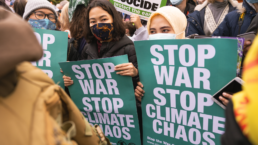
The National Priorities Project at the Institute for Policy Studies released a fact sheet, “No National Security without Climate Security,” highlighting the ways that over-investment in militarism and under-investment in climate solutions have contributed to the failure to mitigate climate change – and that ways that we can reinvest military spending to combat the worst existential threat to our communities.
As tropical storms and hurricanes ravage communities and defense spending once again becomes a critical topic of debate in D.C., this resource offers a critical lens on national spending priorities. Over the next couple of months, Congress is slated to debate the National Defense Authorization Act, key military spending legislation that will become a lynchpin once again for the question of how to best direct funding to address our country and our planet’s most urgent security issues.
Experts Lindsay Koshgarian and Ashik Siddique authored the resource.
Key points:
Through FY 2022, climate change prevention represented barely a blip in the nation’s budget.
- In the 20 years following 9/11, the U.S. spent $21 trillion on militarized versions of security, including the Pentagon and war, veterans’ programs, homeland security, and federal law enforcement. For less than a quarter of that cost, $4.5 trillion, the U.S. could have built a fully renewable national energy grid.
- In 2018, the average taxpayer handed over more than $3,400 for the military and nuclear weapons, $123 for disaster relief for increasingly frequent fires, storms, and floods, but barely more than $8 for renewable energy and energy efficiency.
- In 2021, the average taxpayer gave more than $900 to corporate military contractors, 18 times more than the $51 for public transit and trains that reduce fossil fuel emissions.
- The Inflation Reduction Act (IRA) represents the largest investment in climate security in this nation’s history. And yet, climate investment under the IRA will average just $37 billion per year over the next ten years. The annual budget for the Pentagon and nuclear weapons is now more than 21 times that much, and is poised to grow by as much as $65 billion this year alone.
“Security means having running water, keeping the lights and heat on, and keeping your home and loved ones in one piece,” said Lindsay Koshgarian, Director of the National Priorities Project at IPS. “And yet even as extreme weather events become more common and more ferocious, our politicians keep throwing more money at the Pentagon while neglecting investments that would keep us safe. We know the steps we need to take to protect people from the worst effects of climate change. Our politicians just keep choosing to spend that money on other things.”
“The disparity between the public resources we have invested in militarism and what we have invested in climate solutions and infrastructure improvements speaks volumes about what our nation prioritizes, said Ashik Siddique, a researcher with the National Priorities Project at IPS. “We have the solutions right now at our fingertips. Until we shift our public priorities, we will continue to face the human cost of more climate disasters instead of building resilience and power in our communities.”
“While Florida and Puerto Rico are reeling from hurricane impacts, Kentucky hasn’t completely recovered from devastating floods, and much of the West is in chronic drought, the federal government spends staggering sums of money on weapons that do nothing to keep people safe,” said Basav Sen, Climate Policy Director at IPS. “We clearly need a shift in governmental priorities, away from mindless militarism and towards a focus on commonsense climate mitigation and adaptation measures – such as public investment in Puerto Rico’s electric grid and Jackson, Mississippi’s water infrastructure – that actually protect people from threats they face.”
Recent Posts
Blanche says Trump isn’t trying to meddle with Alaska election results by suing over Senate race
Take Action Now A day after the lawsuit was filed on Thursday, Peltola called it “just flagrant, flagrant corruption in my opinion” and a diversion…

The Courage to Keep the Oath
Take Action Now Why We Must Stand with Major Jason WatsonBy Jeffrey Sterling For almost two months, an Air Force officer has been sitting alone in…

‘Act of Collective Punishment’: Netanyahu Condemned Over ‘Full Lockdown’ of Occupied West Bank
Take Action Now The reaction to a shooting incident in Hebron, said one Palestinian critic, “represents an alarming escalation in Israel’s policies…
‘Stop The War on Iran’: Brooklyn Peace Activists Urge Jeffries to Help End Conflict
Take Action Now Democrats have a golden opportunity to capitalize on this issue, win big in November, and take real action on AI data centers to…