Tied up with the apparently very longstanding tradition of claiming that all opponents of atrocities are purely engaged in what has recently been called “virtue signaling” is the idea that only certain types of people are qualified to protest certain things — or to ever say or do anything decent at all.
By David Swanson
Columbia University professor Bruce Robbins exposed his students to possible criticism of the Israeli military, and was for that reason declared by his employer guilty of discrimination and harassment. Robbins could have written a book on the absurdities involved in defining criticism of genocide as discrimination, and defining criticism of any military on Earth other than the Israeli military as not discrimination. Instead, in Who’s Allowed to Protest?, he has written a debunking of some other absurd rejections of protesting.
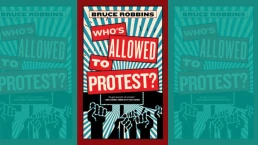
If you don’t read grotesque rightwing columnists or watch television “news,” you may question the need for what Robbins has done. But his book traces the centuries-long history of some of the ludicrous arguments involved, managing to suggest that they have played a greater role in our society than might be clear from the New York Times editorial page alone.
The book opens by looking at the claim that those who protest genocide in Gaza do so purely in order to make themselves look good, and not at all because they care about other human beings. If one were to accept that idea, then, presumably it would follow that every peace demonstration against a distant war, every protest of a distant sweatshop, every effort to preserve livable ecosystems for future generations, and a huge percentage of all activist campaigns ever, back to opposition in Britain to slavery in the Caribbean and beyond, has been entirely sociopathic posturing.
It strikes me as absurd to suggest that a human action of this sort (protesting mass killing) could have only one simple motivation for every person engaged in it. The wars being protested by peace demonstrations often have dozens of motivations even in the same individual. Our political system generally consists of switching back-and-forth between a government that tells you it’s going to bomb people for their own good and a government that tells you it’s going to bomb people because they aren’t people. But regardless of the emphasis, both of those arguments and many others, stated and unstated, accompany every war. How could everyone’s opposition to such wars be uniform? How could no one oppose what wars do to the budgets for useful things? How could no one oppose what wars do to the rule of law? How could no one oppose what wars do to the natural environment? Etc., etc. Actual peace rallies in the real world often struggle with deep divisions, including between those who oppose all sides of all wars, and those who cheer for the other side of some war. If these deeply divided people were all just posturing, then presumably they would have all landed together on whichever was the grandest posture.
And it strikes me as incoherent to suppose that one can make oneself look good by protesting war in a society where no one else actually cares about protesting war and consequently where no one else is going to actually think you look good.
But what after all is wrong with trying to make oneself look good by conspicuously opposing mass murder? Don’t we want a society in which everyone competes with everyone else at most effectively and determinately opposing mass murder? And, in a so-called representative democracy, isn’t the ideal elected official, in the ideal public arena, one who can be moved by public sentiment and agitation to oppose mass murder, even though in their heart of hearts they really don’t want to? Isn’t that the absolute ideal?
I’m reminded of something that David Hume wrote many years ago, which I think stands on its own merits to this day, quite apart from Hume’s belief in numerous absurdities including racism and just empires. Hume wrote:
“There are two things which have led astray those philosophers that have insisted so much on the selfishness of man. In the first place, they found that every act of virtue or friendship was attended with a secret pleasure; whence they concluded, that friendship and virtue could not be disinterested. But the fallacy of this is obvious. The virtuous sentiment or passion produces the pleasure, and does not arise from it. I feel a pleasure in doing good to my friend, because I love him; but do not love him for the sake of that pleasure.
“In the second place, it has always been found, that the virtuous are far from being indifferent to praise; and therefore they have been represented as a set of vainglorious men, who had nothing in view but the applauses of others. But this also is a fallacy. It is very unjust in the world, when they find any tincture of vanity in a laudable action, to depreciate it upon that account, or ascribe it entirely to that motive. The case is not the same with vanity, as with other passions. Where avarice or revenge enters into any seemingly virtuous action, it is difficult for us to determine how far it enters, and it is natural to suppose it the sole actuating principle. But vanity is so closely allied to virtue, and to love the fame of laudable actions approaches so near the love of laudable actions for their own sake, that these passions are more capable of mixture, than any other kinds of affection; and it is almost impossible to have the latter without some degree of the former. Accordingly we find, that this passion for glory is always warped and varied according to the particular taste or disposition of the mind on which it falls. Nero had the same vanity in driving a chariot, that Trajan had in governing the empire with justice and ability. To love the glory of virtuous deeds is a sure proof of the love of virtue.”
In other words, assuming that those who viciously oppose protests of genocide and cheer for violent assaults against protesters actually have in mind a superior sort of genocide protester, can we really be supposed to imagine that such an ideal protester should be indifferent to praise? Have many people ever been found who were indifferent to praise? One can be not indifferent to praise without being dependent on others to act, without being incapable of making one’s own judgments, without seeking to name every public building after oneself or compel Nobel prize winners to hand over their medals. To be completely indifferent to praise seems outrageously extreme as a requirement for any protester to be to any degree actually interested in what they are protesting.
But perhaps some protesters are fairly indifferent to praise. We cannot ask every anonymous donor to a cause or unnamed source in a report whether they’d like to be thanked. But those whom I do know and who ask not to be thanked for their efforts for peace, or who show up at rallies in masks, do not all seek anonymity out of fear. Those willing to be seen and named, however, must set aside the fear of repercussions — it’s not all rewards and glory.
Tied up with the apparently very longstanding tradition of claiming that all opponents of atrocities are purely engaged in what has recently been called “virtue signaling” is the idea that only certain types of people are qualified to protest certain things — or to ever say or do anything decent at all. Perhaps because the critic is himself greedy and unimaginative, the criticism is produced that says only poor people can oppose poverty, only someone in a racial minority can oppose racism. Etc. Robbins questions the current concept of “checking one’s privilege” when it is used to suggest a problem, not with being racist or sexist but with being “white” or male. Of course, “check your privilege” can be used in countless ways, including as a way of asking verbose, articulate people to shut up for a minute and let someone else have a chance to talk, etc.
But the notion that many millions of people are “privileged,” and therefore cannot protest injustice without hypocrisy, not only profiles people unfairly and distracts from the small number of plutocrats leading the destruction of all that is good, but also dooms us to a catastrophic shortage of protesters. Or it would, if we were to listen to it. And wouldn’t we want protests of wars with hypocrisy over no protests of wars?!
Robbins examines the notion of an “elite” that is not of wealth or power, but a cultural elite. By now we’re probably all familiar with the ploy of telling poor people to vote for billionaires in order to vote against some vaguely conceived, cultural and intellectual elite — even if it leaves them and the rest of us all worse off. Robbins points out that columnists like David Brooks, much to the bewilderment of long-time peace agitators, actually claim that students protesting a genocide are simply trying to gain entrance to or maintain their status in a supposed elite.
Robbins interrogates claims of privileged and unprivileged statuses, exposing the wealth of the critics of privilege, noting that the working class in a wealthy country can globally be an elite. In the end, he wants money, wherever it came from, put to good causes. I agree. All money should be redirected to good work, if it’s done without strings attached. And the good work of protesting injustice should be rewarded. More protesters should be “paid protesters,” and we should recognize with Robbins that the notion of an unpaid intellectual was a notion based on hoarded wealth, as the Olympic notion of the unpaid athlete was a notion based on excluding those who needed to be paid if they were going to play at sports all day.
Robbins celebrates student protesters of war. I agree. But I’m less sure of his references to the “responsibility of intellectuals” — the responsibility of those capable of recognizing a genocide to protest it. Millions of people who’ve never set foot on a college campus but have access to social media have recognized a genocide. We should be deeply grateful to those who apply their scholarship to their work for peace, but I wouldn’t sell anyone short or let anyone off the hook.
RootsAction Education Fund will be holding an online book club on April 1 at 5 p.m. PT / 8 p.m. ET with Bruce Robbins, author of Who’s Allowed to Protest? The event is free, but it’s up to you to buy the book or borrow it from a friend or library, then show up and ask questions!
Recent Posts
Nationwide General Strike Planned for May 1: No Kings Organizer
Take Action Now “No work, no school, no shopping. We’re going to show up and say we’re putting workers over billionaires and kings.”By Brad Reed,…

Hegseth Prays for “Overwhelming Violence” in Iran in the “Name of Jesus Christ”
Take Action Now The secretary of defense has previously said that the US is fighting Muslim “religious fanatics” in the Iran war.By Sharon Zhang…
What I Saw in Cuba Was Resilience
Take Action Now I was there as part of an international solidarity convoy; over 500 representatives from more than 30 countries, united by a simple…

It’s Time For Democrats To Face Political Reality on Israel
Take Action Now At its April meeting, the Democratic National Committee must have an open debate on its support of IsraelBy Norman Solomon, Salon…